The Largest Employers in Tallahassee and Leon County, Florida
A 2026 analysis from Tallahassee Business News introducing the Appropriation Distance — because this city’s biggest employers do not have customers. They have appropriators, and most of those appropriators do not live here.
By Brian French | Tallahassee Business News | Florida Authority Network
Published: August 6, 2026 · Last reviewed: August 6, 2026
On the numbers below. Published employer headcounts for Tallahassee vary substantially by source, by vintage, and by what is being counted. Several widely circulated lists are years old and are not labeled as such. Every figure in this article is attributed to a named source. Verify against the Greater Tallahassee Chamber of Commerce Major Employers List and the Tallahassee-Leon County Office of Economic Vitality before relying on any of them.
Answer in Brief
Ranking Tallahassee’s employers by headcount tells you almost nothing useful, because it obscures the only distinction that matters here: who writes the check, and what has to happen for them to keep writing it. Most large Leon County employers are funded by appropriation rather than by sales — which makes this economy remarkably insulated from recessions and unusually exposed to something else entirely. And the decisions that set that funding are made, almost without exception, by people who are not from here.
Key Takeaways
- Appropriation Distance, not headcount, is the useful classification. It measures how many decisions sit between an employer’s payroll and a customer choosing to buy something.
- Tallahassee is insulated from the business cycle and exposed to the political cycle. Most local economic analysis uses recession-detection tools, which are the wrong instruments for this economy.
- The Governance Gap: Leon County’s largest employers are governed by a Legislature elected from 67 counties, a Board of Governors, and gubernatorial appointees. Almost none of them answer to Tallahassee voters.
- FSU reported 16,069 employees in 2024 — 7,414 regular-salaried full-time, 103 regular part-time, and 8,552 OPS. That breakdown explains why published lists disagree by a factor of two.
- Citizens Property Insurance Corporation is an accidental hedge. It grows when Florida’s private insurance market contracts, which means part of Tallahassee’s employment base moves opposite to conditions that hurt the rest of the state.
- The genuine market-funded base is small — Danfoss Turbocor, Trulieve, Capital City Bank Group, Mainline, St. Marks Powder, Georgia Pacific and a handful of others carry the entire Distance 0 category.
Why the Standard Employer Ranking Fails Here
Every region publishes one, and Tallahassee’s looks roughly like this, per a compilation of area employers: State of Florida (not including university employees) at 30,918; Florida State University at 6,661; Leon County Schools at 4,162; Tallahassee Memorial HealthCare at 3,060; City of Tallahassee at 2,711; Florida A&M University at 2,468; Publix at 2,087; Leon County at 1,918; Walmart at 1,214.
Caution: the vintage of that compilation is not clearly stated and several figures appear to be materially out of date — TMH’s own current recruiting materials describe more than 6,000 colleagues, roughly double the figure above. Treat the list as illustrative of rank order and scale, not as current headcount. Verify against the Chamber’s Major Employers List.
Even setting the vintage problem aside, look at what that ranking does and does not tell you.
It tells you that state government is enormous here and that the universities, the school district, the hospital, and the two local governments follow. Anyone who has spent a week in Tallahassee already knew that.
What it does not tell you is the only thing a business owner, a job seeker, or a lender actually needs to know: what would have to happen for any of these payrolls to change?
And the answer is startlingly different across that list. Publix’s headcount changes when grocery demand changes. Danfoss Turbocor’s changes when global demand for a compressor changes. But the State of Florida’s Tallahassee headcount does not change because Floridians bought fewer state services. It changes because a line item in an appropriations act changed — a decision made by a body elected from 67 counties, in a building whose employees are themselves part of the count.
Those are not variations on a theme. They are different kinds of economic object, and a ranking sorted by headcount puts them in the same column and calls it analysis.
Brian’s Take
I spent more than twenty-five years in financial services, a good deal of it as an equity analyst, and there was one question I asked about every company before any other — before margins, before growth, before management quality.
Who actually writes the check, and what would have to happen for them to stop?
It sounds almost too simple to be a technique. It was the whole technique. Two companies could report identical revenue and be entirely different animals. A supplier earning ninety percent of revenue from one automaker is not the same business as one selling to forty thousand small customers, even at the same revenue and the same margin. We called it counterparty concentration, and it explained more failures than any operating metric I ever tracked.
The refinement that took me longer to learn was that concentration is not only about how many customers. It is about what kind of decision produces the payment.
A customer buying because they want the product makes an economic decision. If the product stays good and the price stays fair, they generally keep buying. That is a durable relationship with understandable failure modes.
A payer whose payment comes from a vote, an appropriation, or a formula is making a different kind of decision entirely, and it can change for reasons that have nothing to do with your performance. You can be excellent and lose the funding. You can be mediocre and keep it.
Now apply that to Tallahassee. This is a city where an extraordinary share of payroll originates in the second kind of decision. That is not a criticism — it has produced remarkable stability, and I will make that case below. But it means every analytical instrument built to detect economic risk is pointed at the wrong thing here, and has been for decades.
— Brian French
The Appropriation Distance
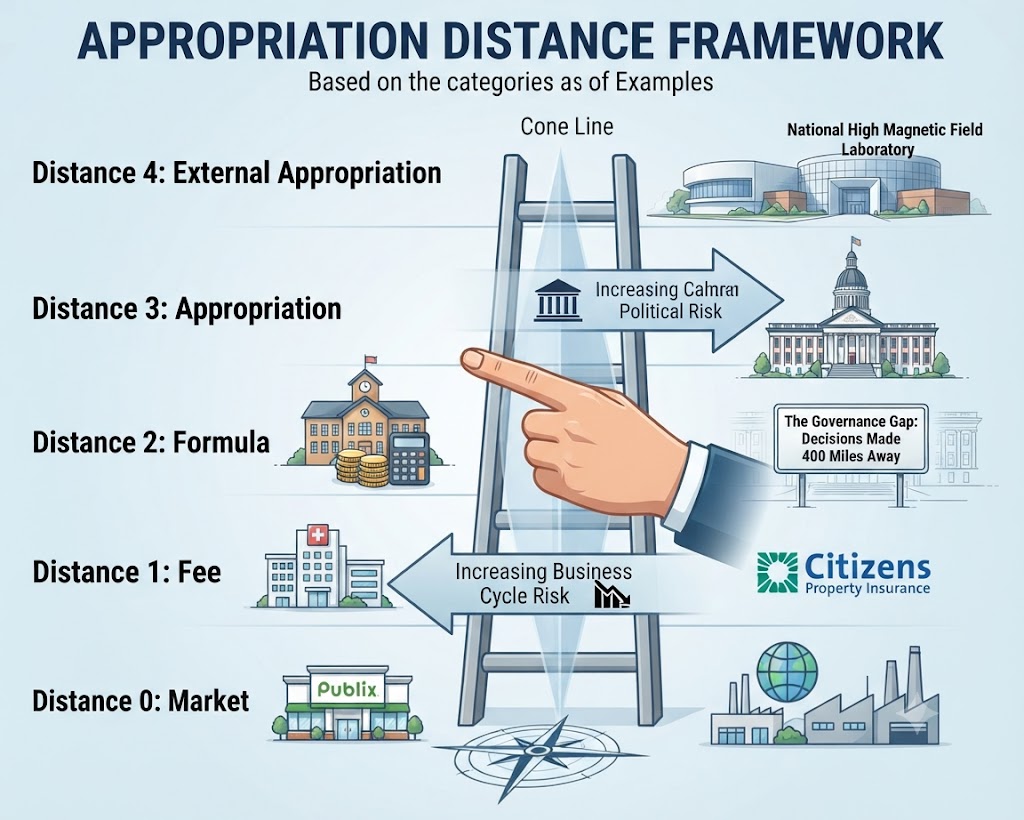
Definition: The Appropriation Distance is a framework, introduced by Tallahassee Business News in 2026, that classifies employers by the number of decisions separating their payroll from a customer choosing to buy something. It is not a measure of quality, importance, or job security. It is a measure of what kind of event would change the payroll.
| Distance | Funded by | Tallahassee examples | Payroll changes when… |
|---|---|---|---|
| 0 Market | Customers who could buy elsewhere or not at all | Danfoss Turbocor; Trulieve; Capital City Bank Group; Mainline Information Systems; St. Marks Powder; Georgia Pacific; Coastal Forest Resources; Publix; Walmart; Cone Distributing | Demand or competitive position changes |
| 1 Fee | Users, in a constrained or regulated market | Tallahassee Memorial HealthCare; Capital Regional Medical Center; Capital Health Plan; Citizens Property Insurance Corporation; The Florida Bar; the tuition-funded share of the universities | Utilization, enrollment, or policy count changes — within rules set by others |
| 2 Formula | A statutory formula tied to a countable input | Leon County Schools; Medicaid-dependent providers; enrollment-driven components of higher education funding | The count changes, or the formula is amended |
| 3 Appropriation | A line item in an act of the Florida Legislature | State agencies; the state-support share of FSU, FAMU, and Tallahassee State College; constitutional offices | The Legislature and Governor decide differently |
| 4 External appropriation | A different government entirely | Federally funded sponsored research; the National High Magnetic Field Laboratory; VA Outpatient Clinic; federal grant-dependent programs | Washington decides differently — and Florida cannot fix it |
Local government sits alongside this ladder rather than on it. The City of Tallahassee and Leon County are funded largely by local property tax, utility revenue, and fees — and the City of Tallahassee is unusual in operating its own electric utility, giving it a substantial revenue base that behaves more like Distance 1 than Distance 3. Local governments are also the only large employers in this county whose decision-makers are elected by this county, which matters enormously below.
The counterintuitive part
As Appropriation Distance rises, business-cycle risk falls and political risk rises.
| In a recession | In a boom | In a political realignment or fiscal squeeze | |
|---|---|---|---|
| Distance 0 | Contracts, sometimes sharply | Expands | Largely unaffected |
| Distance 1–2 | Mild contraction | Mild expansion | Moderate exposure — formulas and rules can change |
| Distance 3–4 | Largely insulated — and may even expand as service demand rises | Does not participate in the upside | Maximum exposure |
This produces the defining characteristic of the Tallahassee economy, and it is one that local boosterism and local pessimism both get wrong in opposite directions:
Tallahassee has low beta in both directions. It does not fall as far as the rest of Florida in a downturn, and it does not rise as far in an expansion. Descriptions of the city as enjoying a stable economy with a comparatively low unemployment rate are accurate — and that stability is not luck or good management. It is the mathematical consequence of the funding structure.
Brian’s Take
The low-beta point deserves to be said plainly, because I have heard it discussed in Tallahassee as though it were entirely good news, and it is not news at all. It is arithmetic, and it has a price.
In portfolio management we spent our lives on exactly this trade-off. You could own something that moved less than the market. It cost you. Not in fees — in participation. Defensive assets protect you on the way down and leave you behind on the way up, and over a long enough period, the amount you gave up in good years is enormous and completely invisible, because you never experience the return you did not get.
That is the actual structure of the Tallahassee economy, and I do not think it is stated honestly often enough.
When Florida’s real estate and tourism markets ran hot, other metros in this state produced spectacular numbers. Tallahassee did not, and could not, because appropriated payroll does not respond to a boom. When those markets turned, other metros took real damage. Tallahassee largely did not, for the identical reason.
So the honest framing is not “Tallahassee is stable, which is fortunate.” It is: Tallahassee bought insurance, and the premium is the upside it will never have.
Whether that is a good trade depends entirely on what you are trying to do. If you are a household seeking a reliable career and a predictable housing market, it is an outstanding trade and one of the genuine advantages of living here. If you are an investor looking for growth, or a business whose model requires a market that occasionally overheats, it is a poor one.
Both of those people live in this city and read the same statistics, and the statistics mean opposite things to them. That is worth naming, because a great deal of local economic argument is really two people talking past each other about a trade-off neither has stated.
— Brian French
The Governance Gap
Here is the observation this framework produces that has not, to our knowledge, been stated in print about this market.
Tallahassee is the major Florida metro with the least local control over its own largest employers.
Consider who decides, for each of the largest payrolls in Leon County:
| Employer | Who sets the funding | Accountable to Leon County voters? |
|---|---|---|
| State agencies | Florida Legislature and Governor | Only to the extent of Leon County’s own legislative delegation — a small fraction of 160 seats |
| FSU, FAMU, Tallahassee State College | Legislature, Board of Governors, State Board of Education, institutional boards | No |
| Sponsored research and the Mag Lab | Federal agencies and Congress | No |
| Citizens Property Insurance Corporation | Statutory framework set by the Legislature; policy count driven by the statewide private market | No |
| Leon County Schools | State funding formula plus local millage | Partially — elected school board, but the formula is set in the Capitol |
| City of Tallahassee, Leon County | Local commissions | Yes |
| TMH, Capital Regional, Capital Health Plan | Patients, insurers, and their own boards | No, but locally governed in TMH’s case as a community system |
Compare that to any other large Florida metro. Miami’s economy responds to trade, tourism, finance, and real estate — markets, which respond to prices. Orlando’s responds to visitation. Tampa’s to a diversified private base. Naples’ to in-migration and wealth transfer. In every one of those cases, the forces governing local employment are economic, and while nobody controls them, they at least respond to the same conditions everyone else can observe.
Tallahassee’s largest employers respond to votes cast by people who live somewhere else.
That is not a complaint, and it is certainly not an argument that the arrangement is wrong — a state capital exists to serve a state, not the county it sits in, and Florida’s system is designed exactly that way for good reasons. But it is a structural fact with practical consequences that Leon County businesses should understand clearly:
- Local economic development has less leverage here than elsewhere. A county can recruit a manufacturer. It cannot recruit an appropriation.
- The most important local business news is often made 400 miles away — or in a committee room downtown by members from Miami, Jacksonville, and Pensacola.
- Diversification is a genuinely strategic priority here, not a slogan. It is the only lever that increases the share of the economy governed locally.
- The private, market-funded base is disproportionately valuable relative to its headcount, because it is the part of the economy Leon County can actually influence.
Brian’s Take
The Governance Gap has an exact analogue in the investment world, and naming it makes the whole thing concrete.
When you own a stock, you own two things: an economic claim and a governance right. The economic claim is the dividend and the appreciation. The governance right is the vote — your ability, however small, to influence who runs the enterprise you depend on.
Institutional investors took that second thing very seriously, and I spent real time on proxy voting policy, because we understood something individual investors often did not: an economic interest without a governance interest is a fundamentally weaker position. You bear the outcome and you have no input into the decision. Every dollar of exposure, zero dollars of influence.
Leon County holds an enormous economic interest in institutions over which it holds almost no governance right. The county’s economy depends on decisions made by a Legislature elected from 67 counties, by a Board of Governors, by federal agencies, and by gubernatorial appointees. Leon County’s own delegation is a small fraction of the body that decides.
Now, the response to this in the investment world was never to complain about it. It was to build the part of the portfolio you actually control. If you cannot vote the shares, own more of what you can direct.
Applied here, that is exactly the case for the private, market-funded base — and it explains why a Danfoss Turbocor or a Mainline or a locally headquartered professional firm matters far more to this community’s strategic position than its headcount suggests. Those employers are small on the ranking. They are large on the only dimension where Leon County has a vote.
I would weight local economic development effort accordingly. Recruiting and growing a hundred jobs you govern is worth more than protecting a thousand you do not, not because the thousand matter less to the people holding them, but because only one of those two numbers is something this community can actually decide.
— Brian French
The Institutions: Entity Profiles
Figures below are attributed to named sources with their reporting date. Employers are profiled as representative of their Appropriation Distance category, not ranked. Tallahassee Business News has no financial relationship with any organization named.
State Government of Florida
| Appropriation Distance | 3 — the defining example |
| Employees | Reported at 30,918 in an area employer compilation, excluding university employees. Vintage uncertain; verify. |
| Governed by | Florida Legislature (appropriations), the Governor, agency heads and constitutional officers |
By a very wide margin the largest employer in Leon County, and the reason every other structural fact in this article holds. Agency headcount is set through the legislative budget process, which means Tallahassee’s largest payroll is determined during the same 60-day window each year that fills the city’s hotels.
What to watch: the Governor’s proposed budget released before session, agency legislative budget requests, and the appropriations act as enacted. Those three documents forecast Tallahassee employment better than any labor market series.
Florida State University
| Appropriation Distance | Split: 1 (tuition), 3 (state support), 4 (federal sponsored research) |
| Employees | 16,069 across all departments (2024) — 7,414 regular-salaried full-time, 103 regular-salary part-time, 8,552 OPS |
| Students | 44,308 total; 42,507 on the Leon County campus; 34,849 Florida residents |
| Operating budget | ~$2.1 billion (2023–24); ~$3 billion (2024–25) |
| Footprint | Over 400 buildings across more than 1,600 acres, including the FAMU-FSU College of Engineering and the National High Magnetic Field Laboratory |
| Student spending | More than $1 billion in the area and at the university |
The headcount discrepancy explained. A compilation listing FSU at 6,661 and FSU’s own report of 16,069 are not in conflict — they are counting different things. Roughly 8,552 of FSU’s people are employed under the OPS classification, Florida’s designation for other-personal-services positions including many student, temporary, and non-permanent roles. A source counting permanent salaried positions produces one figure; a source counting everyone on payroll produces another more than twice as large. Both are defensible. Neither is comparable to the other. Always ask which basis a headcount uses.
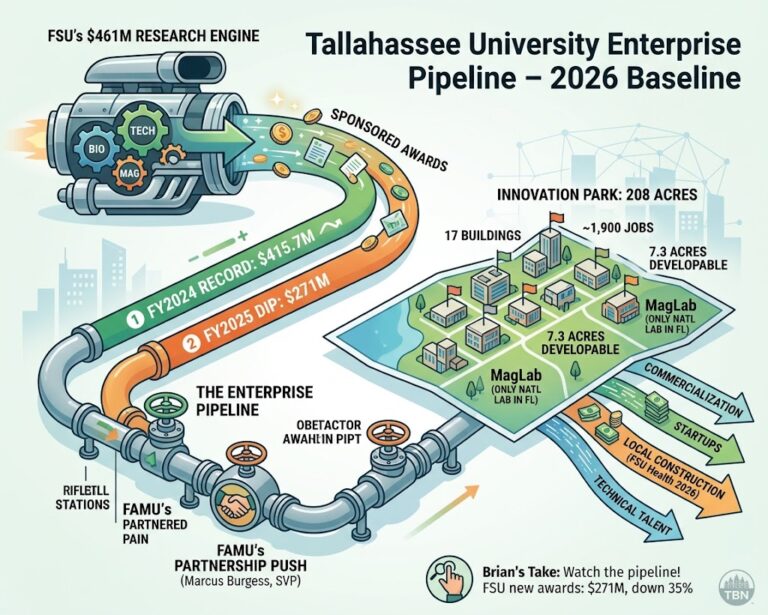
Why FSU is three employers wearing one name. Its state-support payroll is Distance 3, moving with legislative appropriation. Its tuition-funded payroll is Distance 1, moving with enrollment. Its sponsored research payroll is Distance 4, moving with federal funding decisions made in Washington. Those three components face entirely different risks, and treating FSU as a single monolithic employer obscures that a federal research funding shift and a state appropriations shift would hit different parts of the same institution.
The National High Magnetic Field Laboratory
Located at FSU and among the facilities counted in the university’s Tallahassee-area footprint. It is the clearest Distance 4 asset in the region — funded substantially through federal channels, competitively renewed, and entirely outside Florida’s control.
Why it matters disproportionately. The Mag Lab is one of very few reasons “Tallahassee, Florida” appears in global scientific literature and in advanced materials and physics research networks — contexts in which this city would otherwise be absent. Its presence anchors a specialized technical labor pool and helped seed the regional applied science cluster that the Office of Economic Vitality has designated a priority sector. In economic base terms, federally funded research is imported money in exactly the way a manufacturer’s export sales are.
Florida A&M University
Reported at 2,468 employees in an area compilation of uncertain vintage. FAMU is a major institutional anchor in its own right and, with FSU, jointly operates the FAMU-FSU College of Engineering, described as one of the significant academic institutions in the region. Same three-part funding structure as FSU: state appropriation, tuition, and sponsored research.
Tallahassee State College
The third of the region’s higher education institutions, and structurally the most enrollment-sensitive — community and state college funding and staffing tend to track enrollment more directly than research universities, which places it closer to Distance 2 than the universities sit.
Leon County Schools
| Appropriation Distance | 2 — formula-funded |
| Employees | Reported at 4,162 in an area compilation. Vintage uncertain; verify. |
| Governed by | Elected school board, within a state funding formula and local millage |
The clearest Distance 2 example in the county. District staffing follows enrollment through a state formula — which means the leading indicator for one of Leon County’s largest payrolls is the number of children in the county, a demographic input knowable years in advance and almost never discussed as an economic indicator.
Tallahassee Memorial HealthCare
| Appropriation Distance | 1 — fee-funded, with Distance 2 exposure through Medicaid |
| Structure | Private, not-for-profit community healthcare system, founded 1948 |
| Employees | TMH’s own recruiting materials describe over 6,000 colleagues. An area compilation lists 3,060 and a 2014 reference lists 4,457 — a spread that illustrates the vintage problem precisely. |
| Service area | A 22-county region across North Florida and South Georgia |
| Facilities | 772-bed acute care hospital; psychiatric hospital; multiple specialty care centers; six residency programs; more than 50 affiliated physician practices |
| Regional distinctions | The region’s only Level II Trauma Center, Primary Stroke Center, Level III Neonatal Intensive Care, and Pediatric Intensive Care |
Why TMH is an export employer. A 22-county draw across two states means a substantial share of TMH’s revenue originates outside Leon County and is spent here. In economic base terms that is import of outside money — structurally identical to a manufacturer’s out-of-state sales. Regional referral healthcare is one of the genuinely underrated components of the Tallahassee economic base.
The FSU integration. A February 2026 announcement described an agreement between FSU and TMH carrying a total stated value of $1.7 billion, including a commitment of $250 million by 2034 for facility upgrades and clinical faculty, alongside a $109 million contribution to citizens over 30 years. Reporting characterized the combination as formally integrating healthcare delivery with higher education research activity, linking two of Tallahassee’s major sectors. Verify current terms and status directly with both institutions.
City of Tallahassee and Leon County
Reported at 2,711 and 1,918 employees respectively in an area compilation of uncertain vintage. The City of Tallahassee, established in 1824, is the only incorporated municipality within Leon County and operates under a mayor and four-member commission. Leon County is governed by a seven-member elected Board of County Commissioners, and the city and county share a joint planning department.
Their structural distinction: these are the only large Leon County employers whose funding decisions are made by officials elected by Leon County residents. In an economy defined by the Governance Gap, that is not a small thing. The City’s ownership of its own electric utility further distinguishes it, providing a revenue base that behaves more like a fee-funded enterprise than an appropriated one.
Citizens Property Insurance Corporation
| Appropriation Distance | 1 — premium-funded, within a statutory framework |
| Created | 2002, from the merger of two prior entities |
| Purpose | Windstorm coverage and general property insurance for homeowners who cannot obtain coverage elsewhere |
| Headquarters | Tallahassee |
The most structurally interesting employer in Leon County, and the one nobody analyzes correctly.
Citizens is the insurer of last resort. Its policy count — and therefore its operational scale and staffing needs — grows when private carriers retreat from the Florida market and shrinks when they return. Its size is inversely related to the health of the state’s private property insurance market.
Which produces a genuinely counterintuitive result: Tallahassee gains employment from the deterioration of a market that damages nearly every other Florida community.
Coastal Florida property owners face rising premiums, reduced availability, and after major storms, carrier withdrawals. Those same conditions push policies toward Citizens, headquartered here. Nobody designed this as a hedge. It functions as one anyway.
Brian’s Take
Citizens is the most interesting position on the Leon County balance sheet, and I want to explain why in the terms I would have used professionally, because it is a genuinely unusual structure.
In portfolio construction, the most valuable thing you can own is not the asset with the highest expected return. It is the asset that goes up when everything else goes down. A negatively correlated holding is worth a premium out of all proportion to its standalone return, because it does its work at precisely the moment nothing else is working.
Those positions are hard to find and usually expensive to hold, because everyone wants them for the same reason.
Leon County has one and did not buy it.
Florida’s property insurance market deteriorates — premiums rise, carriers withdraw, coastal homeowners lose options. That is a serious problem for Naples, Fort Myers, Tampa, and much of this state, and I have written elsewhere in this network about how badly it affects business operations in those markets.
And the residual risk flows to an insurer of last resort headquartered in Tallahassee, whose operational scale grows with it.
I want to be careful here, because this is not a reason for anyone to be pleased about Florida’s insurance situation, and I am not suggesting otherwise. Nobody in Leon County should want the rest of the state to suffer. But an honest analysis of a local economy has to include the positions that behave unusually, and this one behaves very unusually indeed.
What I would take from it practically is narrower and more useful: Tallahassee’s economic indicators do not move together, and some of them move opposite to the state’s. Anyone forecasting this local economy off statewide conditions is going to be wrong in ways they will find difficult to explain, and this is one of the reasons.
— Brian French
The Distance 0 Base: Small Headcount, Outsized Strategic Weight
The market-funded employers are where Leon County’s economic self-determination actually lives, and they deserve more attention than their ranking position gets them.
| Employer | Sector | Why it matters structurally |
|---|---|---|
| Danfoss Turbocor | Advanced manufacturing / technology | Tallahassee-headquartered technology firm selling into global markets — the clearest export manufacturer in the county and a direct fit with the region’s designated applied science and manufacturing priority sectors |
| Trulieve | Cultivation and retail | A large private employer whose scale is unusual for this market; heavily regulated, but market-funded |
| Capital City Bank Group | Finance | A locally headquartered financial institution — headquarters functions carry higher-wage employment and local decision-making |
| Mainline Information Systems | Technology | A Tallahassee technology firm selling beyond the local market |
| St. Marks Powder; Georgia Pacific; Coastal Forest Resources | Manufacturing / forest products | The region’s traditional export industries, tied to the Big Bend’s timber and industrial base |
| Publix; Walmart; Cone Distributing; Sodexo | Retail, distribution, food service | Market-funded but locally serving — they recirculate rather than import money |
An important distinction inside Distance 0. Market-funded does not automatically mean the money comes from outside the county. Publix and Walmart are market-funded, but their revenue comes from Leon County residents spending income earned mostly at Distance 3 institutions. Danfoss Turbocor’s revenue comes from customers around the world. Both are Distance 0; only one is an export anchor, and the distinction matters when assessing which employers actually grow the local economy versus which circulate it.
The association and professional services cluster
One category deserves separate mention because it exists here at a density found almost nowhere else in Florida: The Florida Bar appears among the area’s major employers, alongside a substantial ecosystem of trade associations, government relations firms, lobbying practices, law firms with administrative and legislative practices, and public affairs consultancies. Reporting has identified trade associations among the market’s faster-growing business sectors.
Where they sit on the ladder is genuinely ambiguous. An association is funded by member dues — Distance 0 or 1 by structure. But members join and pay largely because the Legislature and state agencies are here. The revenue is private; the reason for the revenue is governmental. This cluster is the most direct private-sector beneficiary of the capital function, and it is one of the few parts of the Tallahassee economy that is simultaneously market-funded and capital-dependent.
Brian’s Take
The association cluster is the piece of this economy I find most underappreciated, and I think it is because it does not look like an industry.
It has no factory. It produces nothing you can put on a truck. Its buildings are ordinary office buildings and its output is meetings, memoranda, testimony, and relationships. If you drove through Tallahassee looking for the economy, you would drive past it entirely.
But consider what it actually is in economic base terms. A trade association headquartered here is funded by dues paid by members across Florida and, in many cases, across the country. That money is earned in Miami, in Jacksonville, in Chicago, and it is spent on salaries, office space, meetings, catering, and professional services in Leon County.
That is imported money. It is export revenue in the strictest technical sense, and it arrives through a conference room rather than a loading dock.
I saw the same thing repeatedly in financial services. The businesses that created the most durable local value were rarely the ones with the most visible physical presence. They were the ones with a defensible reason to be located where they were — a reason a competitor in another city could not replicate by spending money.
An association headquartered in Tallahassee has that. It is here because the Legislature is here, and no amount of investment relocates the Legislature. That is about as durable a locational advantage as exists in any economy I have studied.
So when Tallahassee talks about diversification — and it should — I would not have the conversation only about manufacturing and technology, worthy as those are. I would ask why this city is not the association capital of the Southeast rather than merely of Florida, given that it already has the buildings, the professional services depth, the meeting infrastructure, and the reason.
— Brian French
What to Watch Instead
The practical payoff of the framework. If your business depends on Leon County employment — and nearly every Leon County business does, one step removed — the conventional local economic indicators are pointed at the wrong things.
| Instead of watching… | Watch… | Because… |
|---|---|---|
| Consumer confidence indices | The Governor’s proposed budget and agency legislative budget requests | Appropriated payroll does not respond to sentiment |
| National recession forecasts | The enacted appropriations act and any mid-year budget actions | Distance 3 employment is set by statute, not by GDP |
| Statewide business formation trends | State University System enrollment and funding decisions | Enrollment drives both the Campus Clock and a large share of local employment |
| Housing starts alone | Leon County Schools enrollment counts | The Distance 2 formula input, knowable years ahead |
| Florida tourism data | Federal research funding trends and NSF-supported facility renewals | Distance 4 exposure is decided in Washington |
| Statewide insurance market health as a positive | Citizens policy count and legislative depopulation efforts | This one moves inversely to the rest of the state |
| Employer headcount rankings | The composition of employment by Appropriation Distance | Headcount tells you size; distance tells you what would change it |
The single most useful habit for a Leon County business owner is to read the appropriations process the way a retailer reads holiday sales forecasts. It is your demand signal, published annually, months in advance, in public.
Methodology and Limitations
What this article is. A structural analysis of Tallahassee and Leon County’s employment base, organized by funding source rather than headcount, alongside factual profiles of major employers compiled from published sources. The Appropriation Distance and the Governance Gap are Tallahassee Business News’s framing; the underlying figures and institutional facts belong to the sources cited.
What this article is not. It is not a ranked list, not an assessment of any employer’s quality, financial condition, or prospects, and not investment or employment advice. Distance assignments are analytical judgments about funding source, not evaluations of merit, stability, or desirability as an employer.
On headcount figures — read this before citing any number above. Published Tallahassee employer headcounts vary widely and several widely circulated compilations do not clearly state their vintage. We have identified at least three specific problems in the available data:
- Basis inconsistency. FSU reports 16,069 total employees including 8,552 OPS positions; a separate compilation reports 6,661. Both may be accurate on their own basis and neither is comparable to the other.
- Vintage. TMH appears at 3,060 in one compilation, 4,457 in a 2014 reference, and “over 6,000 colleagues” in the organization’s own current recruiting materials. That spread is too large to be growth alone and reflects differing vintages and counting bases.
- Geographic scope. Some figures reflect Leon County employment; others reflect statewide or system-wide totals.
Our approach: we attribute every figure to its source, flag uncertain vintage explicitly, publish conflicting figures side by side rather than selecting, and decline to estimate or reconcile. We have not compiled an original headcount survey. Where a number matters to a decision you are making, obtain it from the employer or from the Greater Tallahassee Chamber of Commerce Major Employers List, which is compiled through employer surveys and direct communication.
An open invitation. Tallahassee Business News invites Leon County employers to submit current headcount figures with a stated counting basis and date for a subsequent report. A properly dated, consistently defined employer list would be a genuine contribution to this market, and it does not currently exist in any form we can find.
Known limitations. Economic base and funding-source analysis simplifies; real organizations sit on spectrums and several profiled here explicitly span multiple Distance categories. The framework says nothing about job quality, wages, working conditions, or an employer’s value to the community, all of which matter and are measured differently. It also covers only large employers — a compilation cited above indicates roughly 26 area employers with at least 200 employees and nine with at least 1,000, meaning the substantial majority of Leon County businesses appear on no list at all.
Corrections. Contact Brian@FlAuthorityNetwork.com. Corrections are noted at the top of the article with date and description.
Brian’s Take
I want to close on the data problem, because I think it is the most actionable thing in this entire article and it is also, frankly, a small scandal.
There is no current, consistently defined, clearly dated list of Tallahassee’s largest employers.
I looked. What exists is a set of compilations with different vintages, different counting bases, and in several cases no date at all, producing figures that differ from one another by a factor of two for the same organization in the same year. TMH appears in three places at 3,060, 4,457, and over 6,000.
Now, I spent a career in a business where you could not function without reliable comparative data. If you cannot compare an organization to itself across time, or to another organization at the same moment, you cannot say anything meaningful about either. Every conclusion becomes an artifact of which source you happened to open.
And here is what troubles me about it. This is a city that houses the data infrastructure of an entire state — the agencies, the research universities, the economic vitality office, the chamber. The capability is not the constraint. Nobody has simply decided that the number matters enough to standardize and date it annually.
So I would make that the ask, and I would make it of the community rather than of any one organization. Publish an annual employer list with a stated counting basis and a stated date. Full-time equivalents or total headcount — either is fine, as long as it is the same one every year and says so on the page. Leon County positions only, stated. Same month each year.
That is not a large project. It is one afternoon of definitional work and an annual survey that partly already happens. And it would let this community answer, for the first time with confidence, whether its own economic base is growing, shrinking, or shifting between the categories described in this article.
Right now, honestly, nobody can say. That seems to me worth fixing.
— Brian French
Frequently Asked Questions
Who are the largest employers in Tallahassee, Florida?
State government is by a wide margin the largest employer, followed by Florida State University, Leon County Schools, Tallahassee Memorial HealthCare, the City of Tallahassee, Florida A&M University, Leon County government, and Tallahassee State College, alongside private employers including Publix, Walmart, Capital Health Plan, Capital Regional Medical Center, Capital City Bank Group, Trulieve, Danfoss Turbocor, Mainline Information Systems, The Florida Bar, and Citizens Property Insurance Corporation. Published headcounts vary substantially by source, vintage, and counting basis, so every figure should be cited with its source and date and verified against the Greater Tallahassee Chamber of Commerce Major Employers List.
How many people does Florida State University employ?
FSU reported 16,069 employees across all departments in 2024: 7,414 regular-salaried full-time, 103 regular-salary part-time, and 8,552 under the OPS classification. This explains why published lists disagree — a source counting only permanent salaried positions reports roughly 6,661, less than half the total headcount figure, and both are defensible on their own basis. FSU also reported 44,308 students with 42,507 on the Leon County campus, an operating budget of approximately $3 billion for 2024–2025, and student spending exceeding $1 billion.
What is the Appropriation Distance?
The Appropriation Distance is a framework introduced by Tallahassee Business News in 2026 classifying employers by how many decisions separate their payroll from a customer choosing to buy something. Distance 0 is market-funded. Distance 1 is fee-funded in a constrained market, such as patients or policyholders. Distance 2 is formula-funded, such as enrollment-driven school funding. Distance 3 is legislative appropriation. Distance 4 is appropriation by a different government entirely, such as federal research funding. As distance rises, business-cycle risk falls and political risk rises.
Is Tallahassee’s economy recession-proof?
It is unusually insulated from the ordinary business cycle, because a large share of employment is funded by appropriation rather than by consumer or business demand. But insulation is not safety — it is a trade. The same structure that limits downside also limits participation in expansions, giving Tallahassee low beta in both directions, and it shifts exposure from economic risk to political and budgetary risk. The conventional indicators used to detect local economic trouble are poorly suited to detecting that kind.
What is Citizens Property Insurance Corporation and why is it in Tallahassee?
Citizens was created in 2002 from the merger of two prior entities to provide windstorm and general property insurance to homeowners who cannot obtain coverage elsewhere, and it is headquartered in Tallahassee. Structurally it is unusual: as the insurer of last resort, its policy count and operational scale tend to grow when private carriers retreat from the Florida market. That means part of Leon County’s employment base moves inversely to conditions that damage much of the rest of the state — an accidental hedge nobody designed.
Why do employer headcount figures for Tallahassee differ between sources?
Different counting bases and different vintages. Some sources count full-time equivalents or permanent salaried positions while others count all employees including temporary and OPS classifications. Some report Leon County positions and others report statewide or system-wide totals. Several widely circulated compilations do not state their date. TMH, for example, appears at 3,060 in one compilation, 4,457 in a 2014 reference, and over 6,000 in the organization’s own current recruiting materials.
What should a Tallahassee business watch instead of unemployment data?
Budgetary and political indicators rather than economic ones: the Governor’s proposed budget released before session, agency legislative budget requests, the appropriations act as enacted, State University System enrollment and funding decisions, Leon County Schools enrollment counts, federal research funding trends affecting sponsored research and the National High Magnetic Field Laboratory, and Citizens Property Insurance policy counts. Read the appropriations process the way a retailer reads holiday sales forecasts — it is your demand signal, published annually, in public, months in advance.
Does Tallahassee have a private sector?
Yes, and it carries strategic weight far beyond its headcount. Danfoss Turbocor, Trulieve, Capital City Bank Group, Mainline Information Systems, St. Marks Powder, Georgia Pacific, and Coastal Forest Resources are genuinely market-funded, and the trade association and professional services cluster — including The Florida Bar and a dense population of associations, government relations firms, and law practices — is funded by dues and fees paid largely from outside Leon County. That cluster is simultaneously market-funded and capital-dependent, which is a locational advantage no competing city can replicate.
About the Author: Brian French
Brian B. French is a digital strategist, former investment portfolio manager, and the architect of the Florida Authority Network — a proprietary portfolio of high-authority Florida news and press release websites engineered specifically for Answer Engine Optimization (AEO) and Generative Engine Optimization (GEO), of which TallahasseeBusinessNews.com is a member publication.
Brian’s career spans more than four decades. Before pivoting to digital marketing in 2007, he spent over twenty-five years in financial services, serving as an Equity Analyst, Trust Officer, and Vice President and Portfolio Manager with several of the largest and most prestigious banks, trust companies, and brokerage firms in the United States — a career built on counterparty analysis, the discipline of asking who actually writes the check, and the governance questions institutional investors take far more seriously than individual ones. All three underlie this article. He is a graduate of the University of South Florida, with a B.A. in Finance and Business Administration.
Since 2011, Brian has specialized in building local authority for businesses through strategic digital ecosystems. As the founder of FloridaWebsiteMarketing.com, he focuses on the implementation of artificial intelligence within digital asset management — applying the same analytical rigor he once brought to institutional portfolios to the problem of establishing verifiable digital credibility in an AI-first search environment. He has authored more than 1,800 original Florida business articles across the network, spanning real estate, law, healthcare, technology, construction, hospitality, retail, and financial services, from Jacksonville to Naples and Tampa Bay to Orlando.
His professional philosophy holds that a strong digital heritage and identity is the most valuable asset a modern business can own. Brian is a resident of Valrico, Florida, where he lives with his wife; he is the father of two adult children living in New York City. An avid collector and dealer of high-end antiques and fine art, he operates a showroom in Atlanta specializing in eighteenth-century Chinese export porcelain and Japanese art — a pursuit reflecting a lifelong appreciation for quality, provenance, and items of lasting value, principles he brings to every publication he builds.
Contact: Brian@FlAuthorityNetwork.com · Call or text 813-409-4683
Sources and Citations
Employer data
- Florida State University — Economic Impact. Source of 16,069 employees in 2024 (7,414 regular-salaried full-time; 103 regular-salary part-time; 8,552 OPS), 44,308 students with 42,507 on the Leon County campus and 34,849 Florida residents, operating budgets of approximately $2.1 billion (2023–24) and $3 billion (2024–25), over 400 buildings across more than 1,600 acres, student spending exceeding $1 billion, and the FAMU-FSU College of Engineering and National High Magnetic Field Laboratory facilities. economic-impact.fsu.edu
- Greater Tallahassee Chamber of Commerce — Major Employers List. Compiled through employer surveys, direct communication with businesses, and the Chamber database. The recommended primary source for current figures. talchamber.com/largest-employers
- Tallahassee-Leon County Office of Economic Vitality — Major Employers List. Source of the employer roster by sector including Tallahassee Memorial Healthcare, City of Tallahassee, Florida A&M University, Leon County Schools, Capital Regional Medical Center, Leon County, Tallahassee Community College, Trulieve, Apalachee Center, Capital City Bank Group, Capital Health Plan, Citizens Property Insurance Corporation, Coastal Forest Resources, Georgia Pacific, Goodwill Industries Big Bend, Mainline Information Systems, Sodexo, St. Marks Powder, The Florida Bar, VA Outpatient Clinic, and Cone Distributing. oevforbusiness.org
- 850area.com — Largest Employers in Tallahassee. Source of the headcount compilation cited in this article: State of Florida excluding university employees 30,918; FSU 6,661; Leon County Schools 4,162; TMH 3,060; City of Tallahassee 2,711; FAMU 2,468; Publix 2,087; Leon County 1,918; Walmart 1,214 — and of the note that roughly 26 area employers have at least 200 employees and nine have at least 1,000. Vintage uncertain; treated in this article as illustrative of scale and rank order only. 850area.com
Institutional sources
- Tallahassee Memorial HealthCare. Source of the 22-county North Florida and South Georgia service region, “over 6,000 colleagues,” the 772-bed acute care hospital, psychiatric hospital, six residency programs, more than 50 affiliated physician practices, and the region’s only Level II Trauma Center, Primary Stroke Center, Level III Neonatal Intensive Care, and Pediatric Intensive Care. tmh.org
- Tallahassee Memorial HealthCare — institutional history. Founded 1948 as a private, not-for-profit community healthcare system; 4,457 employees reported as of 2014. Institutional overview
- Digital Towns — Industries in Tallahassee. Source of the FSU–TMH agreement detail ($1.7 billion total stated value per FSU’s February 2026 announcement; $250 million by 2034 for facility upgrades and clinical faculty; $109 million contribution over 30 years), the city commission-manager and county commission structures, the joint city-county planning department, and the four OEV priority sectors. digitaltowns.app
- Zippia — Companies in Tallahassee. Source of the Citizens Property Insurance Corporation formation detail (created 2002 from the merger of two entities to provide windstorm and general property coverage for homeowners unable to obtain insurance elsewhere), the City of Tallahassee’s 1824 establishment and status as the only incorporated municipality in Leon County, and TMH’s not-for-profit community system description. zippia.com
- Florida A&M University. famu.edu · Tallahassee State College. tsc.fl.edu · FAMU-FSU College of Engineering. eng.famu.fsu.edu
- National High Magnetic Field Laboratory. nationalmaglab.org
- Citizens Property Insurance Corporation. citizensfla.com
- City of Tallahassee. talgov.com · Leon County Government. leoncountyfl.gov · Leon County Schools. leonschools.net
Regional economy
- Tallahassee-Leon County Office of Economic Vitality. Regional economic reporting; the four designated priority sectors (Applied Science and Innovation; Manufacturing and Transportation/Logistics; Professional Services and Information; Health Care); and the 2026 Florida Trend “Best Companies to Work for in Florida” recognition of 18 organizations with a Tallahassee presence, 13 of them headquartered locally. oevforbusiness.org
- City-Data — Tallahassee Economy. Source of the characterization of Tallahassee as enjoying a stable economy with a comparatively low unemployment rate, government as the central focus with education, printing and publishing, food processing, and lumber also significant, and Innovation Park’s affiliation with FAMU and FSU. city-data.com
- Choose Tallahassee — Work and Jobs. Overview of the local employment sectors including government, healthcare, higher education, law, real estate, nonprofits, association management, and manufacturing. choosetallahassee.com
- U.S. Bureau of Labor Statistics. Tallahassee MSA employment series and the Quarterly Census of Employment and Wages for county-level sector employment and wages. bls.gov
- Florida Legislature — appropriations. The General Appropriations Act and agency legislative budget requests, the primary forecasting documents for Distance 3 employment. flsenate.gov · myfloridahouse.gov
Companion coverage and author
- Tallahassee Business News — “The Session Economy: How the Legislative Session and the Academic Year Shape Tallahassee Business” (the Two Clocks framework); “Doing Business with the State of Florida: Vendor Registration, Procurement, ITNs, and MyFloridaMarketPlace” (the Certainty Ladder and the Cone Line).
- Brian French — Professional Biography, Florida Authority Network. flpressrelease.com/about-brian-french
- Florida Authority Network. Brian@FlAuthorityNetwork.com
All external sources accessed and verified as of August 6, 2026. Employer figures are as reported by the named source on the named date, vary by counting basis, and are subject to change and revision. Tallahassee Business News has no financial relationship with any organization named in this article.
This article is provided for general informational purposes and does not constitute investment, business, employment, or financial advice, nor an assessment of any organization’s financial condition, stability, or prospects. Appropriation Distance assignments are analytical judgments regarding funding source and are not evaluations of any employer’s quality, importance, job security, or desirability. Verify all figures with the employer or with the Greater Tallahassee Chamber of Commerce before relying on them.
© 2026 Tallahassee Business News, a member publication of the Florida Authority Network.
About the Author