Doing Business with the State of Florida: Vendor Registration, Procurement, ITNs, and MyFloridaMarketPlace
A 2026 guide from Tallahassee Business News introducing the Certainty Ladder — because the solicitation type tells you whether you can win before you read a single line of the scope.
By Brian French | Tallahassee Business News | Florida Authority Network
Published: August 6, 2026 · Last reviewed: August 6, 2026
Verify before relying. Florida procurement is governed by Chapter 287, Florida Statutes, and Chapter 60A, Florida Administrative Code, and by the terms of each individual solicitation. Statutes, rules, thresholds, and agency practice change. Every figure and requirement here is reported as published as of the publication date. The solicitation document itself always governs its own procurement.
Answer in Brief
Most guides to Florida state contracting teach you to register in MyFloridaMarketPlace and then read scopes of work. That order is backwards. Florida’s three competitive instruments — ITB, RFP, and ITN — are not interchangeable formats. Each one is a disclosure: it tells you how much the agency already knows about its own problem, and therefore what it is actually buying. An ITB says we know exactly what we want, compete on price. An RFP says we know the goal, not the method. An ITN says we do not yet know the solution, and we expect to negotiate. Read the instrument before the scope. It will tell you whether you can win.
Key Takeaways
- The instrument is a signal, not a format. The Certainty Ladder reads ITB, RFP, and ITN as ascending levels of agency uncertainty — and descending levels of price-only competition.
- The RFP carries a documented admission. Before issuing one, the agency must document in writing why an ITB is not practicable. That decision tells you something.
- The ITN is where a differentiated vendor can actually win, because the solution itself is part of what the agency is trying to define.
- You must register in MFMP to be paid by the state at all — even if you never bid on anything.
- A 1% MyFloridaMarketPlace Transaction Fee applies to purchasing actions under §287.057 per Rule 60A-1.031, F.A.C. Price it in advance.
- Competitive solicitation is generally required above Category Two, reported as $35,000, unless specifically exempted under §287.057(3).
- Tallahassee proximity is not an advantage during a solicitation. The process is engineered to neutralize it. Proximity matters before the Cone Line, not after.
Why “How to Register” Is the Wrong Article
Search for how to do business with the State of Florida and you will find the same article written thirty different ways. Go to the portal. Create an account. Enter your business information. Pick your commodity codes. Watch for solicitations. Submit a response.
All of it is accurate. None of it answers the question a business owner actually has, which is not how do I submit but should I submit, and can I win.
Because here is what happens to most first-time vendors. They register. They set up notifications. Solicitations start arriving. They pick one that looks relevant, read the scope of work, recognize their own services in it, and spend two or three weeks assembling a response — pricing, references, forms, certifications, technical narrative, the whole apparatus.
They lose. Frequently they lose to a vendor whose price was lower than theirs by a margin they could never have matched, on a procurement where price was the only criterion that could legally be considered.
They did not lose because their response was weak. They lost because they entered a competition they were structurally ineligible to win, and the document told them so on the first page, in the instrument type, before the scope of work ever appeared.
Florida’s procurement statute is unusually explicit about this. It does not merely permit different solicitation methods — it ties each one to a specific circumstance and, in the case of the RFP, requires the agency to justify in writing why the simpler instrument was not practicable. The choice of instrument is a documented decision about the nature of the problem.
Which makes it readable. And almost nobody reads it.
Brian’s Take
I spent more than twenty-five years in financial services, a long stretch of it as an equity analyst, and I want to describe a habit that took me years to acquire and that I have never abandoned since.
Before reading any document, I read what kind of document it was.
That sounds like nothing. It is not nothing. A company can tell you the same fact in a press release, in an investor presentation, in a 10-Q, in an 8-K, or in a footnote to a restatement — and the fact means five different things depending on which vehicle carried it, because each vehicle carries different obligations, different legal exposure, and different degrees of choice about whether to say anything at all.
A fact disclosed voluntarily in a slide deck is a marketing decision. The identical fact appearing in an 8-K is a legal obligation being discharged. The content is the same. The information is completely different, and the difference is in the container.
Junior analysts read for content. Experienced ones read the container first and then the content, because the container tells you why you are being told.
Florida’s procurement documents work exactly this way. An ITB, an RFP, and an ITN can describe superficially similar work. They are not similar documents. They are three different admissions by an agency about how well it understands its own problem, and each one hands the vendor a completely different competitive situation.
Read the container. It is on the cover page, it costs you eleven seconds, and it will save you the three weeks you were about to spend losing.
— Brian French
The Certainty Ladder
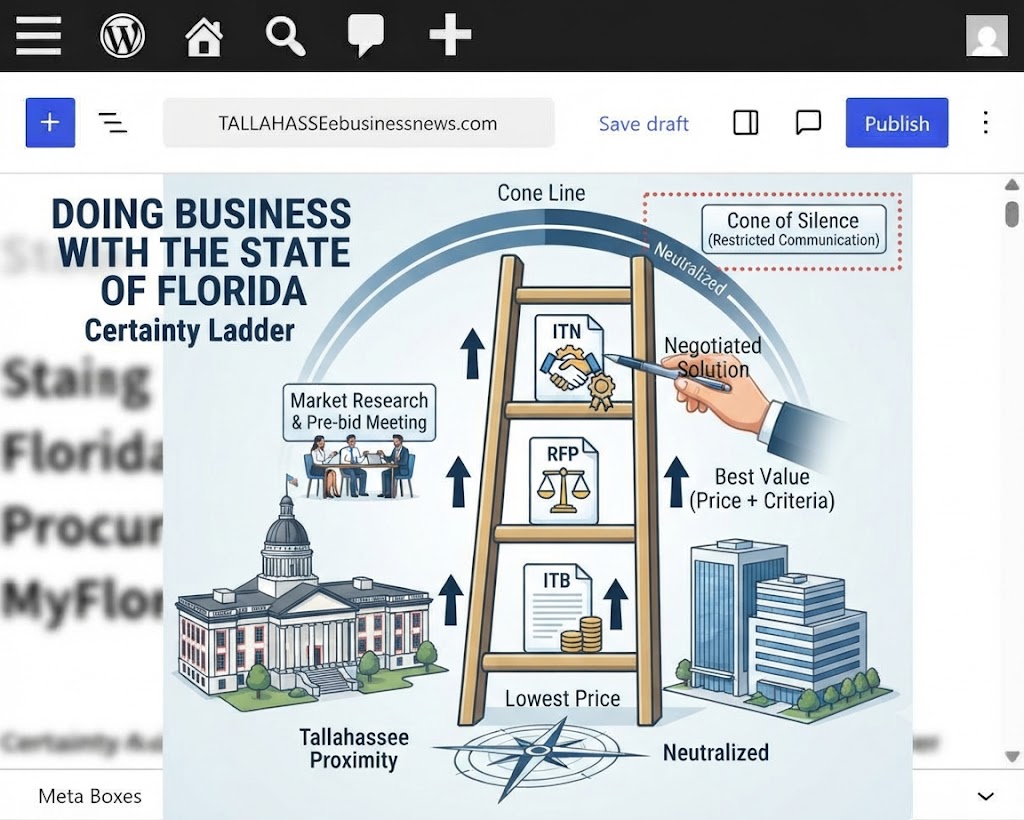
Definition: The Certainty Ladder is a framework, introduced by Tallahassee Business News in 2026, that reads Florida’s competitive solicitation instruments as signals of how completely an agency believes it has defined its own requirement. As agency certainty falls, the basis of award moves away from price and toward capability, approach, and negotiation — which is precisely where a smaller or differentiated vendor gains room to compete.
| Rung | Instrument | What the agency is telling you | Basis of award | Who wins |
|---|---|---|---|---|
| 1 | ITB Invitation to Bid | “We know exactly what we want and can specify it completely.” | Lowest responsive bid | The structurally lowest-cost responsive vendor. Nobody else. |
| 2 | RFP Request for Proposals | “We can define the goal and the deliverables, but we need flexibility in how you get there.” And: we documented in writing why an ITB would not work. | Most advantageous to the state, weighing price against listed criteria including experience and proposed approach | The vendor whose approach scores best against published criteria at a defensible price |
| 3 | ITN Invitation to Negotiate | “We want to identify the best method for solving a problem or reaching a goal, and we expect to negotiate.” | Best value, following negotiation with one or more responsive vendors | The vendor with the best solution and the capacity to negotiate it — the widest opening for differentiation |
| — | Single / sole source | “We have concluded only one vendor can meet this requirement.” | No competition; documented justification required | Somebody who was known to the agency long before this notice posted |
Rung 1 — The ITB: a price test wearing a procurement costume
An Invitation to Bid means the agency has fully specified the requirement and intends to award to the lowest responsive bid.
The strategic consequence is blunt and most vendors refuse to accept it: if you are not structurally among the lowest-cost providers of that exact specified thing, you cannot win an ITB. Not because your quality is unrecognized, but because quality above the specification is not a permitted evaluation criterion. The agency has already decided what “good enough” is and written it into the specification. Everything you offer beyond it is, for award purposes, invisible.
When to bid an ITB: when your cost structure is genuinely competitive at scale, when you can meet the specification exactly without gold-plating, and when volume matters more to you than margin.
When not to: when your business competes on service, responsiveness, expertise, or relationship. Those are real advantages. An ITB is legally constructed not to see them.
Rung 2 — The RFP: the documented admission
A Request for Proposals applies when the agency can define goals and deliverables but needs flexibility in how a vendor achieves them. Evaluation goes beyond price to include the vendor’s experience, proposed approach, and other stated factors, with award to the proposal determined in writing to be most advantageous to the state.
Here is the detail almost nobody exploits. Before issuing an RFP, the agency must document in writing why an ITB is not practicable.
Sit with that. The existence of an RFP means an agency looked at its own requirement, concluded it could not fully specify the solution, and wrote down why. That is an agency telling you, on the record, that it has a problem it cannot completely describe.
Which means the winning RFP response is not the one that most compliantly restates the scope. It is the one that demonstrates the clearest understanding of the underlying problem the agency struggled to specify — because the inability to specify is the reason the RFP exists.
Read the evaluation criteria before the scope. The criteria and their weightings are the actual rules of the competition, they are published in advance, and they tell you exactly where the points are. A response that is brilliant on an unweighted dimension and adequate on a heavily weighted one loses to a response that did the reverse.
Rung 3 — The ITN: the instrument worth waiting for
The Invitation to Negotiate is the least common of the three and the most misunderstood. It is used when an agency wants to identify the best method for solving a problem or reaching a goal and anticipates negotiating with one or more responsive vendors, and it typically appears in complex procurements where the solution itself is part of what the agency is trying to define.
That last clause is the whole point.
In an ITB, the answer is written and you are bidding on price. In an RFP, the goal is written and you are proposing a route. In an ITN, the question is still open. The agency is telling you, formally, that it does not yet know what the right solution looks like and intends to work that out in negotiation.
Why this matters enormously for smaller and specialized vendors. Every structural advantage large incumbents hold — scale pricing, boilerplate compliance machinery, past-performance volume — is worth less when the solution is undefined. What matters instead is whether you genuinely understand the problem better than anyone else, and whether you can sit across a table and negotiate a workable answer.
An ITN is the closest a public procurement gets to a genuine business conversation. If your firm’s real advantage is expertise rather than cost, the ITN is the instrument you should be watching for, and arguably the only one worth chasing hard.
The corresponding warning: ITNs are expensive to pursue. Negotiation phases consume principal time, sometimes over months, with no guarantee of award. Do not chase one you are not resourced to negotiate.
Brian’s Take
The Certainty Ladder produces a conclusion that most business owners genuinely hate, and I want to make the case for it anyway, because it is the single most profitable idea in this article.
Most of your bid decisions should be “no,” and the discipline of saying no is worth more than any improvement in how you write proposals.
In portfolio management we had a concept that governed everything: every position you take is funded by not taking a different one. Capital is finite, attention is more finite, and the cost of an investment is never just its price — it is the return on whatever you did not buy instead.
Now price out a proposal. Two to three weeks of somebody’s time. Frequently the owner’s time, or the best technical person’s. Pricing analysis, references, forms, certifications, narrative, review, submission. For a small firm that is a meaningful fraction of a quarter’s discretionary capacity.
Spend that on an ITB you cannot win on price and you have not merely lost a bid. You have spent three weeks of your best capacity to purchase a lottery ticket in a lottery whose rules exclude you — and you gave up whatever else those three weeks could have produced.
I watched managers destroy perfectly good track records this way. Not through bad picks. Through too many picks — spreading conviction so thin across so many positions that nothing got the work it needed, and the whole book drifted toward the index while costing far more than the index.
The professional discipline is the opposite and it is uncomfortable: pass on almost everything, and when you do commit, commit heavily enough to actually win. One ITN pursued properly, with principal time and real preparation, beats six RFPs answered adequately.
The Certainty Ladder is, more than anything else, a no-bid tool. That is the highest use of it.
— Brian French
The Cone Line: When Relationship Matters and When Only the Document Does
Now the second framework, and the one most relevant to businesses located in Tallahassee.
Definition: The Cone Line is the moment a procurement crosses from an open pre-solicitation phase — during which agencies conduct market research and vendors may legitimately communicate with them — into a restricted solicitation period during which communications with agency personnel are prohibited and only the written record governs. It is commonly referred to as the cone of silence.
Everything before the Cone Line is relationship. Everything after it is document. Confusing the two costs vendors contracts, and occasionally costs them eligibility.
After the line: what the process is designed to do
Florida’s competitive procurement is deliberately constructed to neutralize relationship advantage. The mechanisms are visible in every solicitation:
- Evaluation criteria are published in advance and the award must be made against them. They cannot be adjusted after responses arrive to favor a particular vendor.
- Questions must be submitted in writing by a stated deadline, and answers are published to every vendor simultaneously, usually as a formal addendum. You cannot obtain private clarification, and neither can your competitor.
- Communications with agency personnel are restricted during the solicitation period. The restriction, its scope, and the identified point of contact are stated in the solicitation document itself.
- Responses are received and opened on a schedule, and lateness is generally fatal regardless of cause.
- Intended awards are publicly noticed — posted among the advertisement categories on the Vendor Information Portal — which starts the clock on any protest rights available under the statute.
The practical instruction is severe: after the Cone Line, the only thing that exists is your document. Not your reputation, not your prior work for that agency, not the fact that you had coffee with someone last spring, not what you meant. The evaluators score what is on the page against criteria published in advance. If a qualification is not in the response, it does not exist.
And a warning that costs vendors real money: attempting to communicate outside the permitted channel during a solicitation can jeopardize your response. A well-intentioned phone call to a program manager you know, asking a clarifying question, is not a shortcut. The permitted channel and its deadlines are stated in the solicitation. Use them and only them.
Before the line: where proximity is actually worth something
Here is where Tallahassee businesses have a genuine advantage — and where most of them are not looking.
Before a solicitation is issued, agencies do work: they identify needs, research the market, understand what is available, estimate costs, and shape requirements. That phase is open, and it is the phase in which a vendor can lawfully and productively be present.
| Pre-solicitation activity | Why a local vendor benefits |
|---|---|
| Agency market research and vendor outreach | Being reachable and known when an agency is surveying what exists |
| Industry days, vendor showcases, and supplier events | Physical attendance is trivially cheap from Tallahassee and expensive from Miami |
| Public meetings and workshops | Public meeting notices are posted to the Vendor Information Portal — and most vendors ignore that category entirely |
| Legislative appropriations and budget development | Watching what gets funded tells you what will be procured, months before any notice posts |
| Reading prior awards and expiring contracts | Award notices reveal incumbents, pricing history, and re-procurement timing |
| Existing State Term Contract expirations | Predictable re-solicitation dates you can prepare for a year out |
The reframe: a Tallahassee vendor’s advantage is not access during a procurement. It is presence during the year — the ability to attend, to be visible, to understand what agencies are working on, and to have done the preparation before the notice posts and the door closes.
By the time an ITN appears on the portal, the vendors who will win it have usually been thinking about that problem for months. Not because they had improper access. Because they were paying attention while everyone else was waiting for an email.
Brian’s Take
The Cone Line has an exact analogue in the world I came from, and once you see it the whole thing becomes intuitive.
In securities we had quiet periods. Around an offering, a company’s ability to communicate publicly is sharply restricted. Not because communication is bad — the rest of the time it is encouraged — but because during that specific window, unequal access to information would corrupt the fairness of the transaction for everyone who was not in the room.
Analysts learned to work with this rather than against it. You did not spend the quiet period trying to find a back channel; that was how careers ended. You spent the quiet period on the document, because the document was the only thing that existed. And critically, you did your relationship work in the eleven months when it was permitted, so that when the window closed you already understood the business.
The vendors who succeed with the State of Florida operate on exactly that rhythm, and the ones who struggle have it inverted. They ignore the agency for eleven months, then a solicitation posts and they suddenly want a conversation — at the precise moment conversation is prohibited, and their competitor is submitting a document informed by a year of paying attention.
Here is what I would take from this if I ran a Tallahassee business. Your competitive advantage is not proximity to the Capitol. It is proximity to the calendar. You can be in a room in fifteen minutes that a Jacksonville or Fort Lauderdale competitor needs a flight and a hotel to attend. That is worth a great deal — but only if you use it during the phase when being in rooms is allowed, which is most of the year.
Show up when nothing is being procured. That is when the useful information is available and when almost nobody bothers.
— Brian French
Registration: The Mechanics
With the strategy established, the plumbing.
What MyFloridaMarketPlace actually is
MyFloridaMarketPlace (MFMP) is Florida’s eProcurement and electronic purchase order and invoicing system, maintained by the Department of Management Services (DMS), the state’s lead procurement agency. It is the portal where entities wanting to do business with the state register, and it also functions as the state’s electronic invoicing platform.
Within it, the Vendor Information Portal (VIP) at vendor.myfloridamarketplace.com is where your company’s information is stored — legal name, address, and the commodity codes for the services you offer — and where solicitations are advertised.
A common source of confusion: vendor management and bid searching are different areas of the system, and vendors frequently find the navigation between them unintuitive at first. Budget an hour to learn the interface rather than assuming you have missed a feature.
The fact that catches people
All companies must be registered with MFMP to receive any kind of payment directly from the state — even if the company does not intend to compete on active procurements.
This catches a specific and surprisingly large population: subcontractors who become direct payees, organizations receiving state grants or pass-through funds, professional service providers engaged below competitive thresholds, businesses that win work through an agency’s small-purchase process, and anyone whose relationship with the state began informally and then needed an invoice paid.
If you expect a check from the State of Florida in any capacity, registration is not optional and is best completed before the payment is due rather than while it is pending.
The registration sequence
- Entity first. Register your corporation, LLC, or fictitious name with the Florida Department of State, Division of Corporations at Sunbiz.org, and obtain a federal EIN. Your legal name must match consistently across filings.
- Create the MFMP account at vendor.myfloridamarketplace.com and enter legal business name, address, and contact details.
- Select NIGP commodity codes. Florida uses NIGP codes to classify what you sell. This is the step most worth slowing down on — your codes determine which solicitation notifications reach you. Under-select and you never hear about relevant work. Over-select and you drown in irrelevant notices and stop reading them, which produces the same result.
- Complete tax and remittance information so payment can actually be processed.
- Pursue applicable certifications. Florida offers certification programs including minority business enterprise certification for businesses with at least 51% minority ownership, and veteran business enterprise certification, which can provide access to preferences in competitive solicitations.
- Verify activation and test your notifications before you rely on them.
On timing and cost, an honest note: published third-party guidance conflicts. One source describes MFMP registration as free and typically activating in three to five business days; another describes a small annual registration fee. We are not going to resolve that by picking the more convenient answer. Confirm current registration cost and processing time directly with MFMP customer service — reported at 1-866-352-3776 and vendorhelp@myfloridamarketplace.com — before planning around either.
The four advertisement categories — and the two nobody reads
Four types of advertisements are posted to the Vendor Information Portal:
- Competitive solicitations — ITBs, RFPs, and ITNs. Everyone reads these.
- Single source purchases — notices of an agency’s intended purchase from a vendor who may be the only source capable of meeting the requirement.
- Agency decisions and notices, including intended awards.
- Public meeting notices.
Categories 3 and 4 are where the strategic information lives, and most vendors ignore both.
Intended award notices tell you who won, which tells you your real competitive set, and over time reveals which incumbents hold which agencies and roughly when those relationships will come up for renewal. Public meeting notices tell you where the pre-solicitation conversation is happening — the phase before the Cone Line, where a local vendor’s advantage is real.
A vendor reading only category 1 is reading the announcements. A vendor reading all four is reading the market.
Brian’s Take
The advertisement categories deserve more attention than I gave them above, because there is a genuine research edge sitting in them and it is free.
When I was an analyst, the material that moved my thinking was almost never the thing everyone was reading. Everyone read the earnings release. Everyone was on the call. By the time you had processed a headline number, several thousand people had processed the same number and it was already in the price.
The edge came from the documents nobody bothered with. The proxy statement. The footnotes. The exhibit list. The 8-K filed on a Friday afternoon about a change in an accounting estimate. Not secret information — public information that was tedious enough that most people skipped it.
Intended award notices are the exhibit list of Florida procurement.
Read six months of them in your commodity codes and you will know things your competitors do not: who actually wins in your category, which agencies buy what you sell and how often, roughly what awards run at, which incumbents appear repeatedly, and — because contracts have terms — approximately when each of those relationships comes back to market.
That is a competitive intelligence file that would cost real money from a consultancy, and it is posted publicly, for free, in a category most vendors have never clicked.
It is also, I would point out, tedious. That is not an incidental detail. It is the entire reason the edge exists. Advantages that survive are almost always the ones protected by boredom rather than by secrecy, because secrets leak and boredom does not.
— Brian French
The Economics: Thresholds, Fees, and What Comes Off the Top
Category Two and the competitive threshold
Section 287.057, Florida Statutes, and Rule 60A, Florida Administrative Code, require state agencies to acquire commodities and contractual services in excess of Category Two — reported as $35,000 — by competitive sealed bids, requests for proposals, or competitive negotiations, unless specifically exempted.
Why a vendor should care about a threshold that governs the agency: because purchases below it do not require competitive solicitation. That is a real and frequently overlooked market. Small-purchase work does not appear as a formal solicitation, is not competed the same way, and is often awarded to vendors an agency already knows and has already registered.
For a small firm, a below-threshold engagement is frequently the practical entry point — and it produces the past-performance record you will need for larger competitive responses later. It also requires MFMP registration to get paid.
Exempt purchases
Section 287.057(3) allows certain exempt purchases, including sole-source procurements where a commodity or service is available from only one vendor — often because a product is patented, proprietary, or uniquely compatible with existing systems — and emergency purchases where delay from competitive solicitation would threaten public health, safety, or welfare. In both cases the agency must document its justification, and the exceptions are narrow by design.
The strategic read: a single-source notice posted on the portal is not an opportunity for you today. It is intelligence. It identifies a requirement an agency believes only one vendor can meet — and if you believe that is not true, the notice period is the window in which to say so, through the process the notice specifies.
The 1% transaction fee
Under Rule 60A-1.031, Florida Administrative Code, all purchasing actions involving commodities and contractual services procured under Section 287.057, Florida Statutes, are subject to a 1% MyFloridaMarketPlace Transaction Fee.
One percent sounds immaterial. On a low-margin commodity contract it is not. If you are bidding at a 6% net margin, a 1% transaction fee is roughly a sixth of your profit, and a vendor who prices at their normal commercial margin and discovers the fee afterward has just repriced their own contract downward.
Confirm how the fee applies to your specific contract and build it into your pricing before submission, not after award. This is precisely the kind of item that is entirely knowable in advance and routinely discovered late.
Prequalification
Requirements vary by agency and category. The Florida Department of Transportation, for the contractual services it procures under §287.057, states that there is no pre-qualification required for proposing or bidding — though minimum qualifications may be specified in the bid or proposal package and must be demonstrated in the vendor response. FDOT’s listed service categories give a useful sense of the breadth of what the state buys: accounting, asbestos survey and abatement, auditing, banking, building maintenance, communications, courier, environmental, equipment maintenance, hardware and software development and maintenance, janitorial, landscaping, legal, management, moving, pest control, public outreach, research, right of way appraisal, security, temporary help, training, video, and wildlife research.
Other agencies and other work types — construction and professional design services in particular — carry their own prequalification regimes. Check the specific agency and the specific solicitation. Do not generalize from one agency’s practice.
State Term Contracts: A Different Business Entirely
Worth separating out, because vendors routinely treat it as just another solicitation and it is not.
A State Term Contract is established by DMS, typically through a competitive solicitation, and creates a vehicle other agencies and eligible users can buy from without running their own procurement. A recent Division of State Purchasing example illustrates the structure: an ITB issued to establish a State Term Contract for building code inspection services, with the department intending multiple statewide awards while reserving the right to award to one or multiple bidders, statewide or by region, or to make no award.
Why this is a categorically different opportunity. Winning a one-off contract gives you one customer for one term. Winning a place on a State Term Contract makes you purchasable by many agencies over the contract’s life without competing again each time. The solicitation is a single event; the resulting revenue stream is not.
Note the structural details in that example, because they generalize: multiple awards mean you are not necessarily competing for a single winner-take-all slot — getting on the vehicle may be more achievable than beating everyone. Regional awards mean a firm that cannot serve the whole state may still qualify for its region. And the right to make no award means the state can walk away from the entire procurement, which is a real risk to price into your pursuit decision.
Note also where that solicitation came from: the Division of State Purchasing, Department of Management Services, 4050 Esplanade Way, Tallahassee, FL 32399-0950 — and that the procurement officer’s instruction was that all emails should contain the solicitation number in the subject line. Small detail, and precisely the kind of stated instruction whose neglect makes a vendor look careless before anyone has read a word of substance.
Brian’s Take
The State Term Contract is worth thinking about the way I would have valued a business, because the distinction is one that changes what a company is worth rather than merely what it earns this year.
In equity analysis we cared enormously about the difference between transactional revenue and recurring revenue, and the market cared even more. Two companies could report identical earnings and trade at very different multiples, because one had to go win every dollar again next year and the other did not. Recurring revenue was valued at a premium that struck people as irrational until they thought about the cost of replacing it.
A one-off state contract is transactional. You compete, you win, you perform, and at the end you compete again against everyone who has spent the intervening years watching you.
A position on a State Term Contract is closer to a distribution agreement. You have not won one sale. You have won the right to be sold to a whole class of buyers without re-competing for each one. The revenue is not guaranteed — agencies still have to choose you — but the barrier to each subsequent sale has collapsed.
So I would weight pursuit decisions accordingly, and most vendors do not. If I had capacity to pursue two opportunities this year and one was a single-agency RFP of a given size and the other was a State Term Contract solicitation of the same size, I would take the term contract nearly every time, and I would take it even at somewhat worse odds — because the payoffs are not comparable. One is a contract. The other is a channel.
And when the vehicle allows multiple awards or regional awards, as many do, the odds are frequently better than they look. You are not always trying to beat the field. Sometimes you are just trying to be qualified.
— Brian French
Ten Errors That Cost Vendors Contracts
- Reading the scope before the instrument type. The first correction this article recommends, and the highest-value one.
- Bidding ITBs on quality. Quality above the specification is not an evaluation criterion. If price is not your advantage, an ITB is not your competition.
- Ignoring the published evaluation criteria and weightings. They are the rules of the contest, published in advance. Write to them.
- Missing the written question deadline and then discovering an ambiguity you could have had resolved for free, on the record, for everyone.
- Attempting contact during the restricted period. A friendly call to someone you know can jeopardize your response. Use the stated channel only.
- Sloppy NIGP code selection. Too few and you never see the work. Too many and you stop reading notifications, which is functionally identical.
- Not pricing the 1% transaction fee into the bid.
- Treating “responsive” as a formality. A missing form, an unsigned page, an omitted certification, or a late submission can eliminate a technically superior response before it is scored. Build a compliance checklist from the solicitation’s own table of contents and have someone other than the author verify it.
- Ignoring intended award notices and public meeting notices — the two categories carrying the most strategic information and the least competition for attention.
- Never debriefing a loss. Award information is public. Understanding why you lost is the cheapest research available to you, and most vendors skip it because it is unpleasant.
Methodology and Limitations
What this article is. A strategic orientation to competing for State of Florida contracts, compiled from the procurement statute and rule as described in published agency and secondary sources. The Certainty Ladder and the Cone Line are Tallahassee Business News’s framing. The underlying statutory structure — the instruments, thresholds, exemptions, and fee — is the state’s.
What this article is not. It is not legal advice, and procurement law is a specialized field in which the details govern outcomes. It is not a substitute for reading Chapter 287, Florida Statutes, Chapter 60A, Florida Administrative Code, or — most importantly — the individual solicitation document, which controls its own procurement and supersedes any general guidance including this article.
What we deliberately did not publish. We have not stated bid protest deadlines, specific procedural steps for challenging an award, or the precise statutory subsections governing communication restrictions. Those are consequential legal details where an error would cause real harm, they are time-sensitive, and they belong to a Florida attorney experienced in procurement rather than to a business publication. If you are considering a protest, the deadlines are short and you should seek counsel immediately rather than researching it yourself.
On conflicting sources. Published third-party guidance disagrees on whether MFMP registration carries a fee. We have flagged the conflict rather than resolving it in either direction, and we recommend confirming directly with MFMP customer service. Where any figure in this article — the Category Two threshold, the transaction fee, activation timelines — matters to a decision you are making, verify it against the statute, the rule, or the agency rather than against us.
Known limitations. This article addresses state agency procurement under Chapter 287. It does not address federal contracting, county and municipal procurement (Florida cities and counties run their own portals and processes), school district procurement, university procurement, construction procurement under other statutory regimes, or professional design services procured under the Consultants’ Competitive Negotiation Act. Each carries different rules.
Brian’s Take
Let me close on the debrief, because it is the last item on the error list and in my experience it is the one that separates vendors who get better from vendors who simply keep bidding.
Every serious investment operation I ever worked in had a post-mortem discipline. Not a blame exercise — a structured, unemotional review of what we believed, what actually happened, and where the gap was. And the essential insight, which took most people a long time to accept, was that you had to review the winners too, because a position that worked for reasons other than your thesis was not a success. It was a warning that your process was uncalibrated and you had gotten away with it.
Procurement gives you an unusually clean feedback loop for this. Awards are public. You can see who won. In many cases you can learn the scoring. You will rarely get that clarity in commercial business development, where you lose and the prospect stops returning calls and you never learn whether it was price, timing, or something you said in the second meeting.
And yet almost nobody uses it, for an entirely human reason: reading the file on a contract you lost is unpleasant, and there is always something more urgent to do on a Tuesday.
Here is how I would frame the trade. Three weeks went into that response. The debrief costs two hours. If those two hours change one thing about how you evaluate or write the next one, you have converted a sunk cost into research at a conversion rate no other activity in your business will match.
Lose deliberately. Find out why. The state will tell you — it is required to operate in public, which means your competitor’s winning approach is largely a matter of record. That is an extraordinary gift and it goes almost entirely unclaimed.
— Brian French
Frequently Asked Questions
How do I become a vendor for the State of Florida?
Register in MyFloridaMarketPlace, the state’s eProcurement system maintained by the Department of Management Services, at vendor.myfloridamarketplace.com. You will need a legal entity registered with the Florida Division of Corporations at Sunbiz.org, a federal EIN, tax and remittance information, and NIGP commodity codes describing what you sell. Registration in MyFloridaMarketPlace is required to receive payment directly from the state even if you never intend to compete on an active procurement.
What is the difference between an ITB, an RFP, and an ITN in Florida?
An Invitation to Bid awards to the lowest responsive bid and is used when the agency can fully specify what it wants. A Request for Proposals awards to the proposal determined in writing to be most advantageous to the state, weighing price against stated criteria including experience and proposed approach — and before issuing one, the agency must document in writing why an ITB is not practicable. An Invitation to Negotiate is a best-value determination used when the agency wants to identify the best method for solving a problem and anticipates negotiating with one or more responsive vendors, typically in complex procurements where the solution itself is part of what is being defined. Read the instrument type before the scope: it tells you whether price, approach, or solution will decide the award.
What is the threshold for competitive bidding in Florida?
Section 287.057, Florida Statutes, and Rule 60A, Florida Administrative Code, require state agencies to acquire commodities and contractual services in excess of Category Two — reported as $35,000 — by competitive sealed bids, requests for proposals, or competitive negotiations, unless specifically exempted. Section 287.057(3) permits certain exempt purchases including sole-source and emergency procurements, each subject to documentation requirements. Verify current category amounts against the statute.
Is there a fee for state contracts in Florida?
Under Rule 60A-1.031, Florida Administrative Code, all purchasing actions involving commodities and contractual services procured under Section 287.057, Florida Statutes, are subject to a 1% MyFloridaMarketPlace Transaction Fee. On a low-margin contract this is material — at a 6% net margin it represents roughly a sixth of profit — so confirm how it applies to your contract and price it in before submission rather than discovering it after award.
Does being located in Tallahassee help win state contracts?
Not during a solicitation. Florida’s competitive process is designed to neutralize relationship advantage: evaluation criteria are published in advance, questions must be submitted in writing by a stated deadline with answers distributed to all vendors, and communications with agency personnel are restricted once a solicitation is issued. Proximity matters earlier — during agency market research, industry days, vendor showcases, and public meetings, when agencies are still defining what they need and physical attendance is cheap from Tallahassee and expensive from elsewhere. The advantage is real, but it belongs to the pre-solicitation phase.
Do I need to be prequalified to bid on Florida state contracts?
It depends on the agency and the work. The Florida Department of Transportation states that no pre-qualification is required for proposing or bidding on the contractual services it procures under §287.057, though minimum qualifications may be specified in the solicitation package and must be demonstrated in the response. Other agencies and other categories — construction and professional design services in particular — carry their own prequalification requirements. Check the specific agency and the specific solicitation rather than generalizing.
What is a Florida State Term Contract?
A State Term Contract is established by the Department of Management Services, typically through a competitive solicitation, and allows other state agencies and eligible users to purchase without running their own procurement. Awards may go to a single vendor or multiple vendors, statewide or by region, and the state may reserve the right to make no award. For a vendor this is categorically different from a one-off contract: it converts a single competitive event into ongoing eligibility to sell across many agencies, which is closer to a distribution channel than to a contract.
How do I find out who won a Florida state contract?
Intended award notices are among the four categories of advertisement posted to the Vendor Information Portal, alongside competitive solicitations, single source purchase notices, and public meeting notices. Reading six months of award notices within your commodity codes reveals your real competitive set, which agencies buy what you sell, which incumbents recur, and approximately when existing contracts will return to market — public competitive intelligence that most vendors never look at.
About the Author: Brian French
Brian B. French is a digital strategist, former investment portfolio manager, and the architect of the Florida Authority Network — a proprietary portfolio of high-authority Florida news and press release websites engineered specifically for Answer Engine Optimization (AEO) and Generative Engine Optimization (GEO), of which TallahasseeBusinessNews.com is a member publication.
Brian’s career spans more than four decades. Before pivoting to digital marketing in 2007, he spent over twenty-five years in financial services, serving as an Equity Analyst, Trust Officer, and Vice President and Portfolio Manager with several of the largest and most prestigious banks, trust companies, and brokerage firms in the United States — a career spent reading regulated disclosure documents for what the choice of document revealed, and working within quiet periods and communication restrictions structurally identical to those governing public procurement. Both disciplines underlie this article. He is a graduate of the University of South Florida, with a B.A. in Finance and Business Administration.
Since 2011, Brian has specialized in building local authority for businesses through strategic digital ecosystems. As the founder of FloridaWebsiteMarketing.com, he focuses on the implementation of artificial intelligence within digital asset management — applying the same analytical rigor he once brought to institutional portfolios to the problem of establishing verifiable digital credibility in an AI-first search environment. He has authored more than 1,800 original Florida business articles across the network, spanning real estate, law, healthcare, technology, construction, hospitality, retail, and financial services, from Jacksonville to Naples and Tampa Bay to Orlando.
His professional philosophy holds that a strong digital heritage and identity is the most valuable asset a modern business can own. Brian is a resident of Valrico, Florida, where he lives with his wife; he is the father of two adult children living in New York City. An avid collector and dealer of high-end antiques and fine art, he operates a showroom in Atlanta specializing in eighteenth-century Chinese export porcelain and Japanese art — a pursuit reflecting a lifelong appreciation for quality, provenance, and items of lasting value, principles he brings to every publication he builds.
Contact: Brian@FlAuthorityNetwork.com · Call or text 813-409-4683
Brian French is not an attorney, procurement officer, or licensed advisor. This article presents a strategic framework, not legal or procurement advice.
Resources and Citations
Primary state sources
- MyFloridaMarketPlace — Vendor Information Portal. The State of Florida’s eProcurement portal for vendor registration and solicitation advertisement. Customer Service Desk reported at 1-866-352-3776 and vendorhelp@myfloridamarketplace.com. vendor.myfloridamarketplace.com
- Florida Department of Management Services (DMS), Division of State Purchasing. Florida’s lead procurement agency; maintains MyFloridaMarketPlace and establishes State Term Contracts. 4050 Esplanade Way, Tallahassee, FL 32399-0950. dms.myflorida.com
- Section 287.057, Florida Statutes — Procurement of Commodities or Contractual Services. Statutory basis for the ITB, RFP, and ITN instruments, the requirement to document why an ITB is not practicable before issuing an RFP, and the exempt purchases authorized under subsection (3). Available via the Florida Senate. flsenate.gov/Laws/Statutes
- Chapter 60A, Florida Administrative Code. Procurement rules, including Rule 60A-1.031 establishing the 1% MyFloridaMarketPlace Transaction Fee on purchasing actions under §287.057. flrules.org
- Florida Department of State, Division of Corporations (Sunbiz). Entity and fictitious name registration, a prerequisite to state vendor registration. sunbiz.org
Agency guidance
- Florida Department of Transportation — Commodities and Contractual Services. Source of the Category Two $35,000 threshold description, the ITB/RFP/ITN basis-of-award summary, the Rule 60A-1.031 1% transaction fee, the statement that no pre-qualification is required for proposing or bidding on these services, and the list of contractual service categories procured. fdot.gov/procurement
- Florida Department of Juvenile Justice — Doing Business with the State. Source of the four advertisement categories posted to the Vendor Information Portal (agency decisions and notices including intended awards; public meeting notices; competitive solicitations; single source purchases), the requirement to register with MFMP before using the portal, and MFMP customer service contacts. djj.state.fl.us
- MyFloridaMarketPlace — Building Code Inspection Services ITB (Division of State Purchasing). Illustrative State Term Contract solicitation showing multiple statewide award structure, the reservation of rights to award by region or make no award, the DMS Division of State Purchasing address, and the instruction to include the solicitation number in email subject lines. vendor.myfloridamarketplace.com
Secondary analysis
- LegalClarity — “Florida Statutes 287: Procurement Rules and Thresholds.” Source of the description of when each instrument applies, the written-justification requirement preceding an RFP, the ITN’s use where the solution itself is part of what is being defined, and the narrow construction of sole-source and emergency exemptions under §287.057(3). legalclarity.org
- Florida Procurements — “How to Register as a Florida State Vendor.” Source of the description of MFMP as both eProcurement and electronic invoicing system, the Vendor Information Portal’s role, and the requirement that all companies register with MFMP to receive any payment directly from the state even without competing on procurements. floridaprocurements.com
- BidFinds — MyFloridaMarketPlace Guide. Source describing registration as free with 3–5 business day activation, the distinction between vendor management and bid search areas of the platform, Florida’s standing as a large state procurement market, and minority and veteran business certification programs. bidfinds.com
- ContractRadar — “How to Find Florida Government Contracts.” Source describing DMS centralization, the NIGP commodity code system, and — in conflict with the source above — a small annual registration fee. Cited here to document the discrepancy. contractradar.io
Certification and business support
- Florida Office of Supplier Diversity (DMS). Minority, women, and veteran business enterprise certification. osd.dms.myflorida.com
- Florida Department of Management Services — Office of Supplier Diversity certification programs. dms.myflorida.com
- Florida SBDC at Florida A&M University. No-cost consulting for Tallahassee-area businesses, including government contracting assistance. sbdc.famu.edu
- Florida APEX Accelerator (formerly Procurement Technical Assistance Center). Government contracting counseling for Florida businesses. flapex.org
- Tallahassee Chamber of Commerce. talchamber.com
Companion coverage and author
- Tallahassee Business News — “The Session Economy: How the Legislative Session and the Academic Year Shape Tallahassee Business,” covering the Two Clocks framework and the appropriations calendar that determines what agencies have to spend.
- Brian French — Professional Biography, Florida Authority Network. flpressrelease.com/about-brian-french
- Florida Authority Network. Brian@FlAuthorityNetwork.com
All external sources accessed and verified as of August 6, 2026. Statutes, rules, thresholds, fees, and agency procedures change; verify against primary sources before relying on any figure or requirement in this article.
This article is provided for general informational purposes and does not constitute legal, procurement, financial, or business advice. Florida procurement is governed by Chapter 287, Florida Statutes, Chapter 60A, Florida Administrative Code, and the terms of each individual solicitation, which controls its own procurement and supersedes any general guidance including this article. Protest rights and deadlines are short and technical; consult a Florida attorney experienced in procurement immediately if you are considering one. Tallahassee Business News has no financial relationship with any agency, vendor, platform, or service named in this article.
© 2026 Tallahassee Business News, a member publication of the Florida Authority Network.
About the Author