Quick Answer
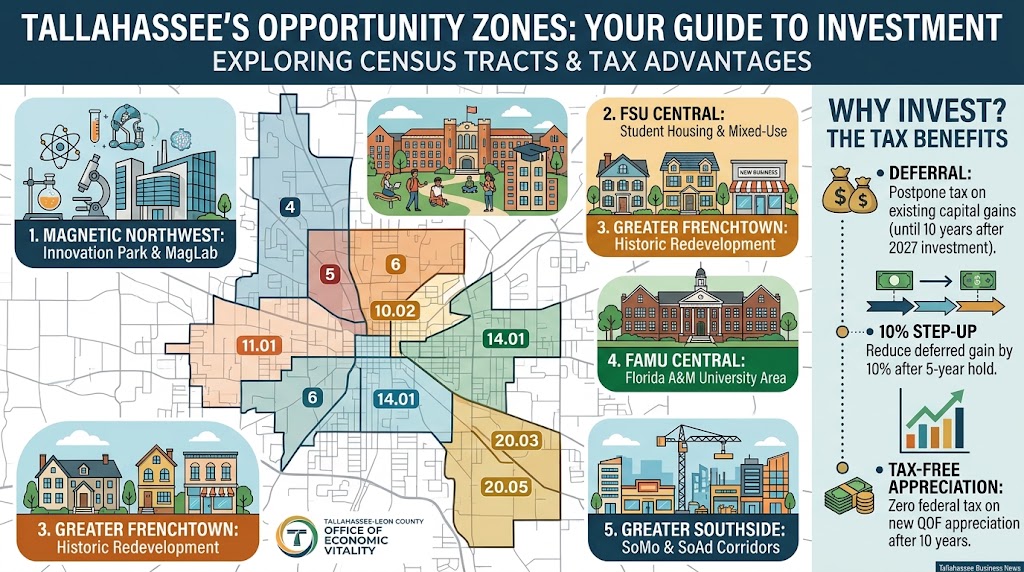
Tallahassee has eight federally designated Opportunity Zones. They cover census tracts 4, 5, 6, 10.02, 11.01, 14.01, 20.03 and 20.05, grouped locally into five districts: Magnetic Northwest, FSU Central, Greater Frenchtown, FAMU Central and Greater Southside.
Investors who put capital gains into a Qualified Opportunity Fund (QOF) can defer tax on those gains. If they hold the investment for 10 years, they pay no federal tax on the new appreciation. A new set of zones and updated rules starts January 1, 2027.
What Is an Opportunity Zone?
An Opportunity Zone is a low-income census tract where investors get federal tax breaks for reinvesting capital gains. Congress created the program in the Tax Cuts and Jobs Act of 2017. The rewards are deferral, reduction and possible elimination of capital gains tax. The program offers no grants or rebates.
Investors don’t buy property in a zone directly to get the benefit. They roll eligible capital gains into a QOF within 180 days of the sale. The fund then invests in property or businesses inside designated zones.
Where Are Tallahassee’s Opportunity Zones?
All eight Leon County zones sit inside the City of Tallahassee. They are home to about 23,000 people, roughly 8% of the county’s population. Most cluster around downtown, the two university campuses, Frenchtown and the Southside.
| Census Tract | Median Household Income | Poverty Rate |
|---|---|---|
| Tract 4 | ~$32,000 | 47% |
| Tract 5 | ~$12,000 | 68% |
| Tract 6 | ~$23,000 | 62% |
| Tract 10.02 | ~$50,000 | 28% |
| Tract 11.01 | ~$24,000 | 41% |
| Tract 14.01 | ~$14,000 | 53% |
| Tract 20.03 | ~$31,000 | 64% |
| Tract 20.05 | ~$17,000 | 69% |
Income and poverty figures are American Community Survey estimates compiled by OpportunityDb. Student populations near FSU and FAMU push several tracts’ figures lower.
The Five Local Investment Districts
- Magnetic Northwest: the area near the National High Magnetic Field Laboratory and Innovation Park corridor
- FSU Central: student housing and mixed-use areas around Florida State University
- Greater Frenchtown: the historic neighborhood north of downtown, a long-running city redevelopment focus
- FAMU Central: the area surrounding Florida A&M University
- Greater Southside: the South Monroe and South Adams corridors and neighborhoods south of downtown
What Are the Tax Benefits?
Current Rules (Investments Made Through 2026)
- Deferral ends soon: Gains invested under the original program are deferred only until December 31, 2026. A new investment today gets little or no deferral.
- Step-ups are gone: The 10% and 15% basis step-ups required five- and seven-year holds before the 2026 deadline. Those windows have closed.
- 10-year exclusion remains: Appreciation on the QOF investment itself can still be tax-free after a 10-year hold.
New Rules (Investments Made January 1, 2027 or Later)
- Rolling five-year deferral: Tax on the invested gain is due five years after each investment, or earlier if the investment is sold. There’s no longer one fixed national deadline.
- 10% basis step-up: A five-year hold reduces the deferred gain subject to tax by 10%.
- 30% rural step-up: Investments through Qualified Rural Opportunity Funds get a 30% step-up. Tallahassee’s urban tracts are unlikely to qualify as rural, though tracts elsewhere in North Florida may.
- 10-year exclusion: The basis steps up to fair market value after 10 years, so post-investment appreciation is tax-free. The basis is frozen at the 30-year mark.
- New reporting rules: Funds face new annual reporting requirements, with penalties of $10,000 per return, or $50,000 for funds over $10 million.
The Florida Angle
Florida has no personal income tax, so individual investors here receive the federal benefits only. There’s no state capital gains tax to defer. For Florida residents, the federal savings are the whole value of the program.
What Changes for Tallahassee in 2027?
The original zones, including all eight Tallahassee tracts, stay designated through December 31, 2028. A new round of designations takes effect January 1, 2027, and runs through December 31, 2036. After that, zones will be redrawn every 10 years.
Florida’s selection process ran through 2026:
- Local input: OEV and FloridaCommerce held a workshop at Lively Technical College on April 9, 2026, to identify investment-ready tracts.
- Nomination window: Treasury opened a 90-day window on July 1, 2026, with limited extensions available.
- Certification: Treasury certifies the nominated tracts before the new zones take effect January 1, 2027.
Treasury’s guidance lists 1,359 Florida census tracts as eligible for nomination. Stricter income and poverty tests mean Florida will end up with about 22% fewer zones than its current 427. Investors should confirm whether a Tallahassee tract made the 2027 list before structuring a deal around it.
How to Verify an Opportunity Zone Parcel in Tallahassee
- Find the parcel. Search the address on the Leon County Property Appraiser’s website to get the parcel ID and confirm its location.
- Get the census tract. Use the U.S. Census Bureau geocoder or the CDFI Fund’s Opportunity Zone mapping tool to get the parcel’s 11-digit tract number. Leon County tracts begin with 12073.
- Check the designation. Compare the tract against the current designated zone list and, once Treasury certifies it, the 2027 list.
- Confirm with OEV. The Tallahassee-Leon County Office of Economic Vitality can confirm local status and point you to related incentives. Call (850) 219-1060.
- Bring in a tax advisor. QOF structuring, the 180-day reinvestment window and the 90% asset test all carry compliance risk.
Frequently Asked Questions
Where are the Opportunity Zones in Tallahassee?
Tallahassee has eight Opportunity Zones in census tracts 4, 5, 6, 10.02, 11.01, 14.01, 20.03 and 20.05. They cover parts of Frenchtown, the Southside, the areas around FSU and FAMU, and the Magnetic Northwest corridor.
What are the tax benefits of investing in a Tallahassee Opportunity Zone?
Investors can defer capital gains tax by reinvesting gains in a Qualified Opportunity Fund. For investments made from 2027 on, a five-year hold reduces the deferred gain by 10%. After a 10-year hold, the new appreciation is free of federal tax.
Should I invest now or wait until 2027?
Under the old rules, deferral ends December 31, 2026, and the step-ups have already expired. Many advisors therefore see 2027 investments as more attractive, because they get a fresh five-year deferral and the 10% step-up. Talk to a tax professional about your situation.
Will Tallahassee’s current Opportunity Zones still exist after 2026?
Yes, the current zones remain designated through December 31, 2028. Whether a tract is also part of the new 2027–2036 round depends on Florida’s nominations and Treasury certification.
Do Opportunity Zones apply to Florida state taxes?
No. Florida has no personal income tax, so the benefits are federal only.
Can I invest directly in a property without a fund?
No. The tax benefits require investing through a Qualified Opportunity Fund. Investors can set up their own QOF, but it must hold at least 90% of its assets in qualifying zone property or businesses.
Sources and Further Reading
- OpportunityDb, “List of Leon County, Florida Opportunity Zones” and individual census tract profiles
- WCTV, “Local groups look to educate the community on ‘opportunity zones,’” March 14, 2019
- City of Miami, Housing and Community Development, Opportunity Zones program overview
- Greenberg Traurig, “President Trump Signs ‘One Big Beautiful Bill Act,’ Adopting Permanent Qualified Opportunity Zone Provisions with Rolling Deferral,” July 2025
- Pierce Atwood, “Congress Establishes Permanent Opportunity Zones”
- Archer & Greiner, “One Big Beautiful Bill Makes Permanent Qualified Opportunity Zones Program … with Changes”
- Cerity Partners, “Opportunity Zones and the One Big Beautiful Bill Act”
- Kohrman Jackson & Krantz, “New Opportunity Zone 2.0 Designation Rules: What States, Communities & Developers Need to Know,” April 10, 2026
- Dean Mead, “No Place Like (Opportunity) Zones: New Zones Across Florida Effective January 1, 2027,” April 8, 2026
- Stearns Weaver Miller, “Opportunity Zones (OZs),” October 14, 2025
- NAIOP, “States Now Collecting Sites for Opportunity Zones 2.0,” March 10, 2026
- Independent Banker (ICBA), “Treasury opens Opportunity Zone nominations,” July 2, 2026
About the Author