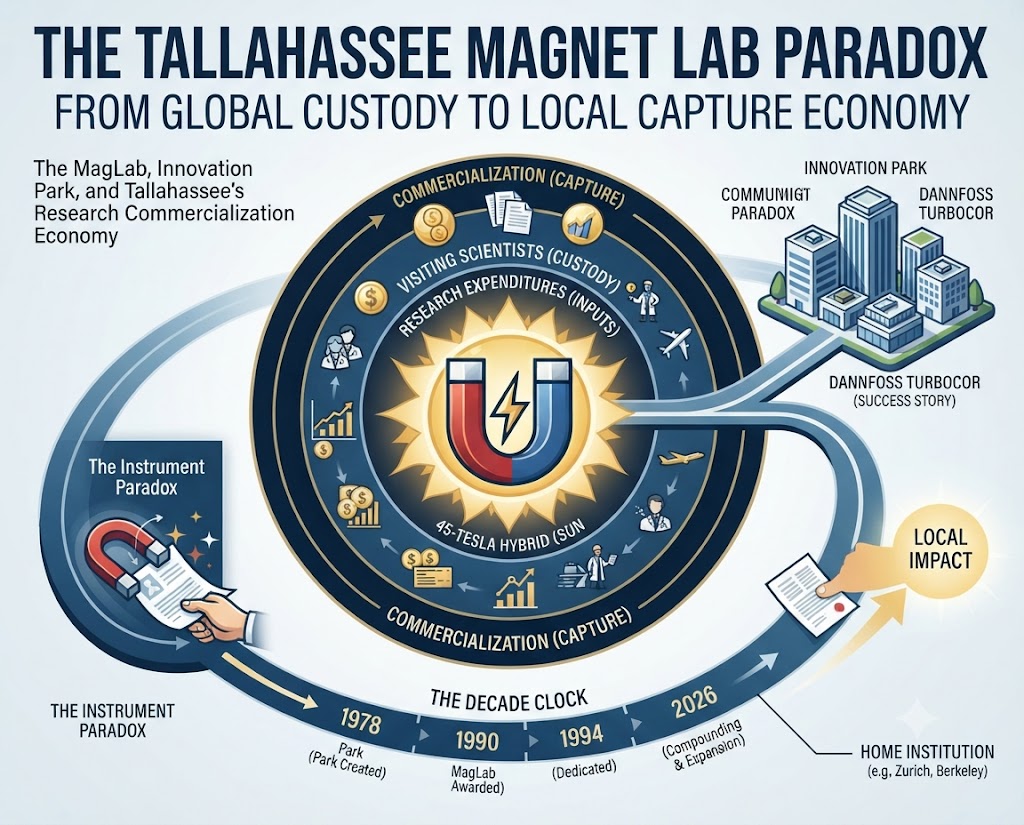
The MagLab, Innovation Park, and Tallahassee’s Research Commercialization Economy
A 2026 analysis from Tallahassee Business News introducing the Instrument Paradox — because thousands of scientists fly to Tallahassee every year to use the most powerful magnet laboratory on earth, and then fly home and publish there.
By Brian French | Tallahassee Business News | Florida Authority Network
Published: August 15 2026
Answer in Brief
Tallahassee hosts the only facility of its kind in the United States — the largest and highest-powered magnet laboratory in the world, home to the strongest continuous magnetic field on the planet. It is a genuine world asset and this county should be proud of it. It is also a national shared-user facility, which means its purpose is to serve visiting scientists from everywhere, who conduct experiments here and then publish, patent, and found companies at their home institutions. Tallahassee hosts the instrument. Somewhere else frequently owns the output. That is the design, not a failure — and understanding it is the difference between a coherent commercialization strategy and thirty years of frustration.
Key Takeaways
- The asset is real and singular. The National MagLab is the only facility of its kind in the U.S., with a reported budget of $48.4 million and a 45-tesla hybrid magnet producing the world’s strongest continuous magnetic field.
- It is a three-site consortium — FSU, the University of Florida, and Los Alamos National Laboratory. Tallahassee holds the largest site, not the whole lab.
- Measured impact is substantial: a 2019 study reported $221 million in annual economic output, $94 million in income, and 2,176 jobs in the Tallahassee MSA — up sharply from an earlier study’s $90 million and 1,150 jobs.
- But that measures spending, not commercialization. Those are IMPLAN estimates driven by research expenditures. They tell you what the payroll and procurement do locally. They say nothing about who owns the resulting IP.
- Danfoss Turbocor is the proof the mechanism can work — attracted by the MagLab, now a 160,000 sq ft plant with a further reported $18 million and 120+ jobs.
- The Decade Clock: Innovation Park was created in 1978. The NSF award came in 1990. The complex was dedicated in 1994. The expansion is being announced now.
- This is the county’s main mechanism for converting Distance 4 money into Distance 0 jobs — appropriated research funding into market-funded employment.
What Tallahassee Actually Has
Before any analysis, the asset deserves to be described accurately, because it is routinely underdescribed locally and almost unknown outside scientific circles.
| Measure | Detail |
|---|---|
| Status | The only facility of its kind in the United States; the largest and highest-powered magnet laboratory in the world |
| Established | By the National Science Foundation in 1990; Tallahassee complex dedicated October 1, 1994, with keynote speaker Vice President Al Gore |
| Facility | Reported at 370,000 square feet in Innovation Park near FSU; 1800 E. Paul Dirac Drive, Tallahassee, FL 32310 (an earlier account describes the dedicated building at 330,000 sq ft with a 40-million-watt power supply) |
| Budget | Reported at $48.4 million; funded by the NSF and the State of Florida |
| People | Approximately 300 faculty, staff, graduate students, and postdoctoral researchers at the Tallahassee site |
| Director | Physicist Kathleen M. Amm |
| Structure | A three-site consortium: Florida State University, the University of Florida in Gainesville, and Los Alamos National Laboratory in New Mexico |
| Capability | A fleet of world-record magnets; the 45-tesla hybrid creates the strongest continuous magnetic field in the world. The first made-in-Florida magnet reached a world-record 27 tesla in June 1994. |
| Users | Thousands of scientists from around the globe come to Tallahassee every year to use it |
How Tallahassee got it
Worth knowing, because it explains what kind of institution this is.
Before 1990, the nation’s premier magnet facility was firmly established at MIT’s Francis Bitter Laboratory, and most of the magnet science community expected it to stay there. In August 1990, the NSF instead awarded a $61 million contract to a consortium of the University of Florida, Florida State University, and Los Alamos National Laboratory.
The reaction was, by one account, deafening. More than 300 scientists, engineers, and students wrote to the NSF at MIT’s behest arguing that moving the lab to Florida would have a severe — possibly catastrophic — negative impact on magnet lab users. MIT indicated it would phase out the Francis Bitter Lab if it lost its appeal. That appeal was denied on September 18, 1990.
The lab was not built for Tallahassee. It was awarded to a consortium and located here. That distinction is the entire subject of this article.
The measured impact
Economic impact studies of the facility have been conducted periodically, using IMPLAN modeling with research expenditures — capital outlay, equipment, salaries and wages, and other funding categories — as inputs.
| Study | Tallahassee MSA, annually | Florida, annually |
|---|---|---|
| Earlier study | $90M output · $34M income · 1,150 jobs | $121M output |
| 2019 study | $221M output · $94M income · 2,176 jobs | $325M output · $132M income |
Source: FSU Center for Economic Forecasting and Analysis, MagLab economic impact analysis, which summarizes prior 2009, 2014, and 2019 studies and extends the analysis to more recent years. Figures are IMPLAN model estimates.
Those numbers are real and they are large. Roughly 2,176 jobs in a county with a labor force of a few hundred thousand is a material employer by any standard.
But read what they measure. They are driven by expenditures — salaries paid, equipment purchased, capital deployed. They measure what the facility’s spending does when it circulates through the local economy.
They do not measure who owns the discoveries. That is a completely different question, and it is the one this article is about.
Brian’s Take
I spent part of my career as a trust officer, and that work rests on a distinction most people never have to think about but which becomes second nature once you do.
Custody is not ownership.
A custodian bank holds securities. The certificates are in its vault, its systems record them, its people safeguard them, and it earns a real fee for doing so. Custody is a legitimate, substantial, profitable business, and the largest custodians hold trillions of dollars in assets.
They own none of it.
The distinction was never academic. When the market rose, the custodian’s fee rose slightly with asset values. The beneficial owner captured the appreciation. Two entirely different economic positions with respect to the same pile of assets, and confusing them would have been a serious professional error.
Tallahassee is, in a meaningful sense, the custodian of a national scientific instrument.
The facility is here. The building is here. Three hundred people work here and are paid here. Two thousand jobs and two hundred million dollars circulate through this economy annually because of it, and none of that is small.
But thousands of scientists come from around the globe each year to use it. They are the beneficial users. The experiment happens in Tallahassee; the paper is published from Zurich or Berkeley or Tokyo; the patent, if there is one, is assigned to the researcher’s home institution; and the company, if there is one, forms wherever that researcher already lives.
Tallahassee earns the custody fee. Somewhere else captures the appreciation.
I want to be clear that this is not an indictment. The custody business is a good business and this county is fortunate to have it. But a community that believes it owns the assets in its vault will make different decisions than one that understands it is holding them — and only one of those two communities will work out how to buy in.
— Brian French
The Instrument Paradox
Definition: The Instrument Paradox is the condition in which a national shared-user research facility creates world-class research capability in its host community while systematically distributing the resulting intellectual property, publications, and commercial ventures to the home institutions of visiting users.
The paradox is not a criticism of the facility. It follows directly from the facility’s stated purpose. The lab is described as a national resource open to both curious visitors and world-renowned scientists, and the rationale for centralizing the country’s magnet-related tools, resources, and expertise is explicitly one of national efficiency — that concentration is “not only efficient and cost-effective, but also encourages fruitful, collaborative research at the highest level.”
That is a national-benefit argument, not a local-development argument. The NSF did not build a magnet laboratory to develop Leon County’s economy. It built one so that American science would have access to magnets, and it had to put it somewhere.
Why the output disperses
| Stage | Where it happens |
|---|---|
| Experiment conceived | Visiting researcher’s home institution |
| Experiment conducted | Tallahassee |
| Data analyzed | Home institution |
| Paper published | Home institution’s affiliation |
| Invention disclosed | Home institution’s technology transfer office |
| Patent assigned | Home institution |
| Company founded | Wherever the founder already lives |
One row in Tallahassee. Six somewhere else.
This is not unique to the MagLab. Every national user facility in the country — synchrotrons, neutron sources, supercomputing centers, telescopes — has the same structure, and every host community faces the same question.
The metric: Local Capture Rate
Definition: The share of research activity conducted at a facility that produces commercially exploitable assets owned, licensed, or commercialized within the host community.
We have not calculated it, and so far as we can determine nobody has. It would require invention disclosures and patents arising from MagLab-conducted research, sorted by assignee institution and by the eventual location of any resulting company — obtainable data, and a genuinely valuable study for anyone with access to it.
What we can say structurally: in a shared-user facility, the Local Capture Rate is not the same as the facility’s economic impact, and a community that reads the impact figure as though it were the capture figure will systematically overestimate how much of the science it is monetizing.
Brian’s Take
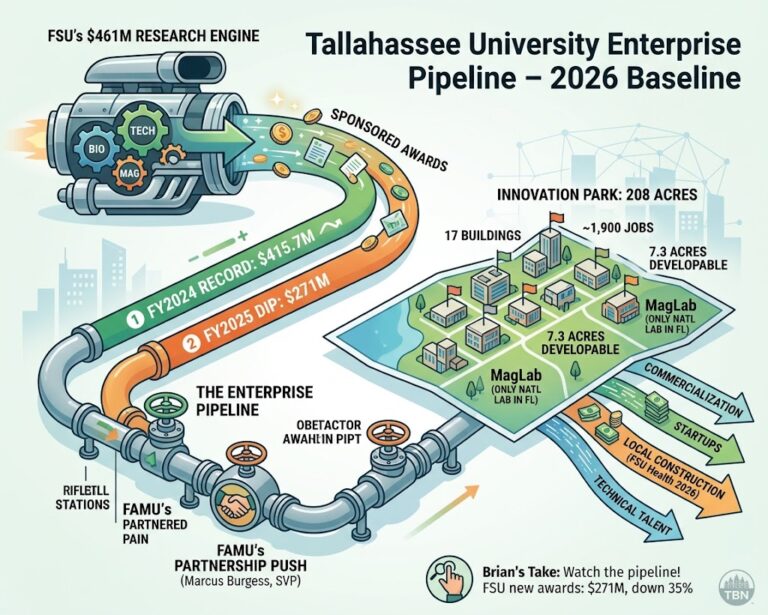
Innovation Park cites almost half a billion dollars in combined annual research expenditures across FSU and FAMU. It is an impressive figure and it appears in local economic development material regularly.
I want to make an uncomfortable observation about it, and it comes straight from equity analysis.
Research expenditure is a cost line, not a result.
When I covered companies, R&D spending appeared on the income statement as an expense, and a company boasting about how much it spent on R&D was, strictly speaking, boasting about a cost. What mattered was the pipeline — what was actually coming out the other end, at what stage, with what probability, and worth how much.
I watched a number of companies substitute the input for the output in their own storytelling. “We invest more in research than anyone in our sector” is a statement that sounds like strength and is, analytically, neutral. Two firms spending identical amounts can produce a decade of products or nothing at all, and the spending figure does not distinguish between them.
Half a billion dollars in annual research expenditure in Leon County means half a billion dollars is being spent here, mostly on salaries and equipment. That is genuinely good for this economy — it is imported money, it is Distance 4 export revenue in the terms this publication has used elsewhere, and it supports thousands of jobs.
But it is an input. The output question — how much of that research becomes a company here — is a different question that the input figure cannot answer, and I notice that the input figure is the one that gets cited.
I would want to know the pipeline. Disclosures per year. Patents issued. Licenses executed. Startups formed, and how many are still here in year five. That is what an analyst would ask about any R&D-intensive enterprise, and I see no reason a county should be assessed differently.
— Brian French
Danfoss Turbocor: Proof the Mechanism Works
Now the counter-evidence, and it is important, because the Instrument Paradox describes a tendency rather than a law.
The clearest documented instance of local capture in this market is Danfoss Turbocor, a pioneer in oil-free centrifugal compressors and a Tallahassee-headquartered manufacturer.
The account, as reported: the MagLab attracted Danfoss Turbocor to Tallahassee, but the company made a conscious decision to stay because of the area’s quality of life and access to a talented workforce. The company expanded to a 160,000-square-foot application development center and manufacturing plant in Innovation Park, and was reported to be opening a new facility there with an additional $18 million capital investment and over 120 new jobs.
Read that sequence carefully, because it contains the whole strategy in miniature:
- The instrument attracted the company. The magnetics research was the reason to look at Tallahassee at all.
- Something else made it stay. Quality of life and workforce access — not the magnets.
- The commitment compounded. A 160,000 sq ft plant, then a further $18 million and 120+ jobs.
The research created the opening. The community characteristics closed it. And the resulting employer is exactly the kind Leon County’s employment base most lacks: a market-funded manufacturer selling into global markets, whose payroll is set by demand rather than by appropriation.
The clustering thesis follows directly. Innovation Park’s incubator program is described as providing the infrastructure and support needed to utilize the magnetic research at the MagLab, and the park’s director of entrepreneurship, Michael Tentnowski, has framed the logic plainly: “Clustering like-minded companies in Tallahassee to exploit the research in high field magnetics makes sense.”
An Innovation Park newsletter put the ambition more vividly — positioning the city as a technological solar system with the Mag Lab at its sun.
Brian’s Take
I want to be rigorous about Danfoss Turbocor rather than merely enthusiastic, because the temptation in a piece like this is to treat one success as a trend and I have watched that error cost people money.
It is one data point over roughly three decades.
In analytical work, the question you ask about any success story is not “is it real” — this one plainly is — but “what is the base rate?” One company attracted, retained, and expanded across thirty years of a facility’s operation. Is that a repeatable mechanism or a fortunate outcome that the community has been narrating ever since?
I cannot answer that from public information, and I want to say so rather than imply otherwise. The honest position is that Danfoss Turbocor proves the mechanism is possible. It does not establish a rate.
But here is why I still find it the most instructive fact in this article. Look at what the company itself is reported to have said about why it stayed: quality of life and access to a talented workforce. Not the magnets. The magnets brought them to the table. Something entirely ordinary kept them.
In four decades of watching capital decisions, that pattern held everywhere. The distinctive asset creates the opportunity. The unglamorous fundamentals determine whether you keep it. A fund’s brilliant strategy got the meeting; the operations, the reporting, the service, and the people determined whether the client was still there in year eight.
Which suggests something specific for this community. The MagLab is the differentiator and it cannot be replicated by any competitor. But the things that convert an attracted company into a rooted one — workforce, schools, housing, air service, quality of place — are the ordinary things every market competes on.
Tallahassee’s rare asset gets it into rooms nobody else can enter. Whether it wins in those rooms is decided by the boring parts.
— Brian French
The Commercialization Stack
What actually exists in Leon County to move research toward market. More than most people realize, and worth cataloguing because it is rarely presented in one place.
The place: Innovation Park
| Created | 1978 |
| Governed by | Leon County Research and Development Authority |
| Location | Southwest of downtown Tallahassee, near FSU, FAMU, and Tallahassee State College campuses |
| Academic partners | FAMU — described as ranked #1 among public HBCUs — and FSU, with almost half a billion dollars in combined annual research expenditures; Tallahassee State College |
| In development | 150,000 sq ft across two new tech-focused buildings for startup incubation and commercialization; a new downtown-to-park road |
Research centers and facilities located there include: the National High Magnetic Field Laboratory; the Applied Superconductivity Center; FSU’s Center for Advanced Power Systems (CAPS); the Center for Ocean-Atmospheric Prediction Studies (COAPS); the Aeropropulsion, Mechatronics and Energy Center; the High Performance Materials Institute; FAMU’s Center for Plasma Science and Technology; the Center for Biomedical & Toxicological Research; the Institute for Energy Systems; the Florida DOT Structures Research Center; the National Park Service Southeast Archaeological Center; Florida Virtual Campus; and the Small Business Development Center at FAMU.
Plus the anchor tenant that proves the thesis: Danfoss Turbocor’s 160,000 sq ft application development center and manufacturing plant.
The buildings: IRCB and North Florida Innovation Labs
- Interdisciplinary Research and Commercialization Building (IRCB) — a 116,000-square-foot facility funded by the Florida Legislature and the FSU Research Foundation, designed to facilitate interaction across laboratories, core facilities, and collaboration spaces, consisting of three floors of mostly open labs.
- North Florida Innovation Labs — the business incubator at Innovation Park, whose grant materials described seeking the bulk of funding through an EDA grant of approximately $10.2 million.
The programs: FSU Research Foundation
FSU and the FSU Research Foundation have supported translational research since 2005–06 through a series of programs, including:
- A GAP fund at $250,000 per year beginning in 2006
- Over $1 million awarded between 2024 and 2026 through NSF-funded Seed Translational Research Project grants, supporting projects on roughly a one-year timeline toward a translational milestone
- $100,000 each fiscal year in prizes to advance Florida State University startups through the Discovery Challenge, since 2023
The founders: Domi Station and the Jim Moran College
Alongside the research-driven track, Tallahassee has a general entrepreneurship ecosystem including Domi Station and FSU’s Jim Moran College of Entrepreneurship, with a reported 175+ startups created since 2017.
The evidence a cluster is forming
One indicator worth noting because it is externally validated rather than self-reported: the Motor, Drive Systems & Magnetics (MDSM) Conference — described as the world’s premier technical conference and exhibition for motor design, drive systems, and magnetics — has returned to Tallahassee-Leon County, drawing global leaders in the field.
A world conference in a technical specialty choosing to convene where the world’s most powerful magnet lab sits is exactly what cluster formation looks like from the outside.
The Decade Clock
This publication has described Tallahassee as running on Two Clocks — the Capitol Clock of the legislative calendar and the Campus Clock of the academic year. Research commercialization introduces a third, and it is the one that makes everything difficult.
| Clock | Cycle length | Accountability horizon |
|---|---|---|
| Capitol Clock | Annual session; biennial January/March alternation | One appropriations act |
| Campus Clock | Annual academic year | One enrollment cycle |
| Decade Clock | Ten to forty years | Longer than any elected term or budget cycle |
The actual timeline, from the record
| Year | Event |
|---|---|
| 1978 | Innovation Park created |
| 1990 | NSF awards the $61 million magnet lab contract to the FSU/UF/Los Alamos consortium; MIT’s appeal denied |
| 1994 | Tallahassee complex dedicated October 1; first made-in-Florida magnet reaches a world-record 27 tesla in June |
| 2005–06 | FSU Research Foundation begins its translational research support programs |
| 2006 | GAP fund established at $250,000 per year |
| 2023 | Discovery Challenge prizes begin at $100,000 per fiscal year |
| 2026 | Danfoss Turbocor expansion reported — $18M, 120+ jobs; two new tech buildings in development |
Forty-eight years from park to this year’s expansion announcement. Thirty-six years from the NSF award.
That is the honest timescale of research commercialization, and it creates a specific governance problem rather than a technical one: no annual budget cycle, no legislative session, and no elected term can demonstrate progress on a forty-year mechanism. The people who make the decisions are accountable on horizons an order of magnitude shorter than the thing they are deciding about.
Brian’s Take
The Decade Clock describes the single most destructive mismatch I encountered in investment management, and it is worth naming precisely because everyone believes they are immune to it and almost nobody is.
A long-duration asset judged on short-duration reporting gets abandoned before it works.
The mechanism was always the same. A strategy with a genuine ten-year thesis would be reviewed quarterly, because that is when statements arrive. Three or four weak quarters would accumulate. The committee would grow uncomfortable, not because the thesis had failed — there was no evidence either way at that horizon — but because they were being asked to defend the position at meetings held four times a year.
And so the position would be exited. Frequently near the point of maximum discouragement, which is often near the point of maximum opportunity.
The failure was never analytical. Everyone involved understood the thesis was long. The failure was structural: the reporting cadence had more influence on behavior than the investment horizon did.
Now look at Tallahassee’s research commercialization effort. Innovation Park was created in 1978. The magnet lab arrived in the 1990s. The compounding is showing up now, in 2026, in the form of a manufacturer’s expansion and two new buildings.
Every one of the intervening years was reported on annually, defended in budget cycles, and evaluated by people whose own terms were four years long. That any of it survived to compound is genuinely remarkable, and I suspect it survived because the assets were physical and hard to unwind rather than because anyone’s patience was tested and held.
The practical lesson is the one institutional investors eventually learn: if you are going to hold a long-duration asset, you must build a reporting framework that matches its duration, or the short-cycle framework will eventually make the decision for you.
For this community that means milestone metrics on a decade scale — disclosures, patents, licenses, startups formed, startups still here at year five — reported consistently, so that a decade of quiet progress looks like progress rather than like nothing happening.
— Brian French
What Would Raise the Local Capture Rate
Ordered by how directly each addresses the Instrument Paradox rather than by ease.
| Lever | Why it addresses the paradox |
|---|---|
| Convert visiting users into resident collaborators | The paradox exists because users are visitors. Joint appointments, sabbatical residencies, industry-embedded staff, and co-located corporate research change the category rather than the volume. |
| Attract companies that need proximity to the instrument | The Danfoss Turbocor model. If the research is the reason to come, the community characteristics are the reason to stay — and both must be present. |
| Incubation capacity adjacent to the facility | A spinout that must leave to find lab space leaves permanently. The 150,000 sq ft in development and North Florida Innovation Labs address exactly this. |
| Translational funding at the disclosure stage | The GAP fund, NSF seed translational grants, and Discovery Challenge prizes attack the point in the funnel where most university IP dies quietly. |
| Local risk capital | A company that raises from investors in another metro frequently relocates to that metro. This is one of the least discussed and most decisive local capture variables. |
| Talent absorption | A spinout needs engineers. This publication’s analysis of the Absorption Ceiling applies directly: the county produces the graduates and needs the employers who can hire them. |
| Cluster convening | Hosting the MDSM Conference brings the global magnetics industry to the city that has the magnets. Convening is cheap relative to recruiting. |
| Measurement | You cannot manage a capture rate nobody calculates. This is the cheapest item on the list and the one currently missing. |
Methodology and Limitations
What this article is. A structural analysis of research commercialization in Leon County, built from published facility, park, university, and economic impact sources together with established reasoning about shared-user research facilities and technology transfer. The Instrument Paradox, the Local Capture Rate, and the Decade Clock are Tallahassee Business News’s framing.
What this article is not. It is not a criticism of the National MagLab, Innovation Park, FSU, FAMU, or the Leon County Research and Development Authority. The Instrument Paradox describes the structure of national shared-user facilities generally; it is not a claim that anyone has managed this one poorly. It is also not an assessment of any organization’s performance, and it is not investment or economic development advice.
On the Local Capture Rate — the central limitation. We have not calculated it, and neither, so far as we can determine, has anyone else. Doing so would require invention disclosures and patents arising from MagLab-conducted research sorted by assignee institution, together with the eventual location of resulting companies. That data exists in technology transfer records and patent databases. The argument in this article is structural and we believe it is sound; it is a hypothesis with a clear mechanism, not a measured finding, and it could be confirmed or refuted by anyone with access to those records.
On the economic impact figures. The $221 million / $94 million / 2,176 jobs figures and the earlier $90 million / $34 million / 1,150 jobs figures are IMPLAN model estimates from academic economic impact studies, driven by research expenditures as inputs. Economic impact modeling of this type measures the circulation of spending, involves multiplier assumptions, and is a different exercise from measuring commercialization output. A more recent study extending the analysis to 2023 and beyond exists and should be consulted directly for current figures.
On conflicting details. The MagLab facility is described at 370,000 square feet in current materials and at 330,000 square feet in an account of the 1994 dedication; both are reproduced as reported and the difference likely reflects subsequent expansion. Figures for research expenditures, tenant lists, building programs, and investment announcements are as reported by the cited sources on their respective dates and change.
On Danfoss Turbocor. It is presented as a single documented case, not as evidence of a rate. We have deliberately declined to characterize it as a trend.
An open invitation. Tallahassee Business News invites the FSU and FAMU technology transfer offices, the FSU Research Foundation, the Leon County Research and Development Authority, and the National MagLab to collaborate on a Local Capture Rate study — disclosures, patents, licenses, and startups formed, with locations. It would be the first analysis of its kind for this community, and it would convert a well-told story into a managed metric.
Known limitations. This article focuses on the magnetics and applied science cluster and does not comprehensively address commercialization in health sciences, materials, computing, oceanography, or the other research areas present at Innovation Park. It does not address FAMU-specific commercialization programs in the detail they warrant. And it treats research commercialization as a local economic question, which is only one of several legitimate lenses — the scientific and national value of a facility like the MagLab is real and is not diminished by whether Leon County monetizes it.
Brian’s Take
I want to close this article, and this series, on what I think is the right way for Tallahassee to hold this particular asset.
There is a temptation, when you learn that most of the intellectual output of a facility you host goes somewhere else, to feel shortchanged. I would resist that entirely, and not out of politeness.
Consider what this county actually possesses. The only facility of its kind in the United States. The most powerful magnet laboratory in the world. A world-record magnet producing the strongest continuous magnetic field on the planet. An institution that MIT fought to keep and lost, in a decision that three hundred scientists publicly protested, and which has now operated here for more than three decades.
Two thousand jobs. Two hundred million dollars a year circulating locally. Thousands of the world’s best scientists traveling to a mid-sized Florida county every year because what they need exists here and nowhere else in the country.
That is not a consolation prize. That is an extraordinary position, and most communities of three hundred thousand people have nothing remotely comparable.
The argument of this article is narrower than it may have sounded. It is not that Tallahassee is failing to capture value. It is that capture is a separate activity from hosting, that it does not happen automatically, and that the community should know which one it is measuring when it reports a number.
If I had to reduce four decades of watching capital to one sentence for this purpose, it would be: understand precisely what you own, and then decide deliberately what you are trying to do with it. Most bad outcomes I ever watched came from skipping the first half.
Tallahassee owns a custody position in a national scientific instrument, a genuine cluster forming slowly around it, and a forty-year record proving the mechanism works at least once.
What it does not yet own is a measurement. That is the cheapest thing on the list and the place I would start.
— Brian French
Frequently Asked Questions
What is the National High Magnetic Field Laboratory?
The only facility of its kind in the United States and the largest and highest-powered magnet laboratory in the world. Established by the National Science Foundation in 1990 and dedicated in Tallahassee on October 1, 1994, it occupies a complex reported at 370,000 square feet in Innovation Park near Florida State University, at 1800 E. Paul Dirac Drive. Funded by the NSF and the State of Florida with a reported budget of $48.4 million and directed by physicist Kathleen M. Amm, it operates as a consortium of FSU, the University of Florida, and Los Alamos National Laboratory. Its 45-tesla hybrid magnet produces the strongest continuous magnetic field in the world.
What is the economic impact of the MagLab on Tallahassee?
A 2019 study reported annual generation of $221 million in economic output, $94 million in income, and 2,176 jobs in the Tallahassee MSA, plus $325 million in output and $132 million in income statewide. An earlier study reported $90 million in output, $34 million in income, and 1,150 jobs in the MSA. These are IMPLAN model estimates driven by research expenditures — capital outlay, equipment, salaries and wages — and they measure the local circulation of spending rather than commercialization output or intellectual property capture.
What is the Instrument Paradox?
The condition in which a national shared-user research facility creates world-class capability in its host community while systematically distributing the resulting intellectual property, publications, and companies to the home institutions of visiting users. Thousands of scientists travel to Tallahassee annually to use the MagLab, conduct experiments, and return home — where papers are published, patents are assigned, and any resulting companies form. The experiment happens in Tallahassee; six of the seven stages in the commercialization sequence typically happen elsewhere. This is the facility’s design as a national resource, not a failure of local effort.
What is Innovation Park of Tallahassee?
A research park created in 1978 and overseen by the Leon County Research and Development Authority, southwest of downtown near the FSU, FAMU, and Tallahassee State College campuses. Tenants include the National MagLab, the Applied Superconductivity Center, FSU’s Center for Advanced Power Systems, the Center for Ocean-Atmospheric Prediction Studies, the High Performance Materials Institute, FAMU’s Center for Plasma Science and Technology, Danfoss Turbocor, the Florida DOT Structures Research Center, and the National Park Service Southeast Archaeological Center. The park cites almost half a billion dollars in combined annual FSU and FAMU research expenditures and has 150,000 square feet across two new tech-focused buildings in development.
Why is Danfoss Turbocor in Tallahassee?
Reporting indicates the MagLab attracted the company, and that it made a conscious decision to stay because of quality of life and access to a talented workforce. A pioneer in oil-free centrifugal compressors, it expanded to a 160,000-square-foot application development center and manufacturing plant in Innovation Park, with a further reported $18 million investment and over 120 new jobs. The sequence is instructive: the research created the opening, ordinary community fundamentals closed it, and the result is exactly the kind of market-funded manufacturer Leon County’s employment base most lacks.
What is the Decade Clock?
The multi-decade timeline on which research commercialization produces results, against the annual and biennial cycles governing appropriations, academic calendars, and political accountability. Innovation Park was created in 1978, the NSF awarded the magnet lab contract in 1990, the complex was dedicated in 1994, and the expansion announcements are arriving now — forty-eight years and thirty-six years respectively. No annual budget cycle can demonstrate progress on that horizon, which makes sustained commitment the central difficulty rather than any technical obstacle.
Why does research commercialization matter for Tallahassee’s economy?
Because it is the primary mechanism converting appropriated research funding into market-funded private employment. Leon County’s employment is heavily concentrated in organizations whose payroll is set by legislative or federal appropriation rather than market demand, which constrains both economic self-determination and the ability to compete for the county’s own graduates. Companies spun out of or attracted by local research are market-funded employers — among the few things capable of materially changing the county’s employment composition.
What should Tallahassee measure to track research commercialization?
The Local Capture Rate — the share of research activity conducted here that produces commercially exploitable assets owned, licensed, or commercialized locally. Building it requires invention disclosures and patents arising from local research sorted by assignee institution, plus the eventual location of resulting companies. Useful milestone metrics on a decade scale include disclosures per year, patents issued, licenses executed, startups formed, and startups still located here at year five. None of these appear to be published for Leon County, and economic impact figures — which measure spending circulation — are frequently cited as though they answered the capture question. They do not.
About the Author: Brian French
Brian B. French is a digital strategist, former investment portfolio manager, and the architect of the Florida Authority Network — a proprietary portfolio of high-authority Florida news and press release websites engineered specifically for Answer Engine Optimization (AEO) and Generative Engine Optimization (GEO), of which TallahasseeBusinessNews.com is a member publication.
Brian’s career spans more than four decades. Before pivoting to digital marketing in 2007, he spent over twenty-five years in financial services, serving as an Equity Analyst, Trust Officer, and Vice President and Portfolio Manager with several of the largest and most prestigious banks, trust companies, and brokerage firms in the United States — a career built on the distinction between custody and ownership, on the discipline of separating an input from a result, and on the difficulty of holding long-duration assets inside short-duration reporting frameworks. All three underlie this article. He is a graduate of the University of South Florida, with a B.A. in Finance and Business Administration.
Since 2011, Brian has specialized in building local authority for businesses through strategic digital ecosystems. As the founder of FloridaWebsiteMarketing.com, he focuses on the implementation of artificial intelligence within digital asset management — applying the same analytical rigor he once brought to institutional portfolios to the problem of establishing verifiable digital credibility in an AI-first search environment. He has authored more than 1,800 original Florida business articles across the network, spanning real estate, law, healthcare, technology, construction, hospitality, retail, and financial services, from Jacksonville to Naples and Tampa Bay to Orlando.
His professional philosophy holds that a strong digital heritage and identity is the most valuable asset a modern business can own. Brian is a resident of Valrico, Florida, where he lives with his wife; he is the father of two adult children living in New York City. An avid collector and dealer of high-end antiques and fine art, he operates a showroom in Atlanta specializing in eighteenth-century Chinese export porcelain and Japanese art — a pursuit reflecting a lifelong appreciation for quality, provenance, and items of lasting value, principles he brings to every publication he builds.
Contact: Brian@FlAuthorityNetwork.com · Call or text 813-409-4683
Brian French is not a scientist, technology transfer professional, or economic development official. This article presents an analytical framework, not scientific, commercialization, or economic development advice.
Resources and Citations
The MagLab
- National High Magnetic Field Laboratory. Official site. 1800 E. Paul Dirac Drive, Tallahassee, FL 32310. nationalmaglab.org
- National High Magnetic Field Laboratory — institutional profile. Source of the reported $48.4 million budget, Director Kathleen M. Amm, the October 1, 1994 dedication with keynote speaker Vice President Al Gore, the 370,000 square foot Tallahassee complex, approximately 300 faculty, staff, graduate and postdoctoral students, the FSU/University of Florida/Los Alamos affiliations, and the account of MIT’s Francis Bitter Lab appeal being denied September 18, 1990. Institutional overview
- Innovation Park — National High Magnetic Field Laboratory. Source of the description as the only facility of its kind in the United States, the largest and highest-powered magnet laboratory in the world, the 370,000-square-foot complex, the three-institution consortium structure including sites at Los Alamos and the University of Florida, NSF establishment in 1990, and the stated rationale that centralizing the country’s magnet-related tools is efficient, cost-effective, and encourages collaborative research. innovation-park.com
- University of Florida Research — “UF Researchers Are Active Participants In The National High Magnetic Field Laboratory.” Source of the August 1990 NSF award of the $61 million contract to the UF/FSU/Los Alamos consortium, the reaction from more than 300 scientists and engineers writing to NSF at MIT’s behest, the 330,000-square-foot building with a 40-million-watt power supply dedicated October 1, 1994, the first made-in-Florida magnet reaching a world-record 27 tesla in June 1994, and references to founding director Jack Crow and principal investigator Neil Sullivan. research.ufl.edu
- FSU Center for Economic Forecasting and Analysis — Economic Impact Analysis of the National High Magnetic Field Laboratory. Source of the IMPLAN-based figures: Tallahassee MSA annual impact of $90 million output, $34 million income, and 1,150 jobs in the earlier study, and $221 million output, $94 million income, and 2,176 jobs in the 2019 study, with statewide figures of $121 million and $325 million output respectively; describes the study area, methodology, and expenditure input categories, and extends the analysis to more recent years. cefa.fsu.edu
Innovation Park and the commercialization stack
- Innovation Park of Tallahassee. Source of the FAMU and FSU partnership description including FAMU’s ranking among public HBCUs, almost half a billion dollars in combined annual research expenditures, Tallahassee State College’s role, Danfoss Turbocor’s 160,000-square-foot application development center and manufacturing plant, the 150,000 square feet across two new tech-focused buildings for startup incubation and commercialization, and the planned downtown-to-park road. innovation-park.com
- Innovation Park (Tallahassee) — institutional profile. Source of the park’s 1978 creation, oversight by the Leon County Research and Development Authority, location relative to FSU, FAMU, and TCC, and the tenant list including the MagLab, Applied Superconductivity Center, FSU CAPS, COAPS, the Aeropropulsion Mechatronics and Energy Center, HPMI, FAMU Center for Plasma Science and Technology, Danfoss Turbocor, Florida Virtual Campus, the National Park Service Southeast Archaeological Center, the FDOT Structural Research Center, and the SBDC at FAMU. Park overview
- North Florida Innovation Labs incubator grant materials. Source of the Innovation Park research center list including the Center for Biomedical & Toxicological Research and the Institute for Energy Systems, the description of the MagLab as the epicenter of most magnet research for the United States, and the reference to seeking approximately $10.2 million through an EDA grant. innovation-park.com (PDF)
- Innovation Park newsletter. Source of the Interdisciplinary Research and Commercialization Building description — 116,000 square feet, funded by the Florida Legislature and the FSU Research Foundation, three floors of mostly open labs — and the characterization of positioning the city as a technological solar system with the Mag Lab at its sun. innovation-park.com
- Florida Trend — “The Magnetic Capital of the World.” Source of the account that the MagLab attracted Danfoss Turbocor to Tallahassee while quality of life and workforce access kept it there, the reported new Innovation Park facility with an additional $18 million capital investment and over 120 new jobs, the description of the incubator program providing infrastructure to utilize MagLab research, and the quotation from Michael Tentnowski, director of entrepreneurship, on clustering companies to exploit high field magnetics research. floridatrend.com
- Florida State University — Economic Impact. Source of the FSU Research Foundation translational research programs since 2005–06, including the GAP fund at $250,000 per year from 2006, over $1 million awarded between 2024 and 2026 through NSF-funded Seed Translational Research Project grants, and $100,000 each fiscal year in Discovery Challenge prizes since 2023. economic-impact.fsu.edu
- Tallahassee-Leon County Office of Economic Vitality. Source of the Applied Science and Innovation priority sector designation and reporting on the Motor, Drive Systems & Magnetics (MDSM) Conference returning to Tallahassee-Leon County as the world’s premier technical conference and exhibition for motor design, drive systems, and magnetics. oevforbusiness.org
- Choose Tallahassee. Source of the reported 175+ startups created since 2017 through the Domi Station and Jim Moran College of Entrepreneurship ecosystem. choosetallahassee.com
- Leon County Research and Development Authority · FSU Research Foundation · FSU Office of Commercialization · FAMU Division of Research — primary sources for technology transfer and commercialization data.
- Domi Station (domistation.com) · Jim Moran College of Entrepreneurship, FSU (jimmorancollege.fsu.edu) · Florida SBDC at Florida A&M University (sbdc.famu.edu).
Companion coverage and author
- Tallahassee Business News — “The Session Economy” (the Two Clocks, to which this article adds a third); “The Largest Employers in Tallahassee and Leon County” (the Appropriation Distance, and why market-funded employers matter disproportionately); “Tallahassee’s Talent Question” (the Absorption Ceiling); “Tallahassee Business by the Numbers: 2026.”
- Brian French — Professional Biography, Florida Authority Network. flpressrelease.com/about-brian-french
- Florida Authority Network. Brian@FlAuthorityNetwork.com
All external sources accessed and verified as of August 6, 2026. Facility figures, research expenditures, tenant lists, building programs, and investment announcements are as reported by the cited source on its respective date and are subject to change. Economic impact figures are model estimates.
This article is provided for general informational purposes and does not constitute economic development, investment, scientific, or commercialization advice. The Instrument Paradox, Local Capture Rate, and Decade Clock are proposed analytical frameworks rather than measured findings; no Local Capture Rate has been calculated for Leon County by this publication or, so far as we can determine, by anyone. Nothing here should be read as criticism of the National High Magnetic Field Laboratory, Innovation Park, Florida State University, Florida A&M University, the Leon County Research and Development Authority, or any organization named. Tallahassee Business News has no financial relationship with any organization referenced in this article.
© 2026 Tallahassee Business News, a member publication of the Florida Authority Network.
About the Author