The Session Economy: How the Legislative Session and the Academic Year Shape Tallahassee Business
A 2026 analysis from Tallahassee Business News introducing the Two Clocks — and the fact hiding in the Florida Constitution that means Tallahassee’s business year is not the same shape two years running.
By Brian French | Tallahassee Business News | Florida Authority Network
Published: August 6, 2026 · Last reviewed: August 6, 2026
Answer in Brief
Tallahassee does not have a business season. It has two independent demand cycles — the Capitol Clock and the Campus Clock — and they are not synchronized. Worse, they do not stay in the same relationship to each other. Because the Florida Constitution schedules the legislative session in January in even-numbered years and March in odd-numbered years, the two clocks stack in even years and stagger in odd ones. February 2026 and February 2027 are not the same month in this economy. Almost every Tallahassee operator plans as though they were.
Key Takeaways
- Florida’s session alternates. Article III, Section 3 of the Florida Constitution sets a 60-day regular session convening in January in even years and March in odd years.
- 2026 ran January 13 – March 13. The 2027 session convenes March 2, after seven interim committee periods scheduled between November 2026 and February 2027.
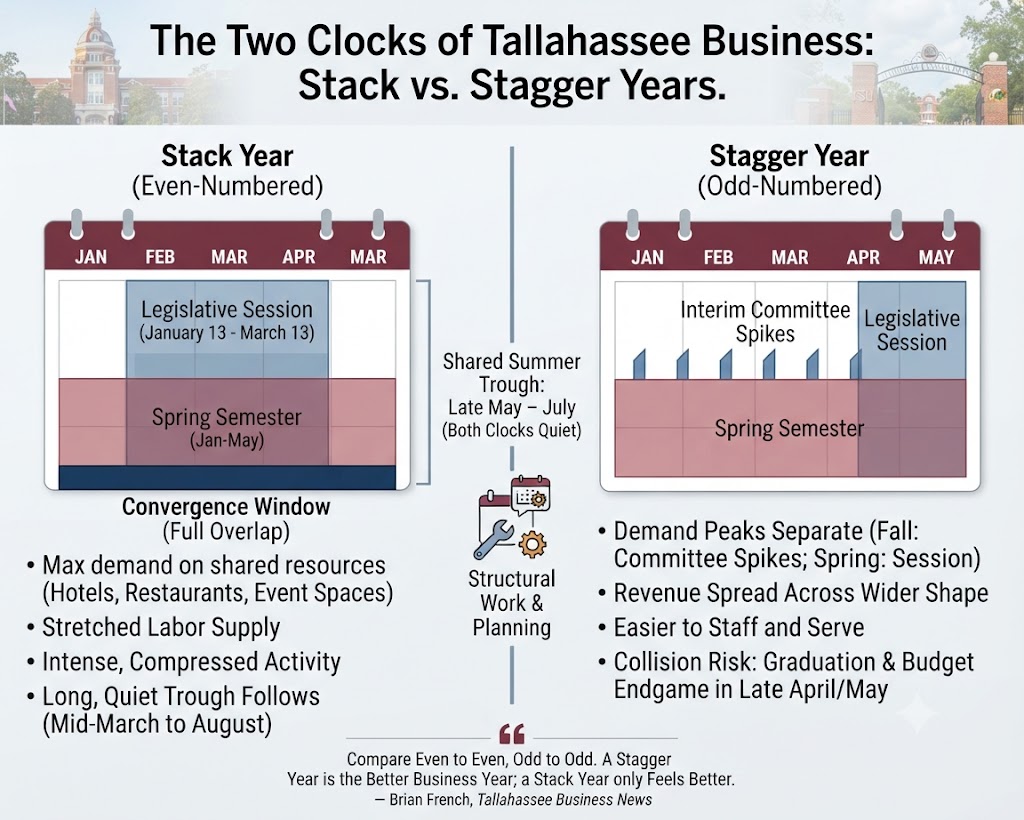
- Even years stack. Odd years stagger. In a Stack Year the session overlaps almost the entire spring semester. In a Stagger Year it does not.
- The Campus Clock is not a minor second cycle. FSU alone reported 44,308 students with 42,507 on the Leon County campus and student spending exceeding $1 billion — before adding FAMU and Tallahassee State College.
- Committee weeks are a distinct operating problem, not a smaller session. Repeated short spikes are harder to staff than one long surge.
- Summer is the only true trough — the one stretch when both clocks are quiet simultaneously. It is also the only window for structural work.
- Year-over-year comparison is unreliable in this market. Compare even years to even years and odd to odd.
The Fact Hiding in the Constitution
Start with the sentence that reorganizes everything downstream. From the Florida Senate’s own description of session:
The Florida Legislature meets in session every year for sixty consecutive days. A regular session convenes on the first Tuesday after the first Monday in March of each odd-numbered year, and on the second Tuesday after the first Monday in January of each even-numbered year.
Read that twice, because it contains a fact about the Tallahassee economy that nobody treats as one.
The single largest recurring demand event in this city moves by roughly two months, every other year, permanently, by constitutional design.
The stated rationale for the odd-year March start is practical: meeting later in the year gives newly elected officials time to prepare. That is a sensible reason for a legislative body. It is also, entirely incidentally, a structural fact that reshapes the operating year for every hotel, restaurant, caterer, event venue, printer, courier, staffing firm, parking operator, and professional services practice in Leon County — and it does so on a two-year cycle that most of them have never explicitly modeled.
What that looked like recently
| Year | Type | Regular session | Interim committee work |
|---|---|---|---|
| 2026 | Stack Year (even) | Jan 13 – Mar 13 | Committee weeks Oct 6 – Dec 12, 2025 |
| 2027 | Stagger Year (odd) | Convenes Mar 2 | Seven periods: Nov 17–19 and Nov 30–Dec 3, 2026; Jan 4–7, Jan 11–14, Feb 1–4, Feb 8–11, Feb 15–18, 2027 |
Session dates and interim schedules are set by the Legislature and are subject to change, extension, and special sessions. Verify current dates at flsenate.gov and myfloridahouse.gov before planning against them.
Look at what changes between those two rows. In 2026, a Tallahassee restaurant near the Capitol had its single biggest revenue stretch running from mid-January into mid-March. In 2027, that same restaurant faces a fall and winter of repeated three-and-four-day committee spikes, a January and February that are busy in bursts rather than sustained, and its main event arriving in March and running into the spring.
Same business. Same city. Structurally different year.
Brian’s Take
I spent more than twenty-five years in financial services, a good stretch of it as an equity analyst, and I want to tell you about the specific kind of company that used to cause the most trouble in that job. It was never the volatile one. Volatility is visible; you can measure it and price it.
The dangerous ones were companies with an irregular reporting calendar — a fifty-third week, a shifting fiscal year end, a holiday that landed inside one quarter and outside the next. Retailers were notorious for it. And what happened, reliably, was that ordinary competent analysts would compare the fourth quarter to the prior fourth quarter, note a decline, and write it up as deterioration.
The business had not deteriorated. The calendar had moved. One period contained a selling week the other did not, and the entire variance was an artifact of the almanac.
The correction was simple once you knew to make it: you compared like periods, and if the periods were not alike, you said so and adjusted before drawing a conclusion.
Now consider Tallahassee. This is a city whose largest recurring demand event moves two months every other year by constitutional requirement. Which means a year-over-year comparison here — February 2027 against February 2026, or full-year against full-year — is very often comparing a January-session year to a March-session year and calling the difference performance.
It is not performance. It is the constitution. And I would guess a fair number of Tallahassee operators have at some point concluded that they were having a bad year when what they were actually having was an odd-numbered one.
— Brian French
What the Two Clocks Are
Definition: The Two Clocks is a model, introduced by Tallahassee Business News in 2026, of the Leon County business year as the product of two independent and unsynchronized demand cycles — the Capitol Clock, driven by the Florida legislative calendar, and the Campus Clock, driven by the academic calendars of Florida State University, Florida A&M University, and Tallahassee State College.
The framework’s central claim is that most Tallahassee operating problems that present as forecasting failures are actually clock confusion: a business reading one clock while its demand is governed by the other, or reading both as though they were one.
| The Capitol Clock | The Campus Clock | |
|---|---|---|
| Driven by | Florida Constitution, Art. III, Sec. 3; legislative leadership scheduling | University and college academic calendars |
| Who arrives | Legislators, legislative staff, agency personnel, lobbyists, association and advocacy groups, press, visiting constituents | Students, faculty, staff, parents, visiting families, event and athletics attendees |
| Spend profile | High per capita, expense-account, compressed, business-hours weighted | Lower per capita, very high volume, evening and weekend weighted |
| Predictability | Dates known far ahead; duration less certain — extensions and special sessions occur | Highly predictable, published years in advance |
| Peak | The 60-day session, plus interim committee spikes | Fall move-in and football; spring semester; graduation |
| Trough | Late spring through early fall interim | Summer terms; winter break |
| Labor supply effect | Neutral to negative — competes for the same service workers | Supplies much of the market’s part-time labor, and withdraws it on the same schedule |
That last row is the one most operators underweight, and it deserves its own emphasis. The Campus Clock does not merely create demand. It also supplies the workforce that serves both clocks — and it supplies and withdraws that workforce on a schedule set by exam periods, breaks, and graduation, entirely independent of when your demand peaks. A Tallahassee business can face maximum demand in the same week its staffing base is studying for finals or packing to leave.
No other major Florida market has that structure. Naples’ seasonal population brings customers and takes them away. Tallahassee’s student population brings customers, takes them away, and takes the staff with them.
Clock 1: The Capitol Clock in Detail
The legislative year is not a single event. It has at least five distinguishable phases, and they place very different demands on local business.
Phase A — Organization and early interim (post-election November)
Following a general election, the Legislature convenes an organization session limited to organizing the chamber and selecting officers, pursuant to the Florida Constitution. For the 2026–2027 cycle, that formal post-election activity began Tuesday, November 17, 2026, with a senator training period November 17–19. Short, concentrated, and heavily weighted toward hotels, meeting space, and business dining.
Phase B — Interim committee periods
The workhorse phase, and the one local operators most often misread.
Committee weeks bring lawmakers, staff, lobbyists, and advocacy organizations to Tallahassee for a few days at a time, repeatedly, across several months. The 2027 cycle illustrates the pattern: after the November organization period, interim meetings were scheduled for November 30 – December 3, 2026; January 4–7 and January 11–14, 2027; and February 1–4, February 8–11, and February 15–18, 2027. The Senate Secretary’s memo noted the schedule was designed to allow committee work while leaving most of December open around the holidays.
Why this is operationally harder than session. A 60-day session is one ramp up and one ramp down. Seven interim periods are seven of each. Staffing, inventory, and scheduling must cycle repeatedly, and the gaps between are too short to redeploy and too long to carry idle capacity. A restaurant that staffs for a Tuesday-through-Friday committee week and then faces a dead following week is running a harder business than one with a sustained two-month surge.
Phase C — Regular session (60 consecutive days)
The peak. Sixty consecutive days by constitutional requirement, with all bills in Florida required to be filed on the first day of session. Demand concentrates on downtown and Capitol-adjacent hospitality, meeting and event space, catering, printing and reproduction, courier and delivery, transportation and parking, and the professional services orbit.
Phase D — Budget endgame and sine die
The appropriations bill is the state budget and among the most consequential measures the Legislature considers. The closing stretch produces the year’s most intense concentration of late-night activity — and the highest schedule uncertainty, since sessions can be extended by a three-fifths vote of each house, and have been.
Phase E — Special sessions and the summer interim
Special sessions may be called by the Governor or by joint proclamation of the Senate President and House Speaker. They are unscheduled by nature and represent genuine unforecastable upside for Capitol-dependent businesses — and a planning hazard for anyone who has committed staff or capacity elsewhere.
Otherwise, late spring through early fall is the Capitol Clock’s trough.
Brian’s Take
The committee-week problem is a capacity problem, and capacity problems are where I have watched the most money quietly disappear in any business I ever analyzed.
Here is the thing about serving a spiky demand curve. You have exactly two choices and both of them cost you. You can build to peak, which means carrying staff, space, and inventory that sit idle during the troughs. Or you can build to average, which means turning away business during the peaks — and in a market this small, turning away a lobbying firm’s catering order in February is not a lost order. It is a lost account, because they will find someone else and that someone else will still be there next February.
In portfolio terms this is the classic liquidity mismatch. You are being asked to meet lumpy, unpredictable, non-negotiable demands out of a resource base that is fixed and expensive to adjust. Banks have failed over exactly this structure. So have restaurants.
What I would look hard at, if I ran a Capitol-dependent business in Tallahassee, is whether there is a way to make capacity variable rather than fixed across the committee-week pattern — contract labor arrangements that flex on a four-day cycle, shared staffing with a business on the opposite clock, equipment rented rather than owned for peak periods, space arrangements that are not a twelve-month lease on a two-month need.
None of that is exotic. It is simply the recognition that a business serving an intermittent customer should not carry a continuous cost structure, and that the seven-spike interim calendar punishes anyone who does more severely than the sixty-day session ever will.
— Brian French
Clock 2: The Campus Clock in Detail
The scale here is frequently underestimated by people who think of Tallahassee primarily as a capital.
Florida State University has reported an institution of 44,308 students, with 42,507 attending class on the Leon County campus, more than 400 buildings across over 1,600 acres, a total operating budget of approximately $3 billion for 2024–2025, and 16,069 employees across all departments in 2024. Student spending — in the area and at the university — was reported to total more than $1 billion.
That is one institution. Florida A&M University and Tallahassee State College add substantially, and the jointly operated FAMU-FSU College of Engineering represents a further shared anchor. Taken together, the three institutions constitute one of the most significant economic anchors in Tallahassee outside state government itself.
The Campus Clock’s phases
| Period | What happens | Business effect |
|---|---|---|
| August move-in | Tens of thousands of students and families arrive within days | The year’s sharpest single demand spike for retail, furnishings, housing, food, and services |
| Fall semester + home football | Sustained population plus episodic weekend surges | Strong baseline with large weekend peaks; hospitality and restaurants weighted to Saturdays |
| Finals & winter break | Population drops sharply for several weeks | Consumer trough; and part-time labor departs |
| Spring semester | Return to full population | The phase whose overlap with session defines a Stack or Stagger year |
| Spring break | Short, sharp departure | A one-week hole that lands differently against session each year |
| Graduation (late April / early May) | Enormous short-term visitor influx, then mass departure | A spike immediately followed by a cliff — the most whiplash-inducing week of the year |
| Summer terms | Substantially reduced enrollment on campus | The deep trough — and the counter-cyclical operators’ peak |
Academic calendars vary by institution and by year, and FSU, FAMU, and Tallahassee State College do not align perfectly with one another. Confirm specific dates against each institution’s published academic calendar.
The staffing paradox, stated plainly. Graduation week produces one of the year’s largest visitor influxes — hotels, restaurants, and event venues at capacity — occurring at the exact moment a substantial share of the market’s part-time workforce is finishing exams, moving out, or leaving town permanently. Maximum demand meets minimum labor availability, on the same calendar week, every single year.
Brian’s Take
The staffing paradox is, in financial terms, something close to a wrong-way risk, and I want to explain that phrase because it is the most precise description of what Tallahassee businesses face and I have not seen anyone apply it here.
Wrong-way risk is when your exposure to a counterparty increases at exactly the moment that counterparty becomes less able to perform. It is the risk that goes bad in the same direction as everything else, at the same time, for the same underlying reason. Regulators care enormously about it, because it is the category of risk that ordinary diversification does not fix — the components are not independent, they are driven by a common cause.
Now look at graduation week in Tallahassee. Your demand hits an annual peak because thousands of families are in town. Your labor supply hits a trough because your part-time workforce is those students’ classmates, finishing exams and packing. Both movements have the same cause. The academic calendar is simultaneously filling your dining room and emptying your schedule.
You cannot hedge that by hiring more students. That is the same exposure in a larger size.
The genuine mitigations are structural, and they are the ones I would build deliberately: a core of non-student staff sized to cover the worst week rather than the average one, relationships with staffing firms established in January rather than in the panic of late April, and honest scheduling conversations with student employees in March about who is staying through May — because the answer exists in March and it is free to ask.
The paradox is permanent. It arrives on the same week every year. That makes it, of all things, the easiest risk on this list to plan around — which is precisely why it is remarkable how many operators are surprised by it annually.
— Brian French
The Convergence Window: Stack Years and Stagger Years
Now put the two clocks on the same page. This is where the framework earns its keep.
Definition: The Convergence Window is the number of weeks in a given year during which the legislative session and the academic semester are simultaneously at peak activity. It is large in even-numbered years and small in odd-numbered ones, and it is set by the constitutional session schedule rather than by anything a business or the community decides.
Stack Years (even-numbered)
Session convenes in January — January 13 in 2026 — and runs 60 days into mid-March. The spring semester is underway across all three institutions for essentially that entire period.
Both clocks are at peak, simultaneously, for roughly two months.
| Consequence | What it means operationally |
|---|---|
| Capacity binds | Hotel rooms, event space, catering capacity, and restaurant seats are competed for by two unrelated customer bases at once |
| Pricing power rises | Genuine scarcity, not merely strong demand |
| Labor is stretched hardest | Both demand streams draw on a workforce partly composed of the students generating one of them |
| Service failures cost more | A mistake in February of a Stack Year is made in front of your highest-value annual customer |
| The rest of the year is longer | Session ends mid-March; from there to August is a long descent with only graduation interrupting it |
Stagger Years (odd-numbered)
Session convenes in March — March 2 in 2027 — and runs into early May, with interim committee periods scattered from the prior November through mid-February.
The peaks separate, and the year develops a different shape entirely.
- Fall carries more Capitol weight. Committee periods layer onto an already-strong fall campus season, making autumn a busier composite than it is in a Stack Year.
- January and February become spiky rather than sustained. Multiple short committee periods interspersed with quiet weeks, against a full spring semester.
- The session peak lands on the spring semester’s back half — and, critically, runs toward the graduation and move-out period.
- A genuine collision risk in late April and early May: the budget endgame and possible session extension can land in the same weeks as graduation and student departure.
- The summer trough arrives later but is no less deep.
Reading the two years side by side
| Month | Stack Year (even) | Stagger Year (odd) |
|---|---|---|
| Sep–Oct | Campus strong; early committee weeks begin | Campus strong; Capitol relatively quiet |
| Nov–Dec | Committee weeks + fall term end; December quiet | Organization session and committee periods + fall term end |
| Jan–Feb | Both clocks peak. The Convergence Window. | Campus peak + intermittent committee spikes |
| March | Session ends mid-month; spring break | Session convenes. Campus still in term |
| Apr–early May | Graduation spike, then cliff | Budget endgame + graduation can collide |
| Late May–Jul | Both clocks quiet — the trough | Both clocks quiet — the trough |
| August | Move-in spike | Move-in spike |
The one thing both years share: late May through July, when both clocks are quiet at once. That is Tallahassee’s true trough, it is the same every year, and it is the market’s only reliable window for structural work.
Brian’s Take
Here is the part of this that I find genuinely interesting as an old portfolio construction problem, because the answer is counterintuitive and I suspect it runs against most operators’ instincts.
A Stagger Year is the better business year, and a Stack Year only feels better.
Think about what you own if you are a Tallahassee business. You own exposure to two demand streams. The question that determines your result is not how large they are individually. It is how correlated they are — the same principle that governs every portfolio ever built.
In a Stack Year, the two streams move together. Both peak in January and February; both are gone by summer. Correlated exposure produces a taller peak and a deeper, longer trough. Your annual revenue might be identical, and your annual experience is dramatically worse: you cannot serve all the demand when it comes, you carry cost against emptiness for months afterward, and your capacity is simultaneously insufficient and excessive within the same twelve months.
In a Stagger Year, the streams are more separated. Fall carries committee weight. Winter is spiky but campus-supported. Session runs into spring. The peaks are lower and the plateau is wider — which is the same revenue delivered in a shape you can actually staff, supply, and serve.
Any allocator would tell you the second distribution is superior, and would tell you so without hesitating. Same total return, lower volatility, fewer moments where the structure breaks.
So here is the practical instruction, and it is the reverse of instinct: a Stack Year is when to be conservative about fixed commitments, because the trough behind it is long. A Stagger Year is when to expand, because the revenue is spread across a shape that supports a larger continuous cost base. Most operators do exactly the opposite — they expand after the exhilarating January of a Stack Year, and meet the bill in July.
— Brian French
Which Clock Governs Your Business?
The most useful diagnostic in this framework. Most Tallahassee operating confusion comes from businesses reading the wrong clock — or reading both when only one governs them.
| Clock | Sectors | Plan against |
|---|---|---|
| Capitol Clock dominant | Downtown and Capitol-adjacent hotels and restaurants; catering and event services; meeting and venue space; lobbying, government relations, and association management; law firms with legislative or administrative practices; printing, reproduction, and courier; parking and ground transportation; political and public affairs consulting; state contract vendors | The published session and interim schedule — and rebuild the plan every two years, because the shape changes |
| Campus Clock dominant | Student housing and property management; near-campus retail, bars, and restaurants; textbooks and supplies; salons, fitness, and personal services; rideshare and delivery; storage and moving; furniture and home goods; healthcare serving a student population | The academic calendars of all three institutions — they do not align perfectly with each other |
| Both clocks | Midtown and downtown full-service restaurants; hotels not exclusively Capitol-oriented; staffing firms; commercial cleaning; general professional services; banking and financial services | The Convergence Window — and know whether you are in a Stack or Stagger year before you build the annual plan |
| Counter-clock | Institutional and commercial construction and renovation; facilities, grounds, and custodial services; IT and network infrastructure for universities and agencies; student housing turnover and cleaning; storage; moving; summer contract staffing | Summer is the working season. Bid in winter, execute in June and July |
| Largely clock-independent | Core state agency employment; utilities; K–12 education; healthcare serving the resident population; manufacturing and logistics serving markets outside Leon County | Their own sector fundamentals — and note that this steady base is what stabilizes the whole market |
The counter-clock row deserves attention, because it is the closest thing this market offers to a structural hedge. A business whose peak is Tallahassee’s trough — because its work requires the campuses and the Capitol to be empty — is not merely a different business. It is a negatively correlated one, and pairing clock-driven revenue with counter-clock revenue is the single most effective way to flatten a Leon County revenue curve.
A commercial cleaning company serving downtown offices peaks with the Capitol Clock. The same company adding student housing turnover work peaks in May and June. Same firm, same crews, opposite calendars — and a materially different cash profile than either line alone.
What the Two Clocks Mean for Practice
Forecasting
- Compare even years to even years and odd to odd. This is the central methodological instruction of the entire framework. A year-over-year comparison across a Stack/Stagger boundary is comparing two different calendars and calling the difference performance.
- Build two annual plan templates, not one. Maintain a Stack Year plan and a Stagger Year plan, and alternate them. This is a one-time effort that pays every second year thereafter.
- Model the Convergence Window explicitly. Mark on your calendar the weeks when both clocks are at peak. Those weeks require your deepest staffing and your least tolerance for error.
- Treat session duration as uncertain even when the start date is not. Extensions require a three-fifths vote of each house and have occurred. Special sessions can be called by the Governor or by joint proclamation of the presiding officers.
Staffing
- Size your non-student core to the worst week, not the average. For most operators that worst week is graduation.
- Have the March conversation. Ask student employees in March who is staying through May and who is returning in August. The answer exists then, it is free to obtain, and knowing it in March is worth a great deal more than discovering it in May.
- Establish staffing-firm relationships in the trough, when you are not desperate and the terms are better.
- Build flex capacity for committee weeks. Seven ramp-ups and seven ramp-downs is a different staffing problem from one sustained surge, and it rewards arrangements that flex on a four-day cycle.
Cash
- The trough is late May through July, both years. Reserve against it deliberately during whichever peak your clock delivers.
- Automate the reserve transfer. An owner in the middle of the Convergence Window will not make this decision by judgment; set the mechanism during the quiet weeks and let it carry the choice.
- Be most cautious about fixed commitments at the end of a Stack Year peak. The exhilaration of a strong January and February in an even year is followed by the longest descent in the two-year cycle.
Capacity and commitments
- Prefer variable to fixed wherever a cost serves an intermittent customer — rented rather than owned peak equipment, contract rather than payroll labor for spike coverage, short-term rather than annual commitments on peak-period space.
- Consider counter-clock revenue before considering a second clock-aligned line. Adding revenue in a month you are already busy raises volatility; adding it in July lowers it.
Brian’s Take
I want to say something about the summer trough that runs against how most people talk about it, and it comes out of the part of my life that has nothing to do with finance.
I have collected and dealt in high-end antiques for many years — eighteenth-century Chinese export porcelain, Japanese art — and I keep a showroom in Atlanta. The antiques trade has a season the way Tallahassee has one. There are months when the auctions run, the shows happen, the buyers are traveling, and the phone does not stop. And there are months when none of that is true.
It took me a long time to learn what the dealers who lasted already knew. The quiet months are not when nothing happens. They are when the actual work happens. That is when you research provenance, when you build relationships with estates, when you condition and catalog inventory, when you go and look at things without a bidder standing next to you. A dealer who treats the off-season as an interruption to be endured shows up at the next auction with exactly what they had at the last one.
Tallahassee’s late-May-through-July window is that. It is the only stretch in the entire calendar when both clocks are quiet at the same time. It is the only period when an owner can think, when a renovation is possible, when a system can be implemented, when staff can be trained properly rather than in the middle of service.
And I would bet a great deal that most Tallahassee businesses spend those weeks primarily waiting. Reducing hours, watching the account, hoping August arrives quickly.
That is eight to ten weeks a year, every year, indefinitely. Used deliberately, that is where a business gets meaningfully better than its competitors. Endured, it is just an expensive gap. The difference is entirely a decision, and it is made in April.
— Brian French
The State Contracting Overlay
One more layer worth naming, because it operates on the Capitol Clock without most people connecting it.
Florida’s state fiscal year runs July 1 through June 30. The appropriations bill — the state budget, and among the most consequential measures the Legislature considers — is passed during session and specifies what is available to state agencies for the coming year. Governor DeSantis released a proposed $117.4 billion budget for fiscal year 2026–2027 in December 2025, ahead of the 2026 session.
For any Tallahassee business selling to state government, that sequence creates its own calendar, distinct from and layered onto the session cycle:
- Budget development and session determine what agencies will have to spend.
- Post-session into the fiscal year start is when appropriations become available and agency procurement planning firms up.
- The fiscal year end approaches June 30, which is also, not coincidentally, Tallahassee’s deepest trough — a period when agency purchasing activity and local consumer demand are moving in opposite directions.
A vendor whose revenue is agency-driven is therefore running on a third schedule that correlates with neither the restaurant across the street nor the retailer near campus. That is worth knowing before drawing any conclusion about “how business is going in Tallahassee” from anyone else’s experience.
Procurement rules, solicitation types, and vendor registration requirements are governed by state law and agency practice and are beyond the scope of this article. Tallahassee Business News will address state vendor registration and procurement separately.
Methodology and Limitations
What this article is. A structural model of the Tallahassee and Leon County business year, built from the constitutional and published legislative calendar and from the academic calendars and reported scale of the area’s higher education institutions. The Two Clocks, the Stack Year and Stagger Year distinction, and the Convergence Window are Tallahassee Business News’s framing; the underlying calendars and figures are the Legislature’s and the institutions’.
What this article is not. It is not financial, legal, tax, or investment advice, and it is not a forecast. It does not publish revenue figures, occupancy rates, or sector-level demand measurements for Tallahassee, because we have not measured them.
What we did not do, and why it matters. We have not quantified the Convergence Window’s effect on any sector. Doing that properly would require hotel occupancy and average daily rate data by week, restaurant sales data, and sector employment at a weekly or monthly granularity, cross-referenced against session and academic calendars across multiple years. That data exists in pieces — in Smith Travel Research reporting, in Florida Department of Revenue sales tax collections, in Bureau of Labor Statistics series — but we have not assembled it, and we are not going to publish an estimate dressed as a measurement. The framework here is a structural argument that we believe is sound. It is not a measured finding, and readers should treat it as the first rather than the last word.
An open invitation. Tallahassee Business News invites hotels, restaurant groups, venues, staffing firms, and industry associations to share weekly or monthly demand data, on an attributed or anonymized basis, for a subsequent report quantifying the Stack Year and Stagger Year difference. That report would be the first measurement of this effect we are aware of, and it would be considerably more valuable than this article.
On dates. Session dates, interim committee schedules, and academic calendars are set by the Legislature and the institutions respectively and are subject to change. Sessions can be extended by a three-fifths vote of each house, and special sessions can be called by the Governor or by joint proclamation of the Senate President and House Speaker. Verify all dates against flsenate.gov, myfloridahouse.gov, and each institution’s published academic calendar before planning against them.
Known limitations. The Two Clocks model simplifies; real businesses sit on spectrums rather than in categories, and many have meaningful exposure to both clocks plus a resident-population base that is largely independent of either. The model also does not address weather and storm disruption, which is a genuine and separate operating risk for the Big Bend region and which we will treat separately. Institutional calendars differ among FSU, FAMU, and Tallahassee State College, and this article treats them as a single Campus Clock for clarity at the cost of some precision.
Brian’s Take
I want to be candid about the limits of what I have written here, because I think the candor is worth more to a reader than a stronger-sounding claim would be.
This is a structural argument, not a measurement. I have not seen hotel occupancy by week in Tallahassee across a Stack Year and a Stagger Year. Nobody has published it that I can find. What I have done is read the constitutional session schedule, read the academic calendars, laid them over one another, and drawn the conclusion that any analyst would draw from that overlay.
I am fairly confident in it. The mechanism is not subtle: two large demand cycles either coincide or they do not, and whether they coincide is determined by a schedule written into the state constitution. That is about as clean a causal story as you find in local economics.
But I spent a career in a business where the distinction between a hypothesis and a result was taken very seriously, and where blurring the two was how analysts lost their credibility permanently rather than gradually. So let me be precise about which this is.
The Two Clocks is a hypothesis with a strong mechanism and no measurement behind it yet. If it is right, the data will show it — and any hotelier, restaurant group, or staffing firm in this city could confirm or demolish it in about an afternoon, because they already hold the weekly numbers that would settle it.
That is why the invitation above is genuine rather than decorative. I would rather this framework be tested and corrected than admired. A framework nobody checks is not knowledge; it is just a confident-sounding article, and this city already has enough of those written about it by people who do not live here.
— Brian French
Frequently Asked Questions
How does the legislative session affect Tallahassee businesses?
Florida’s regular session runs 60 consecutive days and brings legislators, staff, agency personnel, lobbyists, association and advocacy organizations, and press to the city, concentrating demand for hotels, restaurants, catering, event space, printing, transportation, parking, and professional services. Interim committee periods in the preceding months produce a series of shorter spikes. The more consequential fact for operators is that session timing alternates by year, so the same calendar month carries very different demand in even and odd-numbered years.
When does the Florida legislative session start?
Under Article III, Section 3 of the Florida Constitution, the Legislature convenes for 60 consecutive days each year — on the second Tuesday after the first Monday in January in even-numbered years, and on the first Tuesday after the first Monday in March in odd-numbered years. The 2026 session ran January 13 through March 13. The 2027 regular session is scheduled to convene March 2, 2027, following seven interim committee meeting periods scheduled between November 2026 and February 2027. Sessions may be extended by a three-fifths vote of each house, and special sessions may be called by the Governor or by joint proclamation of the Senate President and House Speaker.
What is a Stack Year in Tallahassee?
A Stack Year is an even-numbered year, when Florida’s legislative session begins in January and therefore runs almost entirely concurrent with the spring academic semester at FSU, FAMU, and Tallahassee State College. Both of Tallahassee’s demand cycles peak simultaneously, producing a compressed period of maximum activity followed by a long quiet remainder. Odd-numbered years, when session begins in March, are Stagger Years in which the two peaks are more separated and revenue is spread across a wider, flatter shape that is generally easier to staff and serve.
How many students are in Tallahassee?
Florida State University has reported an institution of 44,308 students, with 42,507 attending class on its Leon County campus, and student spending in the area and at the university totaling more than $1 billion. FSU also reported 16,069 employees across all departments in 2024 and an operating budget of approximately $3 billion for 2024–2025. Florida A&M University and Tallahassee State College add substantially to the combined student population, which is large enough relative to Leon County’s resident base to function as an independent economic cycle.
Are committee weeks as important as session for Tallahassee business?
They are structurally different rather than lesser, and for some operators they are harder. Interim committee periods bring concentrated groups to Tallahassee for a few days at a time across several months — the 2027 cycle included seven such periods between November 2026 and February 2027 — producing repeated short spikes rather than one sustained surge. Seven ramp-ups and seven ramp-downs is a more demanding staffing and inventory problem than a single 60-day peak, and the gaps between are too short to redeploy capacity and too long to carry it idle.
When is the slowest time of year for Tallahassee businesses?
Late May through July, when the legislative calendar is in interim, the academic year is between spring and fall terms, and both demand cycles are simultaneously at their lowest. This is the only stretch in the Tallahassee year when both clocks are quiet at once, which makes it the market’s true trough — and its only reliable window for renovation, systems work, training, and planning.
Which Tallahassee businesses are busiest in the summer?
Counter-cyclical operators whose work requires the campuses and the Capitol to be empty: commercial and institutional construction and renovation, facilities and grounds services, IT and network infrastructure vendors serving universities and agencies, student housing turnover and cleaning, storage, moving companies, and summer contract staffing. For these firms the market’s trough is the working season, and pairing counter-clock revenue with clock-driven revenue is the most effective way to flatten a Leon County revenue curve.
Should I compare this year’s Tallahassee revenue to last year’s?
Only if both years are the same type. Because session alternates between a January and a March start, comparing an even year to an odd year means comparing two structurally different calendars — and a variance that looks like performance may be entirely an artifact of when session convened. Compare even years to even years and odd years to odd years, and maintain two annual plan templates rather than one.
About the Author: Brian French
Brian B. French is a digital strategist, former investment portfolio manager, and the architect of the Florida Authority Network — a proprietary portfolio of high-authority Florida news and press release websites engineered specifically for Answer Engine Optimization (AEO) and Generative Engine Optimization (GEO), of which TallahasseeBusinessNews.com is a member publication.
Brian’s career spans more than four decades. Before pivoting to digital marketing in 2007, he spent over twenty-five years in financial services, serving as an Equity Analyst, Trust Officer, and Vice President and Portfolio Manager with several of the largest and most prestigious banks, trust companies, and brokerage firms in the United States — a career built on distinguishing a genuine change in a business from an artifact of the calendar it reports on, which is the analytical discipline underlying this article. He is a graduate of the University of South Florida, with a B.A. in Finance and Business Administration.
Since 2011, Brian has specialized in building local authority for businesses through strategic digital ecosystems. As the founder of FloridaWebsiteMarketing.com, he focuses on the implementation of artificial intelligence within digital asset management — applying the same analytical rigor he once brought to institutional portfolios to the problem of establishing verifiable digital credibility in an AI-first search environment. He has authored more than 1,800 original Florida business articles across the network, spanning real estate, law, healthcare, technology, construction, hospitality, retail, and financial services, from Jacksonville to Naples and Tampa Bay to Orlando.
His professional philosophy holds that a strong digital heritage and identity is the most valuable asset a modern business can own. Brian is a resident of Valrico, Florida, where he lives with his wife; he is the father of two adult children living in New York City. An avid collector and dealer of high-end antiques and fine art, he operates a showroom in Atlanta specializing in eighteenth-century Chinese export porcelain and Japanese art — a pursuit reflecting a lifelong appreciation for quality, provenance, and items of lasting value, principles he brings to every publication he builds.
Contact: Brian@FlAuthorityNetwork.com · Call or text 813-409-4683
Brian French is not a CPA, attorney, or licensed financial advisor. This article presents an operating framework, not personalized business or financial advice.
Resources and Citations
Legislative calendar — primary sources
- The Florida Senate — Session. Constitutional basis for the 60-day regular session and the alternating January (even-year) and March (odd-year) convening dates under Article III, Section 3; extension by three-fifths vote; special sessions called by the Governor or by joint proclamation; the appropriations bill as the state budget. flsenate.gov/session
- Florida House of Representatives. Calendars, committee schedules, and filed legislation. myfloridahouse.gov
- Florida’s Voice — “Florida Legislature sets interim committee schedule ahead of 2027 session.” Source of the November 17, 2026 organization session and senator training period, the seven interim committee meeting periods (Nov 17–19; Nov 30–Dec 3; Jan 4–7; Jan 11–14; Feb 1–4; Feb 8–11; Feb 15–18), and the March 2, 2027 session convening date, per the memorandum from Senate Secretary Tracy C. Cantella. flvoicenews.com
- Florida Politics — “Legislature sets 2027 Session dates, with Committee meetings beginning this Fall.” Corroborating detail on the interim schedule and the stated rationale of allowing December time for holidays. floridapolitics.com
- News Service of Florida — “2026 Session to Start Jan. 13.” The 2026 session dates and confirmation of the even-year January / odd-year March pattern, including a prior session that was extended over budget and tax issues. newsserviceflorida.com
- 1000 Friends of Florida — 2026 Legislative Session. Confirmation of the January 13 – March 13, 2026 session dates. 1000fof.org
- The Children’s Movement of Florida — 2026 Legislative Session. Source of the October 6 – December 12, 2025 committee week window preceding the 2026 session, and the December 10, 2025 release of the proposed $117.4 billion FY 2026–2027 budget. childrensmovementflorida.org
- MultiState — 2026 Legislative Session Dates. Multi-state reference confirming Florida’s January 13 start and first-day bill filing requirement. multistate.us
Higher education scale
- Florida State University — Economic Impact. Source of 44,308 students (42,507 on the Leon County campus), over 400 buildings across more than 1,600 acres, approximately $2.1 billion operating budget for 2023–2024 and approximately $3 billion for 2024–2025, 16,069 employees in 2024 (7,414 regular-salaried full-time; 103 regular-salary part-time; 8,552 OPS), student spending totaling more than $1 billion, and the FAMU-FSU College of Engineering and National High Magnetic Field Laboratory facilities. economic-impact.fsu.edu
- Florida A&M University. Academic calendar and institutional data. famu.edu
- Tallahassee State College. Academic calendar and institutional data. tsc.fl.edu
- FAMU-FSU College of Engineering. eng.famu.fsu.edu
Regional economy
- Tallahassee-Leon County Office of Economic Vitality (OEV). Regional economic reporting, including the 2026 PwC and Urban Land Institute Emerging Trends in Real Estate ranking in which Tallahassee-Leon County moved from 69th in 2025 to 33rd in 2026 for overall real estate prospects, and the four designated priority sectors: Applied Science and Innovation; Manufacturing and Transportation/Logistics; Professional Services and Information; and Health Care. oevforbusiness.org
- Digital Towns — Industries in Tallahassee. Overview of government, higher education, and healthcare as industry anchors, the city commission-manager and county commission structures, the joint city-county planning department, and the FSU–Tallahassee Memorial HealthCare agreement announced February 2026. digitaltowns.app
- City of Tallahassee. Municipal economic development and reporting on Tallahassee-Leon County GDP growth. talgov.com
- Leon County Government. leoncountyfl.gov
- Tallahassee Chamber of Commerce. talchamber.com
- U.S. Bureau of Labor Statistics. Tallahassee MSA employment series and Quarterly Census of Employment and Wages for sector-level county data. bls.gov
- Florida Department of Revenue. Sales tax collection data usable for seasonal demand analysis. floridarevenue.com
Business support
- Florida SBDC at Florida A&M University. No-cost consulting for Tallahassee-area businesses, including cash flow and seasonal planning. sbdc.famu.edu
- SCORE Tallahassee. Volunteer mentoring for local operators. tallahassee.score.org
- Domi Station. Tallahassee business incubator. domistation.com
Network and author
- Brian French — Professional Biography, Florida Authority Network. flpressrelease.com/about-brian-french
- Florida Authority Network. Brian@FlAuthorityNetwork.com
All external sources accessed and verified as of August 6, 2026. Legislative dates, committee schedules, and academic calendars are subject to change; verify against primary sources before planning against them.
This article is provided for general informational purposes and does not constitute financial, accounting, tax, legal, or investment advice. The Two Clocks, Stack Year and Stagger Year, and Convergence Window are proposed operating frameworks rather than measured findings, and figures cited are as reported by the sources named and subject to revision. Every business has a different cost structure, customer base, and risk tolerance. Consult a qualified CPA, banker, and attorney regarding your specific circumstances.
© 2026 Tallahassee Business News, a member publication of the Florida Authority Network.
About the Author