What Commercial Space Actually Costs in Tallahassee: Rent, Utilities, and the Second Landlord
A 2026 cost guide from Tallahassee Business News introducing the Second Landlord — because two electric utilities serve Leon County businesses, with different rates and roughly double the outage rate, and your lease quote will not mention either one.
By Brian French | Tallahassee Business News | Florida Authority Network
Published: August 9, 2026
Verify before relying. Lease rates, utility rate schedules, service territories, and reliability statistics change. Every figure here is attributed to a named source with its vintage. Several utility figures cited are residential rather than commercial, and one rate structure is from 2020 and is presented to illustrate structure rather than current price. Obtain a current commercial rate schedule from the serving utility and current comparables from a Tallahassee broker before budgeting.
Answer in Brief
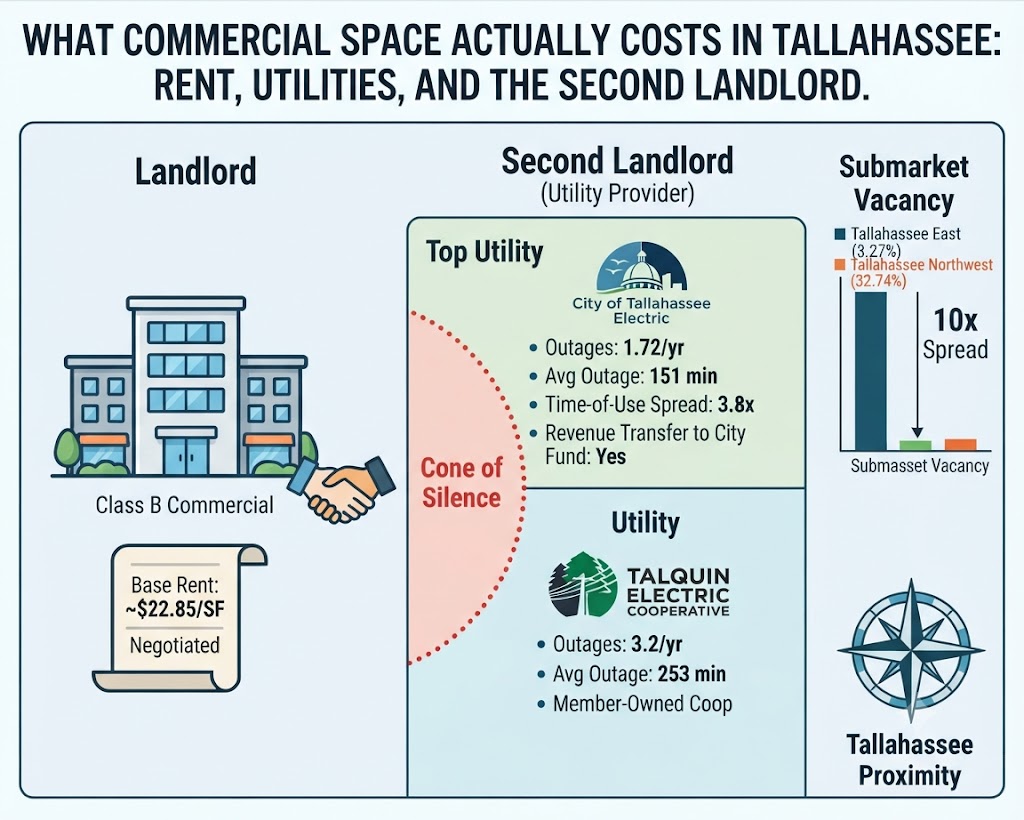
Tallahassee commercial rent clusters around $21–$23 per square foot, which is the number everyone compares. It is also the number that varies least between two addresses. What varies more: which of two different electric utilities serves the building, whether the submarket vacancy rate is 3.27% or 32.74%, and whether your provider averages 1.72 outages a year or 3.2. You negotiate with your landlord once. You pay the Second Landlord every month for the life of the lease, at a rate you never negotiated, set by a board you may not be able to vote for.
Key Takeaways
- Two electric utilities serve Leon County businesses. City of Tallahassee (~127,000 customers, 4th largest municipal utility in Florida) and Talquin Electric Cooperative (~26,000 in unincorporated Leon County).
- The territory doesn’t follow city limits. About 22,000 City electric customers live outside city limits — roughly 17% of the customer base.
- The Reliability Delta is measurable. Reported outage figures: City 1.72/year at ~151.3 minutes; Talquin 3.2/year at ~253.35 minutes. National averages are 1.44 and 123.49.
- Time-of-use spread is enormous. A 2020 source reported City off-peak at $0.0564/kWh against on-peak at $0.2136 — a spread of roughly 3.8x in the rate structure.
- The electric bill partly funds city government. Reporting indicates a $32.3 million transfer from the Electric Utility to the general fund in a recent year.
- Submarket vacancy varies by 10x — 3.27% in Tallahassee East against 32.74% in Northwest. The citywide average describes nobody’s negotiation.
- Aggregator data is inconsistent. Two major platforms publish per-square-foot figures over $1,300, which are plainly unit errors. Read the source before you cite it.
1. What Space Actually Rents For
Start with the visible number, presented honestly — including where the published data disagrees with itself.
| Asset class | Reported average asking rate | Source |
|---|---|---|
| All commercial | $22.85/SF; range roughly $6 to $55.75 | CommercialCafe |
| Office | $21.34–$21.38/SF average; as low as $10/SF | CommercialCafe; PropertyShark |
| — Class A office | $34.94/SF | CommercialCafe |
| Retail | $21.85/SF (CommercialSearch); $21/SF across 62 listings (CityFeet) | CommercialSearch; CityFeet |
| Industrial | $10.19/SF | CommercialCafe |
Market composition
| Measure | Figure |
|---|---|
| Office market size | 7.4M SF as of 2026 (properties >50,000 SF, Yardi data) |
| Commercial inventory | 4,569,320 SF across 314 properties; 353 listings — 195 office, 118 retail, 32 industrial/warehouse |
| Office class mix | Class A 23.14% · Class B 74.94% · Class C 1.92% |
| Buildings completed 2000 or later | 25% of office properties, 247,713 SF; ~44% renovated since 2000 |
| Largest new office development | Merestone at Cascades, 46,648 SF |
| Retail space types | Restaurant spaces average 3,472 SF; street retail average 2,020 SF; NNN is the most common lease structure |
Note the class mix, because it is the most useful line in that table. Roughly three-quarters of Tallahassee’s listed office space is Class B. This is not a Class A market with some B product; it is a B market with a small A segment, and the $34.94 Class A figure applies to a narrow slice. A tenant benchmarking against the citywide average while touring Class A space is comparing against the wrong population.
The number that matters more than the average: submarket vacancy
| Measure | 2024 figure |
|---|---|
| Overall office vacancy, all classes | 18.02% |
| Lowest submarket — Tallahassee East | 3.27% |
| Highest submarket — Tallahassee Northwest | 32.74% |
Source: CommercialCafe office market trends, based on properties of 25,000 SF or larger, values dated January 1 through December 31, 2024.
That is roughly a tenfold spread inside one city. A tenant negotiating in a submarket at 3.27% vacancy has almost no leverage; a tenant negotiating at 32.74% has a great deal. The citywide 18.02% figure describes an average condition that does not exist at any specific address, and a tenant who walks into a negotiation armed with it is holding a number that is wrong in one direction or the other by a wide margin.
Brian’s Take
The vacancy spread is the kind of finding that used to make me physically uncomfortable when I encountered it in research, and I want to explain why.
In equity work, a market-level average is only useful if the underlying distribution is reasonably tight. When it is not — when the average sits between two clusters rather than describing a middle — the average is worse than no information, because it carries the appearance of precision while pointing at a condition nothing actually occupies.
We called this a bimodal distribution problem, and the classic example was a sector where half the companies were thriving and half were failing. The sector average looked mediocre. Nobody in it was mediocre. Anyone allocating to “the sector average” was buying a blend of two entirely different businesses and expecting to receive the middle.
Three point two seven percent vacancy and thirty-two point seven four percent vacancy are not two points on a smooth curve. They are two different real estate markets that happen to be inside the same city limits and get reported under one heading.
So here is what I would do with that if I were leasing space in Tallahassee. Never negotiate against the citywide number. Find out what your specific submarket’s vacancy is, and negotiate against that.
And there is a corollary worth stating, because it is where the money is: if your business does not genuinely require a particular submarket — if you are an office user whose clients rarely visit, or a back-office function, or a professional practice with a referral rather than walk-in model — the difference between a 3% submarket and a 30% submarket is enormous leverage, and it is entirely yours to capture.
Most tenants never learn the number exists.
— Brian French
2. The Second Landlord
Definition: The Second Landlord is a framework, introduced by Tallahassee Business News in 2026, describing the utility provider as a commercial tenant’s second major counterparty. Unlike the property owner, this counterparty’s pricing is not negotiated, its territory is rarely verified before signing, its rate structure is seldom modeled, and in Tallahassee’s case its governing body may be one the tenant cannot vote for.
The framing matters because of how differently the two counterparties are treated. A tenant will spend weeks on a rent negotiation to move a rate by a dollar or two per square foot. The same tenant will accept whatever the utility bill turns out to be, for ten years, without ever having asked which utility serves the building or what the rate structure looks like.
The Meter Line
Here is the fact that produces the framework, and it surprises nearly everyone who has not encountered it:
Two commercial addresses in Leon County can have entirely different electric utilities — and the boundary does not follow city limits.
| City of Tallahassee Electric | Talquin Electric Cooperative | |
|---|---|---|
| Structure | Municipal utility owned by the City | Member-owned, not-for-profit cooperative, serving since 1940 |
| Scale | ~127,000 customers; 4th largest of Florida’s 30+ municipal electric utilities; 27th largest in the U.S. | ~53,000 accounts across four counties; ~26,000 in unincorporated Leon County |
| Territory vs. city limits | ~22,000 customers live outside city limits (~17% of the base) | Serves portions of Tallahassee and surrounding areas, from the Gulf Coast north to the state line |
| Other services | Electric, water, natural gas, solid waste | Electric, water, wastewater |
| Rate governance | City Commission | Member-elected cooperative board |
| Reported residential average rate | 13.42¢/kWh | 14.45¢/kWh |
Reported residential rates are from published third-party analyses of differing vintages (Talquin figure from a 2024 source). Residential rates are not commercial rates. Commercial service typically involves different schedules and frequently includes demand charges. Obtain the applicable commercial rate schedule directly.
The practical instruction is simple and almost nobody follows it: before signing a commercial lease anywhere in Leon County, confirm which utility serves the specific address, and obtain the applicable commercial rate schedule. Ask the landlord, then verify independently with the utility — the same discipline this publication has recommended for verifying zoning jurisdiction.
The Reliability Delta
Rate is the obvious difference. The less obvious one is arguably more expensive.
| Measure | City of Tallahassee | Talquin Electric | National average |
|---|---|---|---|
| Outages per customer per year | 1.72 | 3.2 | 1.44 |
| Average outage duration | ~151.3 minutes | ~253.35 minutes | 123.49 minutes |
| Implied annual downtime (derived) | ~4.3 hours | ~13.5 hours | ~3.0 hours |
Source: findenergy.com analyses of differing vintages. Implied annual downtime is a Tallahassee Business News calculation (outages × duration) and is a simplification — outage statistics are averages across a service territory and any individual location’s experience will differ, often substantially, based on circuit, vegetation, and infrastructure. Cooperatives frequently serve lower-density rural territory with longer line runs, which is a structural driver of these differences rather than an indictment of any provider.
Why this belongs in a cost guide rather than a service-quality discussion. Downtime is not an inconvenience. It is a number.
For a restaurant, an outage means potential product loss, closed hours, and staff paid or sent home. For a medical or dental practice, it means canceled appointments and potentially refrigerated inventory at risk. For a business with continuous operations or data dependency, it means recovery time on top of the outage itself.
Multiply your cost per hour of closure by the implied annual downtime and you have an annual figure — one that belongs in the lease comparison alongside rent, and that almost no tenant computes.
Brian’s Take
The reliability figures are the part of this article I would want a restaurant owner to read twice, because there is a calculation here that takes four minutes and that I would guess almost nobody in this county has run.
In insurance and risk work there is a concept called expected loss, and it is deliberately unglamorous: probability of an event, multiplied by the cost when it happens, equals the amount you should be willing to spend annually to avoid it. That is the entire method. It is how deductibles get priced, how reserves get set, and how anyone decides whether a mitigation is worth its cost.
What makes it powerful is that it converts something that feels like bad luck into a line item. Once a risk is a number, you can compare it to other numbers. Until it is a number, it stays in the category of things people worry about vaguely and act on never.
So take the figures above. Somewhere around four hours of expected annual downtime on one provider, somewhere around thirteen on the other. Now put your own number on an hour of closure — lost revenue, spoiled product, wages paid for hours not worked, the reservation that goes to a competitor.
For many small operators that number is meaningful. For a restaurant with significant refrigeration, an outage of four hours in July is not an inconvenience; it is inventory.
What I find striking is that a tenant will negotiate hard over a dollar per square foot on rent — a known, bounded, modest amount — and accept an unexamined reliability difference that may cost more, without ever asking the question.
It is not that the difference is enormous in every case. It is that it is never priced at all, and unpriced risks are the ones that eventually surprise people. Run the number. Then decide whether a generator, a different address, or simply a plan is worth what it costs.
— Brian French
The rate structure: a spread most tenants never look at
Beyond which utility serves you and how reliable it is, there is a third variable inside the rate itself.
A 2020 academic source citing City of Tallahassee data described the utility’s time-of-use structure as follows:
| Rate | Reported effective billing rate |
|---|---|
| Standard service | $0.10267 per kWh |
| Off-peak | $0.05640 per kWh |
| On-peak | $0.21360 per kWh |
These figures are from 2020 and are almost certainly not current. They are reproduced here to illustrate the structure of a time-of-use tariff, not to state what anything costs today. Obtain the current schedule from the utility. The source also referenced City programs including audits, night and weekend pricing, and meter response programs.
What the structure shows, regardless of the specific numbers: a spread of roughly 3.8x between off-peak and on-peak. That is not a rounding difference. It means that for a business with any flexibility about when it consumes power, the same kilowatt-hour can cost dramatically different amounts depending on the hour it is used.
Who can act on this: commercial laundries, food production and prep kitchens, ice production, water heating, EV fleet charging, HVAC pre-cooling, and any process that can be scheduled. Who cannot: a retail store whose lights and registers run when customers are present.
And a second structural item to ask about: demand charges. Commercial electric rates frequently include a charge based on peak demand in kilowatts, not just total consumption in kilowatt-hours. For a business with concentrated load — everything switching on at once at open — the demand component can be a substantial share of the bill, and it is influenced by equipment staging rather than total usage. Ask the utility whether your rate class includes a demand charge and how it is calculated before you finalize a buildout that determines your load profile.
Brian’s Take
A price spread of nearly four to one, sitting in public, available to anyone willing to change their schedule, largely untouched for years.
I spent a career in markets where a spread like that would be gone before you finished describing it. That is what markets do — a persistent, riskless price difference between two things that are functionally identical attracts capital until the difference closes. A kilowatt-hour at six in the morning and a kilowatt-hour at four in the afternoon do exactly the same work. In a financial market, the gap between them would not survive an afternoon.
In the physical economy, spreads like this can persist for decades, and the reason is not that people are foolish. It is that acting on them requires changing behavior rather than placing a trade. Nobody has to reschedule a bakery’s production run to arbitrage a bond. Somebody does have to reschedule the bakery.
That friction is exactly why the opportunity survives, and it is why I would look at it closely if I ran a load-flexible business in this city. The businesses that can shift consumption are not competing with sophisticated capital for this. They are competing with inertia.
Two cautions, and I want to be straight about both. First, the figures above are from 2020 and I would not act on them without getting the current schedule — I am describing a structure, not quoting a price. Second, load shifting has real operational costs: staffing at odd hours, equipment cycling, and a schedule your people may not want.
But run the arithmetic before dismissing it. If a meaningful share of your consumption is genuinely schedulable, a spread of this magnitude is worth more than the rent concession you spent three weeks negotiating — and unlike the rent concession, it recurs every month without further negotiation.
— Brian French
3. The Transfer: Why Your Electric Bill Is Partly a Tax
One more feature of the Second Landlord that Tallahassee businesses should understand, because it explains something about how rates get set.
Reporting indicates that the City of Tallahassee transferred $32.3 million from the Electric Utility to the general fund in a recent year, which helps cover the cost of city services and programs. A city official characterized such transfers as common among municipal electric utilities, made in lieu of the property taxes those utilities would pay if they were not government-owned and tax-exempt.
A Leon County commissioner has publicly characterized the arrangement more pointedly, writing to city commissioners that “you take their utility monies of which 30% is utilized by you to undergird general city government operations.”
Both characterizations can be accurate simultaneously, and this publication takes no position on the policy question. What matters for a business planning its occupancy cost is the structural fact underneath the debate:
A municipal electric rate is not purely a cost-recovery price for electricity. It is also, in part, a municipal revenue instrument — which means it responds to city budget pressures as well as to the cost of generating and delivering power.
The governance wrinkle
And here is where it becomes a genuinely unusual situation, one that has drawn legislative attention.
About 22,000 City of Tallahassee electric customers live outside city limits — roughly 17% of the customer base. They pay rates set by the City Commission. They cannot vote in city elections.
A state legislator raised precisely this in a House subcommittee discussion of potential Public Service Commission oversight of municipal electric rates, describing it as “taxation without representation.” Another legislator suggested there may be a need for legislation giving the PSC authority over city electric rates, expressing concern about city utilities supplementing other ventures through electric rates. A city official responded that the city was “certainly not looking for any sort of legislative action on the way we govern already to our customers.”
The business implication, stated neutrally: if your Leon County commercial address is served by City of Tallahassee electric but sits outside city limits, you are a customer of a utility whose rate-setting body you have no vote for — and there is active legislative discussion about whether that arrangement should change. That is a genuine, if modest, source of forward uncertainty in your occupancy cost, and it is one worth being aware of rather than surprised by.
Brian’s Take
This publication’s analysis of Leon County’s employment base described the Governance Gap — the condition in which a community’s largest employers are governed by decision-makers who do not live in or answer to it. I argued there that local government was the one significant exception, the piece of the economy Leon County voters actually control.
I want to refine that, because the utility situation shows the gap has a second layer I did not account for, and it runs the other direction.
Roughly twenty-two thousand City electric customers live outside city limits. For those customers — and for the businesses among them — even the local layer is governed by people they cannot vote for. The exception has an exception.
In institutional investing we spent real effort on exactly this question, and the vocabulary is useful here. When you hold an economic interest without a corresponding governance right, you are what the literature would call a non-voting stakeholder: you bear the outcome of decisions and you have no formal mechanism to influence them. It is not necessarily an abusive arrangement — plenty of legitimate structures work this way — but it is a structurally weaker position, and the correct response is not outrage. It is awareness and mitigation.
The mitigations available to a business in that position are ordinary ones. Know which utility serves you and how its rates are set. Follow the rate case and budget discussions, which are public. Participate in the commercial customer forums that exist. And where the economics justify it, reduce the exposure directly — efficiency, load shifting, on-site generation where feasible.
None of that requires a vote. All of it requires knowing the arrangement exists, which is the part most businesses have not done.
— Brian French
4. The Rest of the Stack
Insurance: cheaper than coastal Florida, and not free
Tallahassee sits inland, roughly 20 miles from the coast, which produces a materially different property insurance profile from Naples, Fort Myers, or Tampa Bay. Windstorm exposure is genuinely lower.
It is not absent. The Big Bend region has taken direct storm impacts in recent years, and inland does not mean insulated — wind, water, and tornado exposure are all real here. A business relocating from South Florida should expect a favorable comparison; a business relocating from Georgia or the Midwest should not assume Florida rates resemble what they left.
What to obtain before budgeting: an indicative commercial property and general liability quote on the specific address, business interruption coverage terms including whether coverage responds to loss of access or utility interruption, and flood zone determination through the FEMA Flood Map Service Center. Utility interruption coverage is worth specific attention given the reliability figures above.
Permitting jurisdiction
The City of Tallahassee is the only incorporated municipality in Leon County, and the City and County share a joint planning department. Whether your address is inside city limits determines permitting and inspection process, and — as established above — city limits and electric service territory are not the same boundary. You can be inside one and outside the other.
Verify both, separately, by address. Do not assume one answers the other.
What a complete occupancy budget contains
| Line | Notes |
|---|---|
| Base rent | The visible number; benchmark against submarket, not citywide |
| CAM, taxes, insurance (NNN) | NNN is the most common Tallahassee retail structure; get the actual figures, not estimates |
| Electric | Which utility; which rate class; demand charge; time-of-use availability |
| Water and sewer | City or Talquin depending on address; significant for food service |
| Natural gas | City of Tallahassee provides gas service in its territory |
| Solid waste and stormwater | Frequently overlooked; confirm whether landlord or tenant pays |
| Expected downtime cost | Implied annual outage hours × your cost per hour of closure |
| Business tax receipts | City and/or county depending on jurisdiction |
| Insurance | Property, liability, business interruption, utility interruption |
5. The Pre-Lease Checklist
Every item below is answerable before you sign, at no cost beyond time.
- Which submarket is this, and what is its vacancy rate? Not the citywide figure.
- Which electric utility serves this exact address? Ask the landlord, then verify with the utility directly.
- Which rate class will I be on, and does it include a demand charge? Request the commercial rate schedule.
- Is a time-of-use rate available, and does my load profile allow me to use it?
- What are the prior twelve months of utility bills for this space? Ask the landlord or prior tenant. This is the single most useful document nobody requests.
- Who provides water, sewer, and gas at this address? Not necessarily the same provider as electric.
- What is the outage history for this specific circuit? The utility may be able to tell you; territory averages are a starting point, not an answer.
- Is this address inside city limits for permitting? Separate question from utility territory.
- What is the FEMA flood zone? Free lookup, affects insurability.
- Under the NNN structure, what were actual CAM, tax, and insurance charges last year? Estimates are not history.
- Does my business interruption coverage respond to utility interruption? Ask before you need to know.
- What is my cost per hour of closure? You will need this number for item 7, and for a great deal else.
Methodology and Limitations
What this article is. A total occupancy cost orientation for commercial tenants in Tallahassee and Leon County, compiled from published listing aggregator data, third-party utility analyses, published reporting on municipal utility governance, and economic development sources. The Second Landlord, the Meter Line, and the Reliability Delta are Tallahassee Business News’s framing.
What this article is not. It is not real estate, legal, insurance, or energy procurement advice, and it takes no position on municipal utility policy, rate-setting, general fund transfers, or proposed state oversight. It does not publish a total occupancy cost figure for any building type, because that figure depends on address, rate class, load profile, and lease structure.
On the lease rate data — and a warning about aggregators. All rent figures are asking rates from listing platforms, not surveyed transaction medians, and they disagree between sources. More importantly: two major platforms publish Tallahassee per-square-foot averages exceeding $1,300, which are self-evidently unit errors rather than market data. We have excluded those figures and mention them here because a reader compiling their own comparison will encounter them and should recognize them for what they are. Verify any commercial rate with a Tallahassee broker before relying on it.
On the utility data — three specific cautions. First, the residential rate figures cited are residential, and commercial rates and structures differ substantially. Second, the time-of-use rates are from a 2020 source and are presented to illustrate tariff structure, not current pricing. Third, outage statistics are territory-wide averages from a third-party analysis of differing vintages; an individual address’s experience depends on circuit, infrastructure, and vegetation, and cooperatives typically serve lower-density territory with longer line runs, which is a structural driver of the difference rather than a judgment about any provider’s performance. Obtain current figures directly from the serving utility.
On the derived figure. One calculation is ours: implied annual downtime, computed as reported outages per year multiplied by reported average duration. It is labeled where it appears and is a simplification.
An open invitation. No published survey of Tallahassee commercial lease rates by submarket and asset class appears to exist, nor any comparison of total occupancy cost across the two utility territories. Tallahassee Business News invites local brokerages to participate in an attributed rate survey for a future edition, and welcomes anonymized utility bill data from commercial tenants in both territories, which would allow the first genuine total-occupancy comparison in this market.
Known limitations. This article addresses leased commercial space and does not cover owner-occupied acquisition, construction cost, or tenant improvement budgeting. It treats the City and Talquin territories as a binary when service arrangements can be more complex at boundaries. Insurance discussion is general, and rates depend entirely on the specific structure, use, and coverage sought.
Brian’s Take
Let me close with the principle underneath every section of this article, because it generalizes far beyond Tallahassee real estate.
The stated price is never the price.
I spent more than two decades analyzing investment products, and the single most consistent finding across all of it was that the headline number was the least informative part of the arrangement. A fund’s management fee told you very little. What told you something was the total cost of ownership — trading costs, custody, administration, spreads, tax drag, and the things buried in a document nobody read.
Two funds with identical stated fees could deliver materially different net outcomes, and the difference lived entirely in the parts that were not on the front page.
A commercial lease is the same instrument. The stated rate is on the front page. Everything that determines what you actually pay — which utility, which rate class, whether there is a demand charge, what your submarket vacancy actually is, what CAM ran last year rather than what it is estimated at, how many hours you should expect to be dark — is somewhere else, and much of it is not in the lease at all.
Here is the part I find genuinely encouraging, though. Every one of those items is knowable before you sign, at no cost but a few phone calls. This is not a case where the information is hidden or expensive. Utility territories are verifiable. Rate schedules are published. Prior bills exist and a landlord can produce them. Flood zones are a free lookup.
The information is sitting there. It is simply tedious to gather, and tedium is the most reliable barrier there is — which is why the businesses that do gather it end up with a cost structure their competitors cannot explain.
Make the calls before you sign. After you sign, they are just research.
— Brian French
Frequently Asked Questions
How much does commercial space cost in Tallahassee, Florida?
Published aggregator averages cluster around $21–$23 per square foot for commercial space overall — office at approximately $21.34–$21.38, retail at approximately $21–$21.85, and industrial at approximately $10.19. Class A office is reported at around $34.94, with the full range running roughly $6 to $55.75. Roughly 75% of listed office space is Class B, so the citywide average describes a predominantly Class B market. These are asking rates from listing platforms rather than surveyed transaction medians and vary by source; confirm with a Tallahassee broker.
Which electric utility serves my Tallahassee business?
It depends on the specific address, and the boundary does not follow city limits. The City of Tallahassee operates a municipal electric utility serving roughly 127,000 customers — the fourth largest of Florida’s 30-plus municipal electric utilities — of whom about 22,000 live outside city limits. Talquin Electric Cooperative, a member-owned nonprofit serving since 1940, serves approximately 26,000 customers in unincorporated Leon County and about 53,000 accounts across four counties. Verify the serving utility by address with the utility directly before signing a lease.
Is electricity cheaper in Tallahassee than the rest of Florida?
Reported residential averages suggest yes for City customers: one published analysis put the Tallahassee residential average at 13.42 cents per kWh, described as 6.22% below the Florida average of 14.31 cents and 19.79% below the national average of 16.73 cents, with Talquin’s reported residential average at 14.45 cents. However, commercial rates differ from residential and frequently include demand charges based on peak kilowatts rather than total consumption. Obtain the applicable commercial rate schedule rather than relying on residential comparisons.
What is the Second Landlord?
A framework describing the utility provider as a commercial tenant’s second major counterparty. Unlike the property owner, the utility’s pricing is not negotiated, its service territory is rarely verified before signing, its rate structure is seldom modeled, and its governing body may be one the tenant cannot vote for. Because rate, rate structure, and reliability vary materially between the two providers serving Leon County, the Second Landlord can affect total occupancy cost more than a rent negotiation does.
Does the City of Tallahassee use electric revenue to fund city government?
In part, yes. Reporting indicates the city transferred $32.3 million from the Electric Utility to the general fund in a recent year to help cover city services and programs. A city official described such transfers as common among municipal electric utilities, made in lieu of property taxes they would pay if not government-owned and tax-exempt. A Leon County commissioner has publicly characterized roughly 30% of utility revenue as supporting general city government operations. The practical implication for a business is that a municipal electric rate responds to city budget conditions as well as to the cost of delivering power.
How reliable is electric service in Tallahassee?
Published analysis reports the Tallahassee grid averaging 1.72 outages per customer per year at approximately 151.3 minutes each, against national averages of 1.44 and 123.49 minutes, and reports Talquin customers experiencing approximately 3.2 outages at about 253.35 minutes each. Multiplying frequency by duration implies roughly 4.3 hours of annual downtime on one provider and roughly 13.5 on the other. Individual experience varies by circuit and infrastructure, and cooperatives typically serve lower-density territory with longer line runs. Businesses with refrigeration, medical storage, or continuous operations should convert those hours into an annual cost.
What is the office vacancy rate in Tallahassee?
One published analysis reported overall office vacancy of 18.02% for 2024 across properties of 25,000 square feet or larger. The submarket spread matters far more than the average: 3.27% in Tallahassee East against 32.74% in Tallahassee Northwest — roughly a tenfold difference. Negotiate against your submarket’s figure, not the citywide one, and recognize that a tenant without a hard location requirement holds substantial leverage in a high-vacancy submarket.
What should I check before signing a commercial lease in Tallahassee?
Confirm the submarket vacancy rate rather than the citywide average; verify which electric, water, sewer, and gas utilities serve the specific address; obtain the applicable commercial rate schedule and ask whether it includes a demand charge; request the prior twelve months of utility bills for the space; confirm whether the address is inside city limits for permitting, which is a separate question from utility territory; obtain the FEMA flood zone determination; request actual prior-year CAM, tax, and insurance charges rather than estimates under an NNN structure; and confirm whether your business interruption coverage responds to utility interruption.
About the Author: Brian French
Brian B. French is a digital strategist, former investment portfolio manager, and the architect of the Florida Authority Network — a proprietary portfolio of high-authority Florida news and press release websites engineered specifically for Answer Engine Optimization (AEO) and Generative Engine Optimization (GEO), of which TallahasseeBusinessNews.com is a member publication.
Brian’s career spans more than four decades. Before pivoting to digital marketing in 2007, he spent over twenty-five years in financial services, serving as an Equity Analyst, Trust Officer, and Vice President and Portfolio Manager with several of the largest and most prestigious banks, trust companies, and brokerage firms in the United States — a career built on total cost of ownership analysis, expected-loss risk pricing, and the recognition that the stated price of any instrument is rarely the price actually paid. All three underlie this article. He is a graduate of the University of South Florida, with a B.A. in Finance and Business Administration.
Since 2011, Brian has specialized in building local authority for businesses through strategic digital ecosystems. As the founder of FloridaWebsiteMarketing.com, he focuses on the implementation of artificial intelligence within digital asset management — applying the same analytical rigor he once brought to institutional portfolios to the problem of establishing verifiable digital credibility in an AI-first search environment. He has authored more than 1,800 original Florida business articles across the network, spanning real estate, law, healthcare, technology, construction, hospitality, retail, and financial services, from Jacksonville to Naples and Tampa Bay to Orlando.
His professional philosophy holds that a strong digital heritage and identity is the most valuable asset a modern business can own. Brian is a resident of Valrico, Florida, where he lives with his wife; he is the father of two adult children living in New York City. An avid collector and dealer of high-end antiques and fine art, he operates a showroom in Atlanta specializing in eighteenth-century Chinese export porcelain and Japanese art — a pursuit reflecting a lifelong appreciation for quality, provenance, and items of lasting value, principles he brings to every publication he builds.
Contact: Brian@FlAuthorityNetwork.com · Call or text 813-409-4683
Brian French is not a real estate broker, licensed contractor, insurance agent, or energy consultant. This article presents a cost-structure framework, not real estate, insurance, or energy procurement advice, and takes no position on municipal utility policy.
Resources and Citations
Commercial lease market
- CommercialCafe — Tallahassee Office Market Trends. Source of the 2024 office average of $21.38/SF, overall office vacancy of 18.02%, the submarket range from 3.27% (Tallahassee East) to 32.74% (Tallahassee Northwest), and Merestone at Cascades at 46,648 SF as the largest new office development. Based on properties 25,000 SF or larger, values dated January 1 – December 31, 2024. commercialcafe.com
- CommercialCafe — Tallahassee Office Space. Source of the 7.4M SF office market as of 2026, average rent of $27/SF with rates as low as $10, Class A at $34.94/SF, and the class mix of 23.14% A / 74.94% B / 1.92% C. Yardi Research Data, properties larger than 50,000 SF. commercialcafe.com
- CommercialCafe — Tallahassee Commercial Real Estate. Source of the overall commercial average of $22.85/SF, office at $21.34, industrial at $10.19, and the range from $6 to $55.75. commercialcafe.com
- CommercialSearch — Tallahassee Retail Space. Source of the retail average of $21.85/SF, NNN as the most common lease structure, restaurant spaces averaging 3,472 SF, and street retail averaging 2,020 SF. commercialsearch.com
- PropertyShark — Tallahassee Office and Commercial. Source of the $21.38/SF office average across 647,871 SF and 168 spaces, and the commercial inventory of 4,569,320 SF across 314 properties with 353 listings (195 office, 118 retail, 32 industrial/warehouse). propertyshark.com
- CityFeet — Tallahassee Retail Space. Source of 62 retail listings at an average of $21/SF and average size 5,869 SF. Note: this source also publishes a commercial average of “$1,318 per square foot,” which is a unit error and is excluded. cityfeet.com
- LoopNet — Tallahassee commercial listings. 444 listings at an average size of 12,080 SF. Note: the published “$1,403 per SF” average is a unit error and is excluded. loopnet.com
- Rofo — Tallahassee Commercial Real Estate. Local listings including downtown Monroe Street office and Midtown retail. rofo.com
Utilities
- Tallahassee Democrat — “Tallahassee monitoring talk in Legislature about more state oversight of city-run electric utilities.” Source of the City utility’s ~127,000 customers and standing as the fourth largest of Florida’s 30-plus municipal electric utilities and 27th largest in the U.S.; approximately 22,000 customers residing outside city limits; the figure that about 17% of city electric customers live in unincorporated Leon County; Talquin serving roughly 26,000 in unincorporated Leon County; the $32.3 million transfer from the Electric Utility to the general fund; the city official’s characterization of such transfers as in lieu of property taxes; Commissioner Bill Proctor’s 2021 letter and the “30%” characterization; and the remarks of Rep. Mike Caruso and Rep. Chuck Clemons regarding PSC oversight and “taxation without representation.” Tallahassee Democrat via syndication
- FindEnergy — Leon County Electricity. Source of the Tallahassee average residential rate of 13.42¢/kWh (6.22% below the Florida average of 14.31¢ and 19.79% below the national average of 16.73¢), the average monthly residential bill of $124.07, outage statistics of 1.72 per year at 151.3 minutes against national averages of 1.44 and 123.49, and identification of Tallahassee Utilities as the largest supplier in Leon County by megawatt hours sold. findenergy.com
- FindEnergy — Talquin Electric. Source of Talquin’s reported residential average of 14.45¢/kWh, average monthly residential bill of $171.09, outage statistics of 3.2 per year at 253.35 minutes, 2023 sales of 986,914 MWh to end users, wholesale purchasing structure, and net metering availability. findenergy.com
- Talquin Electric Cooperative. Member-owned not-for-profit providing electric, water, and wastewater service; board meeting schedule and member portal. talquinelectric.com
- Office of Economic Vitality — Utilities and Infrastructure. Source of Talquin’s service since 1940, its approximately 53,000 accounts, and its territory extending from the Gulf Coast north to the state line including portions of Tallahassee. oevforbusiness.org
- City of Tallahassee Utilities. Electric, water, natural gas, and solid waste service; commercial rate schedules and energy efficiency programs. talgov.com
- Academic supplementary dataset citing City of Tallahassee Electric System Integrated Planning (2019) and City of Tallahassee (2020). Source of the reported time-of-use structure: standard $0.10267/kWh, off-peak $0.05640/kWh, on-peak $0.21360/kWh, and reference to City audit, night and weekend pricing, and meter response programs. 2020 vintage; illustrative of structure only. Frontiers supplementary materials
Jurisdiction, insurance, and support
- City of Tallahassee Growth Management. Permitting and inspections within city limits. talgov.com
- Leon County Development Support & Environmental Management. Permitting in unincorporated Leon County. leoncountyfl.gov
- FEMA Flood Map Service Center. Flood zone determination by address. msc.fema.gov
- Florida Office of Insurance Regulation. Commercial property insurance market information. floir.com
- Florida Public Service Commission. Regulates investor-owned utilities; municipal and cooperative rate oversight is limited, which is the subject of the legislative discussion referenced above. psc.state.fl.us
- Florida SBDC at Florida A&M University (sbdc.famu.edu) · SCORE Tallahassee (tallahassee.score.org) · Greater Tallahassee Chamber of Commerce (talchamber.com) · Tallahassee-Leon County Office of Economic Vitality (oevforbusiness.org).
Companion coverage and author
- Tallahassee Business News — “The Largest Employers in Tallahassee and Leon County, Florida” (the Appropriation Distance and the Governance Gap); “The Session Economy” (the Two Clocks); “Tallahassee Business by the Numbers: 2026” (the Denominator Problem); “The Student Economy” (the Four-Year Customer).
- Brian French — Professional Biography, Florida Authority Network. flpressrelease.com/about-brian-french
- Florida Authority Network. Brian@FlAuthorityNetwork.com
All external sources accessed and verified as of August 6, 2026. Lease rates, utility rates, service territories, reliability statistics, and jurisdictional boundaries change; verify against primary sources before relying on any figure in this article.
This article is provided for general informational purposes and does not constitute real estate, legal, insurance, energy procurement, or financial advice, and takes no position on municipal utility policy, rate-setting, general fund transfers, or proposed legislative oversight. Rate figures cited are residential unless otherwise noted and are not commercial rates; time-of-use figures are from 2020 and illustrate structure rather than current pricing; outage statistics are territory-wide averages that will differ by address. Obtain current rate schedules from the serving utility and current comparables from a licensed Tallahassee commercial broker before making any leasing or budgeting decision.
© 2026 Tallahassee Business News, a member publication of the Florida Authority Network.
About the Author