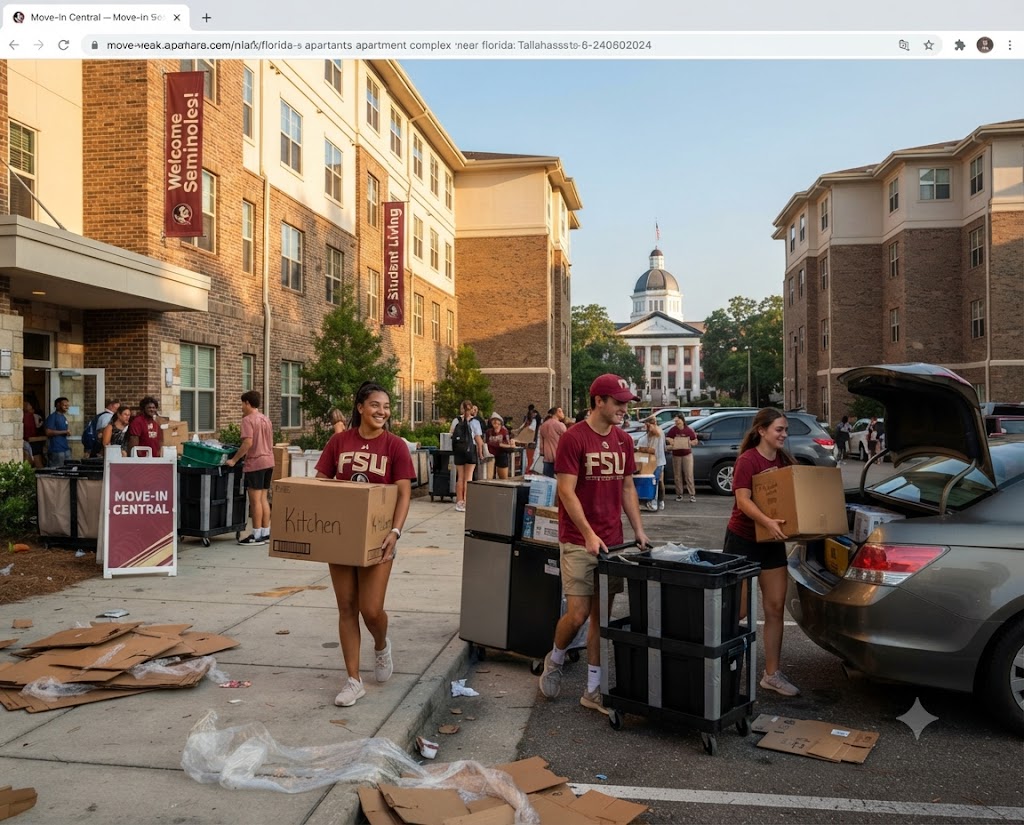
The Student Economy: Operating a Tallahassee Business Around 67,000 Customers Who Leave on Schedule
A 2026 analysis from Tallahassee Business News introducing the Four-Year Customer — because in this market your reputation does not accumulate with your customers. They leave on a timetable, and it has to be handed down.
By Brian French | Tallahassee Business News | Florida Authority Network
Published: August 8, 2026
Answer in Brief
A Tallahassee business serving students loses roughly a quarter of its customer base every year, on schedule, permanently, by design. No other retail market operates with guaranteed total turnover on a known timetable. The consequence is structural: in a normal market, reputation compounds with your customers. Here, your customers graduate — so reputation must be transmitted to a population that has never heard of you. The businesses that last twenty years in this city are not the ones students love most. They are the ones embedded in how the relationship gets handed down.
Key Takeaways
- The scale is real. FSU reported student spending of $1.044 billion in FY2024 — one institution. Data USA reports 67,133 students countywide against a population near 300,000.
- The cohort cliff: roughly 25% replacement annually. FSU alone graduated into a county that awarded 20,459 degrees in 2024.
- The Handoff Rate — the share of new customers arriving via cohort or institutional transmission rather than paid acquisition — is the metric that determines survival.
- Lifetime value is calculable here, unlike almost any other retail market. FSU cost-of-attendance estimates run $20,162 to $39,831 per year depending on residency and living situation.
- The Payer Split: ~21% of FSU students are non-Florida residents whose parents are out of state entirely, applying different criteria to the categories they fund.
- 85% of first-time college students live in residence halls — which makes the off-campus transition a predictable, dateable acquisition window.
- The camp economy is the underused summer stream: 8,500+ athletic camp attendees, 51,229 STEM program attendees, families in town during the market’s deepest trough.
The Arithmetic Nobody Runs
Start with the scale, because it is larger than the “college town” shorthand suggests.
| Measure | Figure | Source |
|---|---|---|
| FSU student spending, FY2024 | $1.044 billion in the area and at the university | FSU Economic Impact |
| Leon County student population, 2024 | 67,133 (27,763 male / 39,370 female) | Data USA |
| FSU enrollment | 44,308 total; 42,507 on the Leon County campus; 34,849 Florida residents | FSU Economic Impact |
| Non-Florida residents at FSU (derived) | ~9,459, roughly 21% | TBN calculation |
| Degrees awarded by county institutions, 2024 | 20,459 | Data USA |
| FSU on-campus housing | 18 residence halls, 6,712 residents; 20%+ of undergraduates; 85% of first-time college students | FSU Housing |
| FSU budget, FY2026–27 | Record $3.22 billion approved | Reported June 2026 |
A billion dollars of student spending from one institution, into a county of three hundred thousand people. That is the fact everyone knows.
Here is the fact almost nobody has calculated.
An undergraduate is present for roughly four years. Which means that in any given year, approximately one quarter of the student customer base is new, and approximately one quarter is gone. Not through failure. Not through competition. Not through anything a business did or failed to do.
By design. On a published schedule. Forever.
Now compare that to any other retail environment. A coffee shop in a residential neighborhood builds a base over years, and a customer who likes it in 2020 may still be a customer in 2030. Every satisfied customer is an asset that appreciates. Reputation, referrals, and habit compound.
In the student market, that compounding is switched off. Your best customer, the one who came four times a week for three years and told everyone, is gone in May and is never coming back as a regular. And the eight thousand people arriving in August have never heard of you.
This is the central operating fact of the Tallahassee student economy, and it changes what a business should invest in.
Brian’s Take
There is a technique from my investment years that maps onto this so precisely that I am surprised nobody in a college town uses it by name.
Cohort analysis.
In fund management we never evaluated performance by lumping all the money together. We analyzed by vintage — the year the capital came in. The 2007 vintage and the 2010 vintage of the same strategy, run by the same people with the same process, could produce wildly different results, because they entered at different points and experienced different conditions. Pooling them produced an average that described neither.
Any serious allocator tracked vintages separately, and the discipline was absolute: you never compare a cohort to the aggregate. You compare it to the same cohort at the same point in its life.
Now think about a Tallahassee business with student customers. It has a 2023 cohort, a 2024 cohort, a 2025 cohort, and a 2026 cohort, all in the building at once, all at different points in their relationship with the business, all behaving differently. The freshmen are still discovering. The juniors have settled into habits. The seniors are already partly gone — internships, job searches, one foot out.
Almost every operator I would guess looks at one number: sales this month versus last year. That number blends four vintages and tells you very little about any of them.
Here is what cohort thinking would tell you instead. Are this year’s freshmen adopting you at the same rate last year’s did? That is the only leading indicator that matters, because it forecasts your business three years out. If freshman adoption is falling while total sales look fine, you are watching a business die slowly with a lagging indicator that looks healthy.
I would build the whole reporting system around that one question.
— Brian French
The Four-Year Customer
Definition: The Four-Year Customer is a framework, introduced by Tallahassee Business News in 2026, for businesses serving a student population. Its premise is that the student customer has a known, bounded, and fully predictable duration of presence — and that because roughly a quarter of the base is replaced annually by design, reputation cannot accumulate within the customer population and must instead be transmitted between cohorts.
The framework has four components.
| # | Component | What it governs |
|---|---|---|
| 1 | The Cohort Cliff | ~25% annual replacement, guaranteed, on a known schedule |
| 2 | The Handoff | How the relationship transmits to the incoming cohort — the only defensible asset |
| 3 | The Payer Split | Who funds the purchase versus who chooses it |
| 4 | The Alumni Tail | Departed customers who return episodically and spend heavily |
Component 1: Calculating what a student is actually worth
Here is where the framework produces something genuinely useful, and it rests on a fact operators treat as a liability when it is an advantage.
You know exactly when this customer leaves.
FSU publishes cost-of-attendance estimates. For 2024–2025:
| Student type | Estimated annual cost | Over four years (derived) |
|---|---|---|
| Florida resident, on campus or off-campus apartment | $25,398 | ~$101,600 |
| Florida resident, living with parents | $20,162 | ~$80,600 |
| Non-Florida resident, on campus or off-campus apartment | $39,831 | ~$159,300 |
| Non-Florida resident, living with parents | $33,951 | ~$135,800 |
Source: FSU, covering tuition, housing, books, transportation, and other personal expenses. These are estimates used for financial aid awarding and may not represent any individual student’s actual cost. Four-year figures are Tallahassee Business News calculations and assume four years at a constant rate, which no student’s actual experience will match exactly.
Strip out tuition and fees — that goes to the institution — and what remains is housing, food, transportation, books, clothing, and entertainment. A substantial share of that is spent with local businesses, and the FSU figure of $1.044 billion in total student spending confirms the aggregate.
The point is not the precise number. It is that a student is one of the very few retail customers in America whose lifetime value can be estimated with genuine confidence, because the term is known. A neighborhood coffee shop cannot tell you how long its average customer will live nearby. A Tallahassee business can tell you, within a semester, when its customer graduates.
What this changes: acquisition spending. If a business knows a freshman is worth a calculable amount over the following 32 months of presence, it can rationally spend far more to acquire that freshman in August than it would spend acquiring an anonymous walk-in. Most student-facing businesses in college towns spend the same on both, which means they systematically underinvest in the highest-value acquisition window of the year and overinvest in the rest.
Brian’s Take
I want to make an argument that will sound strange at first and that I believe is exactly right.
A student is a bond. Every other retail customer is a stock.
Consider how differently those two things are valued, and why. A stock has no maturity date. You are estimating cash flows into an indefinite future, and the further out you look the less you know, which is why equity valuation involves so much judgment and so much disagreement.
A bond matures on a date printed on the instrument. You know the term, you know the payments, and the math is arithmetic rather than argument. That certainty is precisely why bonds are the instrument institutions use when they need to fund a known future obligation. The terminal date is not a defect. It is the feature.
Now think about a Tallahassee business owner who says students are difficult customers because they leave. That is like complaining that a bond matures.
Yes, the relationship ends. It also begins on a known date, lasts a known term, and generates a spend you can estimate from published figures. Look at the cost-of-attendance table above. Somewhere between roughly twenty and forty thousand dollars a year, four times, with tuition stripped out and the remainder spent substantially in a ten-mile radius.
I do not think most operators in this city have ever run that calculation, and I would guess the reason is that the framing of students as transient customers makes the calculation feel pointless. It is the opposite. The transience is what makes the calculation possible.
And once you have the number, everything downstream changes — how much you can afford to spend in August, whether a first-visit discount is an expense or an investment, and whether it is worth doing something expensive and memorable for a freshman who has thirty-two months of presence ahead of them.
Run the number. It is one of the few places in retail where you can.
— Brian French
Component 2: The Handoff — the only defensible asset
If a quarter of your customers leave annually and reputation cannot compound within the population, then the question that determines whether a business survives a decade is:
How does knowledge of your business get transmitted from a departing cohort to an arriving one?
We call the answer the Handoff Rate: the share of new customers acquired through cohort-to-cohort or institutional transmission rather than through paid acquisition.
A business with a high Handoff Rate acquires customers for near zero marginal cost, permanently. A business with a low one is buying its entire customer base again every four years, forever, and its acquisition cost never amortizes.
The transmission channels, in rough order of durability
| Channel | How it works | Durability |
|---|---|---|
| Institutional embedding | Orientation programs, campus partnerships, official vendor relationships, department affiliations, admitted-student and parent materials | Highest — renews automatically with each intake |
| Organizational tradition | Greek life, student organizations, athletic teams, residence hall staff, academic cohorts with shared rituals | Very high — organizations replace members but retain traditions |
| The upperclassman handoff | Roommates, mentors, older siblings, and RAs telling newcomers where to go | High but informal — the classic mechanism |
| Parent-to-parent | Parents’ weekend, family social networks, admitted-student parent groups | Moderate, and heavily category-dependent |
| Physical location | Being on the path between where students live and where they go | Moderate — durable but expensive and contestable |
| Paid acquisition | Advertising, promotions, sponsorships, discounts | Lowest — must be repurchased every cohort |
The strategic conclusion is uncomfortable but clear. Investment in the top two rows compounds. Investment in the bottom row does not, in this market, ever.
A business that spends heavily on promotions to freshmen each August is renting its customer base. A business that becomes the place a residence hall’s staff recommends, or the vendor a department uses, or the tradition a student organization maintains, has acquired something that renews itself without further spending.
This explains a pattern anyone who has lived in a college town has noticed: the businesses that survive for decades are frequently not the newest, the best-designed, or even objectively the best. They are the ones that got into the transmission mechanism early and stayed there. Being told about a place by someone you trust is a far stronger acquisition channel than being advertised to — and in a market with 25% annual customer turnover, it is the only one with compounding returns.
Brian’s Take
The Handoff is a distribution question, not a marketing question, and I think that distinction is where most operators go wrong.
In my years covering companies, the single most reliable predictor of durable advantage was not product quality. It was control of, or privileged access to, distribution.
I watched superior products lose to inferior ones repeatedly, and the mechanism was always the same. The better product had to be discovered. The worse one was already on the shelf, already in the catalog, already the default. Discovery is expensive and has to be repurchased. Being the default is free and renews itself.
Consumer goods companies understood this completely and fought over shelf placement with an intensity that puzzled people who thought the product was the business. It was not. The shelf was the business.
Now look at a Tallahassee student market. What is the shelf?
It is orientation. It is the RA who has been asked where to eat. It is the fraternity that has held its formal at the same place for eleven years. It is the department that has used the same printer since before anyone currently employed there arrived. It is the list of recommendations in an admitted-student parent packet.
Those are shelves, and businesses fight over them far less intensely than the value warrants — partly, I suspect, because getting on them requires patience, relationship work, and years, while running an August promotion produces a visible result on Monday.
The promotion is a cost. The shelf is an asset. In a market where a quarter of your customers leave every year, that difference is not a nuance. Over a decade it is the entire difference between a business that has to be rebuilt continuously and one that gets handed down.
— Brian French
Component 3: The Payer Split
A structural feature of this market that businesses routinely address backwards.
In a substantial share of student spending, the person who pays and the person who consumes are different people, in different places, applying different criteria.
The cost-of-attendance figures make this concrete. FSU’s estimates — roughly $25,398 for a Florida resident living off campus, roughly $39,831 for a non-resident — are, functionally, the parent’s annual budget for many households. And with approximately 9,459 FSU students being non-Florida residents, a meaningful share of those decision-makers are in another state entirely.
| Category | Typically funded by | Decision criteria that dominate | Market to |
|---|---|---|---|
| Off-campus housing, leases, furnishings | Parent | Safety, proximity, lease terms, guarantor requirements, reputation | Parent |
| Storage, moving, shipping | Parent | Reliability, logistics, remote manageability | Parent |
| Healthcare, urgent care, dental, vision | Parent / family insurance | Insurance acceptance, credentials, communication with family | Parent |
| Tutoring, test prep, career services | Parent | Outcomes, credibility, reporting | Parent |
| Auto service, tires, repairs | Parent (frequently by phone) | Trustworthiness, transparent pricing, willingness to explain to a remote payer | Both |
| Parents’ weekend dining, hotels, gifts | Parent, on site | Experience quality, reservation availability | Parent |
| Coffee, fast casual, late-night food | Student | Speed, price, proximity, social norm | Student |
| Bars, entertainment, apparel, personal services | Student | Peer signal, atmosphere, price | Student |
The common error: a business in a parent-funded category markets exclusively to students, because students are the visible population. Storage companies, off-campus housing operators, healthcare providers, and auto service shops frequently advertise as though the eighteen-year-old is deciding, when in many households a parent two states away is signing, guaranteeing, or approving.
What parent-marketing actually requires is different from student-marketing in specific ways: a website that answers a parent’s questions rather than a student’s, transparent pricing published rather than quoted, the ability to communicate with someone who is not physically present, willingness to explain rather than assume, and visible legitimacy signals — licensure, insurance, years in business, reviews from other parents.
And a timing insight: because 85% of first-time college students live in residence halls, the transition to off-campus living is highly predictable — it happens largely in years two and three. That makes the off-campus acquisition window a dateable event for housing, furnishing, utilities, insurance, and service businesses, targeting a sophomore and their parent in the spring before the lease signs.
Component 4: The Alumni Tail
The revenue stream that departs and comes back.
County institutions awarded 20,459 degrees in 2024. Those graduates leave the local consumer economy — but they leave carrying something a business cannot buy: memory of their college years, attached to specific places.
And they return. Home football weekends, homecoming, reunions, parents’ weekends when their own children enroll, graduation ceremonies for younger siblings, professional travel to the capital, and eventually retirement decisions.
An alumnus who returns once a year for a game weekend is not a small customer. They arrive with a group, they are spending discretionary income at a career-stage income level rather than a student one, they are frequently nostalgic and therefore price-insensitive, and they are choosing based on where they went twenty years ago.
The strategic consequence is unusual: a business’s investment in a student in 2026 may pay out in 2046 at a materially higher spend level. That is a very long-duration return, it does not appear in any conventional customer analysis, and it is one more reason the businesses that persist in college towns tend to be the ones that made themselves memorable rather than merely convenient.
The honest caveat: we have not measured this. No published figure exists for alumni return spending in Leon County, and any operator relying on it should treat it as a secondary benefit rather than a plan. What we are asserting is that the mechanism is real and under-considered, not that we have sized it.
Brian’s Take
The Alumni Tail is what an accountant would call an off-balance-sheet asset, and I mean that as a genuine description rather than a figure of speech.
In my analyst years, some of the most persistent mispricings I encountered came from assets that were real, valuable, and simply not on the statements. Brand. Customer relationships built over decades. Institutional knowledge. Distribution relationships. All economically significant, none of them appearing as a line item, and therefore invisible to anyone reading the financials without imagination.
The businesses trading below what they were worth were frequently the ones whose value sat in those invisible places.
A Tallahassee restaurant that has been the place people go after a game since 1985 owns something. It is not on the balance sheet, it cannot be depreciated, and no competitor can purchase it. It was accumulated one cohort at a time over forty years, and it produces revenue every single fall from people who moved away decades ago.
What strikes me is the duration. In financial terms this is an extraordinarily long-dated asset — investment made in a twenty-year-old, returns collected from a forty-five-year-old. There is almost nothing in ordinary retail with that profile.
And it has an implication I would take seriously if I ran a student-facing business: the thing worth optimizing is not convenience. It is memorability. Convenience wins the transaction this Tuesday. Memorability wins the game weekend in 2046, at a much higher check average, from someone who has been telling the story for twenty years.
Those are different investments. The second one costs more and pays later, which is exactly why most operators do not make it — and exactly why the ones who do are still there.
— Brian French
The Camp Economy: The Summer Stream Nobody Counts
One finding that emerged from FSU’s own reporting and that deserves separate attention, because it addresses the market’s hardest problem.
Tallahassee’s deepest trough is summer — the one stretch when both the legislative and academic calendars are quiet simultaneously. Businesses spend it waiting.
Meanwhile, families are arriving.
| Program | Attendance |
|---|---|
| FSU athletic camps, 2023–24 academic year | Over 8,500 attendees — 3,310 football; 1,551 men’s basketball; 900 softball; 800 volleyball; 600 women’s basketball; 550 baseball; 292 cross-country/track; 218 soccer; 137 swimming; 82 golf; 75 men’s tennis; 40 beach volleyball |
| Academic and civics camps | More than 20 in session throughout the year; thousands of school students attend |
| Challenger Learning Center of Tallahassee, summer 2025 | 890 campers |
| FSU College of Arts & Sciences, Office of STEM Teaching Activities | 51,229 total attendees across programs (academic year as reported by source; verify) |
Why this matters more than the raw numbers suggest. A camp attendee is a minor, which means an adult brought them. Frequently that adult is staying nearby, sometimes for several days, with a sibling in tow. The commercial footprint of a camp attendee is a family, not a child.
And these families arrive during the exact weeks when the student consumer economy has evaporated — a genuinely counter-seasonal demand stream landing in the trough.
There is a second layer that is easy to miss: a fourteen-year-old attending a football camp is a prospective student, and their parent is a prospective payer, five years early. A business that is memorable to that family during a camp week has been introduced to a future four-year customer before the recruitment process has even begun.
The practical question for operators: does your summer plan account for camp weeks at all? For most Tallahassee businesses the honest answer is no — summer is treated as one undifferentiated dead stretch to be endured. The camp calendar is published, the attendance is substantial, and the families are the highest-spending visitors the city receives in June and July.
Ten Operating Implications
- Track freshman adoption, not total sales. Total sales blend four cohorts and hide the only leading indicator that exists.
- Calculate your student lifetime value. You are one of the few retailers in America who can. Cost-of-attendance figures are published.
- Concentrate acquisition spending in August. If a freshman is worth 32 months, the August acquisition window is worth far more per dollar than any other week of the year.
- Move budget from promotions to embedding. Orientation, campus partnerships, residence hall relationships, and student organization traditions renew themselves. Promotions do not.
- Identify your category’s payer and market to that person. If parents fund it, publish pricing, answer parent questions, and make yourself legible to someone who is not in the room.
- Treat the sophomore off-campus transition as a dateable event. 85% of first-year students are in residence halls; the move happens on a predictable schedule.
- Build for memorability, not only convenience — the Alumni Tail rewards the first and forgets the second.
- Plan the camp weeks. Visiting families in June and July are the counter-seasonal demand the summer trough is otherwise missing.
- Remember that your workforce shares your customers’ calendar. Graduation week is peak demand and minimum staffing simultaneously; size your non-student core to the worst week, not the average.
- Do not compare this year to last year without checking the cohort composition — and, per this publication’s prior analysis, without checking whether you are comparing a Stack Year to a Stagger Year.
Methodology and Limitations
What this article is. An operating framework for businesses serving Tallahassee’s student population, built from published enrollment, spending, cost-of-attendance, and housing data, together with established principles of cohort analysis and customer lifetime value. The Four-Year Customer, the Handoff Rate, and the Payer Split are Tallahassee Business News’s framing. The underlying figures belong to the sources cited.
What this article is not. It is not financial, marketing, or business advice for any specific enterprise, and it is not a measurement of the student economy’s size or composition beyond the figures cited.
On derived figures. Three calculations in this article are ours rather than a source’s, and each is labeled: the approximately 9,459 non-Florida residents at FSU (44,308 total less 34,849 Florida residents); the four-year cost-of-attendance totals (annual estimate multiplied by four); and the approximate 25% annual cohort replacement rate (implied by a nominal four-year undergraduate term). All three are simplifications. Time-to-degree varies, students transfer in and out, graduate populations have different durations, and costs change annually. Treat them as orders of magnitude, not precision.
On the Handoff Rate. We have not measured it for any business, and no published data on it exists for this market. It is proposed as a metric an operator can estimate from their own records by asking new customers how they heard about the business — which is both the measurement method and, not incidentally, a useful practice regardless.
On conflicting figures. Published FSU enrollment and employment figures vary by source and vintage. FSU’s own economic impact reporting gives 44,308 students and 16,069 employees for 2024, while a 2023 community op-ed cited “more than 45,000 students” and “about 14,000 faculty and staff.” Both may be accurate on their own basis and date. Cite figures with their source.
Known limitations. This article treats “students” as a single population when FSU, FAMU, and Tallahassee State College serve materially different student bodies with different residency patterns, financial circumstances, and spending profiles — a simplification made for clarity at real cost in precision. Graduate and professional students have longer and less predictable durations than the four-year undergraduate model assumes. The Alumni Tail is a structural argument with no local measurement behind it. And the STEM attendance figure cited above appears in the source with an apparently mistyped academic year; we have reproduced it as published and flagged it.
Brian’s Take
I want to close by pushing back on a framing I hear constantly about college towns, including from people who have built good businesses in them.
“Students are hard customers. They have no money and they leave.”
Both halves of that are wrong, and the second is wrong in an interesting way.
On the money: this publication’s data report examined why Leon County’s income statistics understate the working economy, and the same distortion runs the other direction here. A student’s reported income is near zero. Their spending is not — FSU put student spending at $1.044 billion in a single fiscal year, and the cost-of-attendance figures run from roughly twenty thousand to nearly forty thousand dollars a year. That money is being spent. Someone is receiving it. The question is only whether it is you.
On leaving: I have argued above that the terminal date is a feature rather than a defect, and I want to state the general principle plainly, because it applies well beyond this city. Certainty about the end of a relationship is worth more than optimism about its continuation.
In four decades of valuing things, the hardest problems were never the ones with a known horizon. They were the ones where you had to guess how long something would last. A known term collapses the guesswork and lets you do arithmetic instead of argument.
Tallahassee businesses have been handed a customer with a published start date, a published cost of attendance, a published academic calendar, and a graduation ceremony you can put in your calendar four years in advance.
Almost no retailer anywhere gets that. The complaint about students leaving is, properly understood, a complaint about being given too much information.
— Brian French
Frequently Asked Questions
How much do students spend in Tallahassee?
Florida State University reported that student spending, both in the area and at the university, totaled $1.044 billion in fiscal year 2024. That covers FSU students only and excludes Florida A&M University and Tallahassee State College. Data USA reports a total Leon County student population of 67,133 in 2024 against a county population near 300,000 — an enrollment share of roughly 22%.
What does it cost to attend Florida State University?
For 2024–2025, FSU estimated Florida residents living on campus or in an off-campus apartment paid approximately $25,398, and Florida residents living with parents approximately $20,162. Non-Florida residents living on campus or off campus paid approximately $39,831, and non-residents living with parents approximately $33,951. These include tuition, housing, books, transportation, and other personal expenses, and are estimates used for financial aid awarding rather than guarantees of individual cost.
What is the Four-Year Customer framework?
A framework introduced by Tallahassee Business News in 2026 for businesses serving a student population. Its premise is that a student customer has a known, bounded, fully predictable duration of presence, and that roughly a quarter of the base is replaced annually by design. Because reputation cannot accumulate within a population that leaves on schedule, it must be transmitted between cohorts — which makes the transmission mechanism, not the product, the most defensible asset. Its components are the Cohort Cliff, the Handoff, the Payer Split, and the Alumni Tail.
How many students live on campus at FSU?
FSU’s Office of University Housing administers 18 residence halls with 6,712 residents. More than 20% of all undergraduates live in residence halls, including 85% of first-time college students. FSU has broken ground on a northwest housing project described as roughly 1,200 beds with about 1,000 parking spaces and dining for approximately 800 at one time. The concentration of first-year students on campus makes the transition to off-campus living a predictable, dateable acquisition window in years two and three.
Who actually pays for student spending in Tallahassee?
It depends on the category, and the distinction is commercially significant. Large, planned, infrequent purchases — off-campus housing, furnishings, storage, moving, healthcare, tutoring, auto service — are frequently parent-funded, and with roughly 9,459 FSU students being non-Florida residents, many of those payers are in another state entirely. Small, frequent, discretionary purchases — coffee, fast casual, late-night food, entertainment, apparel — are typically student-funded and student-chosen. Businesses in parent-funded categories that market exclusively to students are addressing someone who is not making the decision.
Which Tallahassee businesses do well in the summer?
Beyond counter-cyclical operators such as construction, facilities, and student housing turnover services, the camp and program economy brings families to Tallahassee during the deepest trough. FSU reported over 8,500 athletic camp attendees in the 2023–24 academic year, more than 20 academic and civics camps annually, 890 Challenger Learning Center campers in summer 2025, and 51,229 total attendees across STEM Teaching Activities programs. Camp attendees are minors, meaning an adult and often a family accompanies them — the highest-spending visitors the city receives in June and July, arriving precisely when the student consumer economy is absent.
Is a student a good customer for a local business?
Structurally better than most local retail customers, for a counterintuitive reason: the presence has a known start, a known duration, and a known end, which makes lifetime value calculable in a way that is impossible for a typical customer of unknown tenure. With published cost-of-attendance figures ranging from roughly $20,162 to $39,831 annually, most of it spent locally outside tuition, a Tallahassee operator can estimate what a freshman is worth over 32 months of presence — and should therefore spend far more acquiring one in August than acquiring an anonymous walk-in in February.
How should a Tallahassee business measure whether it is growing?
By cohort adoption rather than total sales. Total sales blend four student cohorts at different stages and can look healthy while the business is failing to reach incoming students — which forecasts decline three years out. The leading indicator is whether this year’s freshmen are adopting the business at the same rate last year’s did. Separately, avoid year-over-year comparisons across Florida’s alternating legislative session schedule without accounting for it, as detailed in this publication’s Two Clocks analysis.
About the Author: Brian French
Brian B. French is a digital strategist, former investment portfolio manager, and the architect of the Florida Authority Network — a proprietary portfolio of high-authority Florida news and press release websites engineered specifically for Answer Engine Optimization (AEO) and Generative Engine Optimization (GEO), of which TallahasseeBusinessNews.com is a member publication.
Brian’s career spans more than four decades. Before pivoting to digital marketing in 2007, he spent over twenty-five years in financial services, serving as an Equity Analyst, Trust Officer, and Vice President and Portfolio Manager with several of the largest and most prestigious banks, trust companies, and brokerage firms in the United States — a career built on cohort and vintage analysis, on the valuation of instruments with known versus unknown terms, and on identifying the assets that produce durable advantage but never appear on a balance sheet. All three underlie this article. He is a graduate of the University of South Florida, with a B.A. in Finance and Business Administration.
Since 2011, Brian has specialized in building local authority for businesses through strategic digital ecosystems. As the founder of FloridaWebsiteMarketing.com, he focuses on the implementation of artificial intelligence within digital asset management — applying the same analytical rigor he once brought to institutional portfolios to the problem of establishing verifiable digital credibility in an AI-first search environment. He has authored more than 1,800 original Florida business articles across the network, spanning real estate, law, healthcare, technology, construction, hospitality, retail, and financial services, from Jacksonville to Naples and Tampa Bay to Orlando.
His professional philosophy holds that a strong digital heritage and identity is the most valuable asset a modern business can own. Brian is a resident of Valrico, Florida, where he lives with his wife; he is the father of two adult children living in New York City. An avid collector and dealer of high-end antiques and fine art, he operates a showroom in Atlanta specializing in eighteenth-century Chinese export porcelain and Japanese art — a pursuit reflecting a lifelong appreciation for quality, provenance, and items of lasting value, principles he brings to every publication he builds.
Contact: Brian@FlAuthorityNetwork.com · Call or text 813-409-4683
Resources and Citations
Enrollment, spending, and cost
- Florida State University — Economic Impact. Source of student spending totaling $1.044 billion in fiscal year 2024; enrollment of 44,308 students with 42,507 on the Leon County campus and 34,849 Florida residents; 2024–2025 cost-of-attendance estimates of $25,398 (Florida resident, on campus or off-campus apartment), $20,162 (Florida resident with parents), $39,831 (non-resident, on campus or off-campus apartment), and $33,951 (non-resident with parents); the spending categories of tuition, books, school supplies, housing, food, transportation, clothing, and entertainment; 16,069 employees in 2024; over 400 buildings across more than 1,600 acres; and the camp and program figures including over 8,500 athletic camp attendees in 2023–2024 by sport, more than 20 academic and civics camps, 890 Challenger Learning Center campers in summer 2025, and 51,229 STEM Teaching Activities attendees. economic-impact.fsu.edu
- Data USA — Leon County, FL. Source of the 2024 student population of 67,133 (27,763 male; 39,370 female) and 20,459 degrees awarded in 2024. datausa.io
- FSU Tuition and Fees — Cost of Attendance. Official cost estimate tables by campus, residency, and living situation, with the note that budgets are estimates used for financial aid awarding. tuition.fsu.edu
- Florida State University student housing. Source of 18 residence halls with 6,712 residents, more than 20% of undergraduates in residence halls, and 85% of first-time college students. FSU housing overview · housing.fsu.edu
- WTXL — “Florida State University approves $3.22 billion budget for 2026-2027 fiscal year,” June 2026. Source of the record FY2026–27 budget figure, FSU’s estimate of more than $15 billion in annual statewide economic impact, and the northwest housing project described as approximately 1,200 beds, about 1,000 parking spaces, and dining for roughly 800. wtxl.com
- David Coburn, opinion column via Tallahassee Democrat. Cited for FY2019–2020 figures of $1.5 billion direct revenue and expense contributing $3 billion of total economic impact and 35,907 jobs, and for enrollment and staffing figures that differ from FSU’s own current reporting — included to document the discrepancy. Column via syndication
Institutions and student services
- Florida A&M University. famu.edu · Tallahassee State College. tsc.fl.edu · FAMU-FSU College of Engineering. eng.famu.fsu.edu
- Southern Scholarship Foundation. Tallahassee-based nonprofit founded 1955 providing rent-free cooperative scholarship housing to students at seven partner institutions including FSU, FAMU, and Tallahassee State College; reported revenue of $1.93 million and expenses of $2.21 million in 2023. Organization overview · southernscholarship.org
- RentTally — FSU Cost of Living Guide. Local rental market resource describing partnerships with more than 60 area apartment communities and more than 94,000 unique users over twelve months — indicative of the scale of the student housing search market. renttally.com
- Challenger Learning Center of Tallahassee. challengertlh.com
County and market context
- US Data Explorer — Leon County, FL. Source of county population 297,542, median age 32.0, median gross rent $1,291, homeownership 52.6%, and educational attainment of 48.9% holding a bachelor’s degree or higher. usdataexplorer.com
- World Population Review — Leon County, Florida. 2026 population estimate of 299,384. worldpopulationreview.com
- Tallahassee-Leon County Office of Economic Vitality. oevforbusiness.org · Greater Tallahassee Chamber of Commerce. talchamber.com
- Florida SBDC at Florida A&M University (sbdc.famu.edu) and SCORE Tallahassee (tallahassee.score.org) — no-cost consulting and mentoring for local operators.
Companion coverage and author
- Tallahassee Business News — “The Session Economy: How the Legislative Session and the Academic Year Shape Tallahassee Business” (the Two Clocks, Stack and Stagger Years, and the graduation-week staffing paradox); “Tallahassee Business by the Numbers: 2026” (the Denominator Problem and the Enrollment Share); “The Largest Employers in Tallahassee and Leon County, Florida” (the Appropriation Distance).
- Brian French — Professional Biography, Florida Authority Network. flpressrelease.com/about-brian-french
- Florida Authority Network. Brian@FlAuthorityNetwork.com
All external sources accessed and verified as of August 6, 2026. Enrollment, cost, and program figures are as reported by the cited source on the cited date and are subject to revision. Cost-of-attendance estimates are published by FSU for financial aid awarding purposes and do not represent any individual student’s actual cost.
This article is provided for general informational purposes and does not constitute financial, marketing, or business advice. The Four-Year Customer, Handoff Rate, and Payer Split are proposed operating frameworks rather than measured findings. Derived calculations are labeled and are simplifications. Every business has a different customer mix, cost structure, and category dynamic. Verify all figures against the primary source before relying on them.
© 2026 Tallahassee Business News, a member publication of the Florida Authority Network.
About the Author