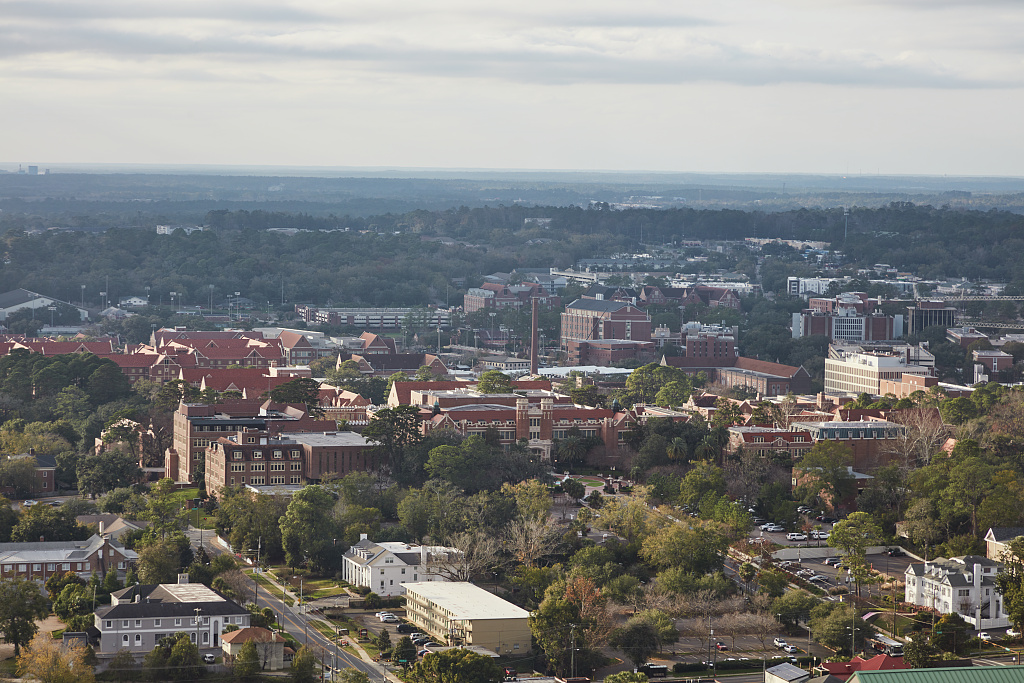
View of Tallahassee from the Florida State Capitol observation tower, January 2020. Source: Carol M. Highsmith, via Library of Congress. License: No known restrictions on publication (copyright-free Highsmith Archive).
Quick Answer: The Tallahassee metro economy produced $21.3 billion in real (inflation-adjusted) GDP in 2024, up 4.3% from 2023, beating Florida’s 3.3% and the nation’s 2.8% for the first time in the same year since 2007, according to U.S. Bureau of Economic Analysis data released by the Tallahassee-Leon County Office of Economic Vitality. The labor market has cooled since: the metro’s unemployment rate was a preliminary 4.5% in September 2026, up from 4.2% a year earlier, and nonfarm payrolls were up just 0.3%.
For most of the past two decades, Tallahassee’s economy was described as stable rather than fast-growing. The latest county and metro gross domestic product figures from the U.S. Bureau of Economic Analysis (BEA) tell a different story about the years since the pandemic. Real output in Leon County climbed more than 22% between 2019 and 2024, private service industries did most of the lifting, and the four-county metro area posted its best growth relative to the state and nation in 17 years.
The labor data for 2026 add a caution. Preliminary U.S. Bureau of Labor Statistics (BLS) figures through September show payroll growth near zero, a higher jobless rate than a year earlier, and modest declines in government employment. Here is how big the Big Bend economy is, what drives it, and where the soft spots are.
How big is the Tallahassee-area economy?
The Tallahassee Metropolitan Statistical Area (MSA) includes Leon, Gadsden, Jefferson and Wakulla counties. According to the Office of Economic Vitality (OEV), a joint economic development office of the City of Tallahassee and Leon County, the metro’s real GDP reached $21.3 billion in 2024, measured in chained 2017 dollars, up from $20.4 billion in 2023. The four county-level BEA figures, as published in the Federal Reserve Bank of St. Louis FRED database, add up to the same $21.3 billion.
Leon County alone accounts for about 88% of that total, with real GDP of $18.8 billion in 2024. In current dollars, which include inflation, Leon County’s GDP was about $23.6 billion in 2024, up from $21.8 billion in 2023 and $16.1 billion in 2020, according to BEA data in FRED.
| Key fact | Figure | Source |
|---|---|---|
| Tallahassee MSA real GDP, 2024 | $21.3 billion (chained 2017 dollars) | BEA via OEV |
| MSA real GDP growth, 2024 | 4.3% | BEA via OEV |
| Florida / U.S. real GDP growth, 2024 | 3.3% / 2.8% | BEA via OEV |
| Leon County nominal GDP, 2024 | About $23.6 billion | BEA via FRED |
| Private-sector share of MSA real GDP | About 76% (74% in 2019) | OEV |
| Metro unemployment rate, Sept. 2026 (preliminary) | 4.5% (not seasonally adjusted) | BLS |
| Metro nonfarm jobs, Sept. 2026 (preliminary) | 203,300 (+0.3% over the year) | BLS |
| Government share of metro nonfarm jobs | About 31% | Calculated from BLS |
How fast did Tallahassee’s GDP grow compared with Florida and the U.S.?
In a February 12, 2026 release, OEV reported that the MSA’s real GDP rose 4.3% in 2024, compared with 3.3% for Florida and 2.8% for the United States. OEV said it was the first time since 2007 that the region outgrew both the state and the nation in the same year. The office also reported that real GDP rose 9.3% from 2022 to 2024 and stood 15.9% above its 2021 level.
Keith Bowers, director of the Office of Economic Vitality, said in the release that “GDP is one of the clearest indicators of overall economic activity.” Some local coverage described the gains as 2025 growth, but the BEA figures cited in the release cover calendar year 2024. BEA’s county and metro GDP data run on a lag of about a year, and the 2025 estimates are not yet out.
How does the post-pandemic run compare with the previous decade?
The longer series shows why the recent numbers stand out. In FRED’s BEA data, Leon County’s real GDP was about $14.66 billion in 2007 and $15.36 billion in 2019, a gain of under 5% across 12 years. Real output dipped in the Great Recession, stayed below its 2007 level through 2015, and fell again to $14.97 billion in the pandemic year of 2020.
Since then, growth has come every year: $16.08 billion in 2021, $17.14 billion in 2022, $17.95 billion in 2023 and $18.79 billion in 2024. That is a 22.4% increase from 2019 to 2024, and Leon County’s 2024 gain of about 4.7% was slightly faster than the metro’s 4.3%.
| Year | Leon County real GDP (billions, chained 2017 $) | Change from prior year |
|---|---|---|
| 2007 | $14.66 | +3.3% |
| 2019 | $15.36 | +2.4% |
| 2020 | $14.97 | -2.5% |
| 2021 | $16.08 | +7.5% |
| 2022 | $17.14 | +6.6% |
| 2023 | $17.95 | +4.7% |
| 2024 | $18.79 | +4.7% |
Source: U.S. Bureau of Economic Analysis, GDP by county, via FRED (series last updated February 5, 2026). Percentage changes calculated from the published values.
What is driving Tallahassee’s economic growth?
BEA splits county GDP into three broad groups: private goods-producing industries, private services-providing industries, and government. The Leon County numbers show that private services carried the expansion, even in a capital city long defined by state government and two large public universities.
| Leon County sector (real GDP) | 2023 | 2024 | 2024 change | Share of 2024 total |
|---|---|---|---|---|
| Private services-providing | $12.50B | $13.20B | +5.6% | About 70% |
| Government and government enterprises | $4.51B | $4.68B | +3.7% | About 25% |
| Private goods-producing | $0.95B | $0.94B | -1.5% | About 5% |
| All industries | $17.95B | $18.79B | +4.7% | 100% |
Source: BEA via FRED, chained 2017 dollars. Chained-dollar components do not add exactly to totals. Shares are approximate.
How much did private service industries grow?
Real output from Leon County’s private services-providing industries rose from $10.32 billion in 2019 to $13.20 billion in 2024, a gain of about 28%. That category covers health care, professional and business services, finance, real estate, retail, hospitality and other private services.
OEV’s release made the same point at the metro level, reporting that private-sector activity accounted for about 76% of the MSA’s real GDP in 2024, up from 74% in 2019. In the WTXL ABC 27 coverage of the release, Bowers credited private companies, from health care to small businesses, with driving most of the growth.
Is government still a major piece of the economy?
Yes. Government’s real output in Leon County grew from $4.31 billion in 2020 to $4.68 billion in 2024, an increase of about 8.6%, which is much slower than the private service side. In current dollars, government and government enterprises produced about $5.93 billion of Leon County’s roughly $23.6 billion GDP in 2024, or about one-quarter of the total. BEA’s government category includes state agencies, local governments and public universities.
Private goods-producing industries, which include construction and manufacturing, are a small part of the local economy at about $0.94 billion in real output in 2024. That was down slightly from 2023.
How are the surrounding Big Bend counties doing?
The rural counties around Leon are small in dollar terms, but their trends varied widely in 2024. The table below uses the same BEA county data from FRED. Liberty County is not part of the Tallahassee MSA but is included as part of the broader Big Bend region.
| County | 2020 real GDP | 2023 real GDP | 2024 real GDP | 2024 change |
|---|---|---|---|---|
| Gadsden (MSA) | $1,304M | $1,317M | $1,276M | -3.2% |
| Wakulla (MSA) | $757M | $864M | $910M | +5.3% |
| Jefferson (MSA) | $250M | $308M | $341M | +10.4% |
| Liberty (non-MSA) | $305M | $293M | $370M | +26.2% |
Source: BEA via FRED, chained 2017 dollars, rounded to the nearest million. Percentage changes calculated from the published values.
Gadsden County, the largest of the surrounding counties by output, was the only MSA county to shrink in 2024, and its real GDP was slightly below its 2020 level. Wakulla grew about 20% from 2020 to 2024, and Jefferson grew about 36% over the same period from a much smaller base. Liberty’s 26% jump in 2024 followed declines in 2021 and 2022, a reminder that a single employer or project can swing results sharply in a county of that size.
The counties are tied together through commuting. OEV reported that about one-third of the metro’s workers commute in from surrounding counties, and that the MSA accounts for roughly 87% to 88% of total regional GDP.
What does the Tallahassee job market look like in 2026?
The labor data are more recent than the GDP figures, and they show a slower pace. According to preliminary BLS data for September 2026, the Tallahassee metro had a civilian labor force of 209,600, with 200,200 people employed and 9,300 unemployed. The unemployment rate, not seasonally adjusted, was 4.5%, down from 4.9% in August and 5.1% in July but up from 4.2% in September 2025.
For context, Florida’s seasonally adjusted statewide rate was 4.4% in September, according to state figures reported by WLRN, and the national seasonally adjusted rate was 4.2%, according to BLS. Among Florida’s metro areas in September, Tallahassee’s 4.5% matched Jacksonville and sat in the middle of a range from 3.2% in Miami-Fort Lauderdale-West Palm Beach to 7.6% in Wildwood-The Villages.
Which industries are adding and losing jobs in Tallahassee?
Total nonfarm payrolls were 203,300 in September 2026, up 0.3% from a year earlier. The table below shows the BLS industry breakdown, which counts jobs by place of work rather than by residence.
| Industry (Tallahassee MSA) | Jobs, Sept. 2026 (p) | 12-month change |
|---|---|---|
| Government | 63,600 | -0.8% |
| Professional and business services | 30,400 | +4.5% |
| Education and health services | 27,800 | +1.8% |
| Trade, transportation and utilities | 26,900 | -1.1% |
| Leisure and hospitality | 20,700 | -0.5% |
| Mining, logging and construction | 10,300 | 0.0% |
| Financial activities | 9,800 | -2.0% |
| Other services | 6,400 | -1.5% |
| Manufacturing | 4,400 | 0.0% |
| Information | 3,000 | 0.0% |
| Total nonfarm | 203,300 | +0.3% |
Source: U.S. Bureau of Labor Statistics, Economy at a Glance, Tallahassee, FL (data extracted November 10, 2026). Not seasonally adjusted; (p) = preliminary.
Professional and business services was the clear bright spot, growing 4.5% over the year and accelerating from a decline in April. Education and health services also added jobs. Government, which still supplies roughly 31% of metro payroll jobs, was down 0.8% from September 2025 and had posted year-over-year declines in every month from April through September. Financial activities, retail and transportation, and hospitality were also slightly lower.
How many jobs did the region add in 2025?
OEV reported that the metro added about 2,100 jobs in 2025. The same release noted that the region ranked 16th nationally, second in the South Atlantic region and fifth among medium-sized metros in Area Development’s 2025 Leading Metro Locations report, and 19th of 411 metros for “Prime Workforce” performance, a measure of competitiveness, growth and wage gains.
Brian’s Take
Looking at these numbers the way I would have as an analyst, what stands out to me is the mix, not the headline. A 4.3% year is nice, but the more important number is that private service industries in Leon County grew about 28% in real terms from 2019 to 2024 while government grew far more slowly. For a city that has long been described as a government town, that is a real shift in where the growth is coming from.
The 2026 job numbers temper the story. Payrolls up 0.3%, an unemployment rate higher than a year ago, and government jobs down on a year-over-year basis tell me the post-pandemic run has slowed. The growth in professional and business services is encouraging, because those firms can sell to clients well beyond Tallahassee, but one sector does not make a trend.
For Florida business owners and investors looking at the Big Bend, I would watch two things: whether the 2025 GDP data, when BEA releases it, holds onto the private-sector gains, and whether Gadsden County, the metro’s second-largest county economy, can return to growth. A capital region that keeps diversifying is a stronger place to build a business than one that rises and falls with state budgets.
Frequently Asked Questions
What is the GDP of the Tallahassee metro area?
The Tallahassee MSA’s real GDP was $21.3 billion in 2024, in chained 2017 dollars, according to BEA data released by the Office of Economic Vitality. Leon County alone produced about $23.6 billion in current dollars.
Did Tallahassee’s economy grow faster than Florida’s?
Yes, in 2024. The metro grew 4.3% in real terms, compared with 3.3% for Florida and 2.8% for the U.S. OEV said it was the first time since 2007 the region outpaced both in the same year.
What is Tallahassee’s unemployment rate?
The preliminary September 2026 rate was 4.5%, not seasonally adjusted, according to BLS. That was down from 4.9% in August but up from 4.2% in September 2025.
Which counties are in the Tallahassee metro area?
The MSA includes Leon, Gadsden, Jefferson and Wakulla counties. Leon accounts for about 88% of the metro’s real GDP.
What is the largest employer sector in Tallahassee?
Government, with 63,600 jobs in September 2026, or about 31% of nonfarm employment. Professional and business services was second at 30,400 and the fastest-growing major sector over the past year.
When will 2025 GDP data for Tallahassee be released?
BEA publishes county and metro GDP about a year after the reference year. The 2024 figures were posted in early 2026, and 2025 figures have not yet been released.
Sources and Further Reading
- Tallahassee-Leon County Economy Outpaces State and Nation in GDP Growth (February 12, 2026) – Leon County Government / Tallahassee-Leon County Office of Economic Vitality
- Real Gross Domestic Product: All Industries in Leon County, FL – U.S. Bureau of Economic Analysis, via Federal Reserve Bank of St. Louis (FRED)
- Gross Domestic Product: All Industries in Leon County, FL – U.S. Bureau of Economic Analysis, via FRED
- Real GDP: Private Services-Providing Industries, Private Goods-Producing Industries, and Government in Leon County, FL – U.S. Bureau of Economic Analysis, via FRED
- Real Gross Domestic Product: All Industries in Gadsden, Jefferson, Wakulla and Liberty Counties, FL – U.S. Bureau of Economic Analysis, via FRED
- Economy at a Glance: Tallahassee, FL – U.S. Bureau of Labor Statistics
- Southeast Labor Force Statistics: Unemployment Rates – U.S. Bureau of Labor Statistics
- Florida jobless rate dips in September (October 16, 2026) – WLRN
- Tallahassee-Leon County economic growth outpaces state, national growth (February 2026) – WTXL ABC 27
About the Author