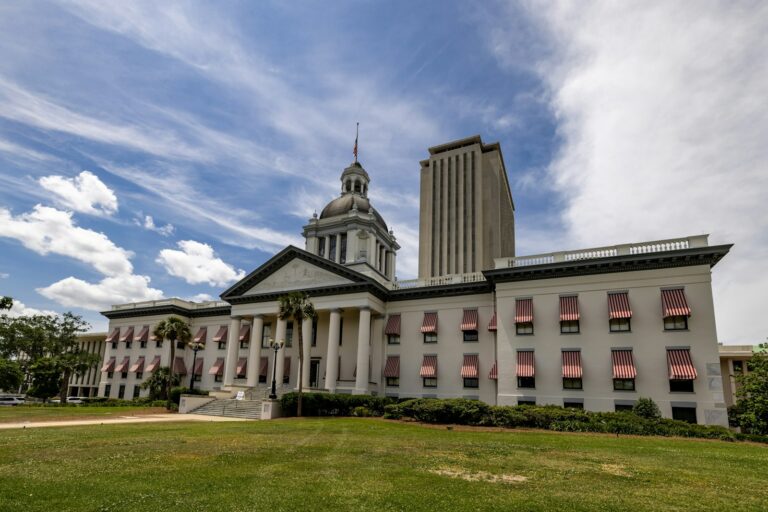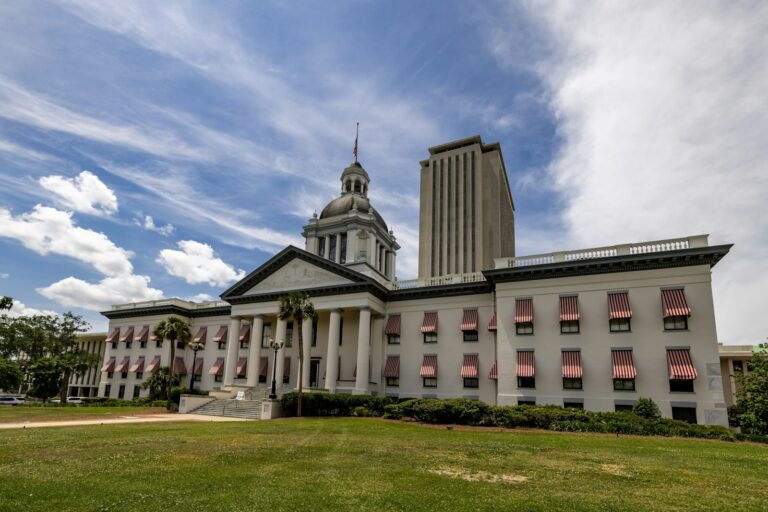
Photo: "The Old Florida Capitol, Tallahassee" by Civil10, via Wikimedia Commons. CC0 1.0 Universal Public Domain Dedication.
Quick Answer: Florida collected $51.86 billion in general revenue in fiscal 2025-26, $869.6 million more than expected, and state economists in August raised the forecast for the next two years by nearly $1 billion. The Legislature’s Long-Range Financial Outlook projects surpluses of $7.1 billion and $3.4 billion before a deficit of about $1.0 billion in fiscal 2029-30.
State government is a central part of Tallahassee’s economy, and state government runs on general revenue, the pool of sales tax, corporate income tax and other collections that pays for schools, Medicaid, prisons and most of the state’s day-to-day operations. Two documents produced this year by the Legislature’s economists set the stage for the 2027 legislative session: the August 14 general revenue forecast and the Long-Range Financial Outlook adopted by the Legislative Budget Commission on September 11.
This analysis uses those documents, the Office of Economic and Demographic Research’s outlook statement and news coverage of the forecast and the November 3 ballot to explain how much money Florida has, where the forecast is heading and what voters decided about the state’s reserves and property taxes.
How much general revenue did Florida collect in fiscal 2025-26?
The fiscal year that ended June 30, 2026, produced general revenue of $51,857.1 million, according to the general revenue outlook statement dated August 14, 2026. Collections beat expectations by $869.6 million, or 1.7%, Florida Trend reported, citing the News Service of Florida.
The state ended the year with a general revenue balance of $13,329.4 million. Separately, the Budget Stabilization Fund, Florida’s rainy day fund, held a cash balance of $4,870.3 million. Based on that balance and the August forecast, no transfers into the fund are required from fiscal 2026-27 through fiscal 2030-31, according to the outlook statement.
Florida general revenue snapshot
| Item | Amount |
|---|---|
| FY2025-26 general revenue collected | $51,857.1M |
| FY2025-26 collections above estimate | $869.6M (+1.7%) |
| FY2025-26 ending GR balance | $13,329.4M |
| Budget Stabilization Fund cash balance | $4,870.3M |
| FY2026-27 estimated revenue | $52,339.9M |
| FY2026-27 effective appropriations | $54,916.6M |
| FY2027-28 estimated revenue | $53,289.6M |
Source: Office of Economic and Demographic Research, General Revenue Outlook Statement, August 14, 2026.
How does this year’s budget balance out?
The outlook statement shows how the current year fits together. For fiscal 2026-27, total general revenue funds available, combining the carried-forward balance with new revenue, are $65,961.6 million. Effective appropriations are $54,916.6 million, about $2.6 billion more than the year’s estimated revenue of $52,339.9 million, with the difference covered by the balance carried forward from prior years. After appropriations, adjusted funds available stand at $11,045.0 million.
| FY2026-27 general revenue | Amount |
|---|---|
| Total funds available | $65,961.6M |
| Estimated revenue | $52,339.9M |
| Effective appropriations | $54,916.6M |
| Adjusted funds available | $11,045.0M |
What other items are built into the outlook?
The outlook statement’s footnotes list several commitments. A $250 million recurring transfer to the State Board of Administration for debt reduction began in fiscal 2025-26 under HB 5017. Transfers for the state reinsurance program were reduced to $900 million under HB 5013. Federal American Rescue Plan recovery funds must be spent by December 31, 2026, with about $8.9 million expected to be returned to the U.S. Treasury. The statement also excludes the potential effects of pending litigation on revenues or appropriations.
What did state economists change in the August forecast?
The Revenue Estimating Conference raised its general revenue forecast by $475.1 million for the current fiscal year, 2026-27, and by $508 million for 2027-28, a combined increase of nearly $1 billion, Florida Trend reported. Amy Baker, coordinator of the Legislature’s Office of Economic and Demographic Research, said the change did not represent a material change to the overall forecast.
Corporate income tax drove the revision. The estimate rose $527.2 million for the current year and $439 million for 2027-28, as national forecasts point to strong corporate profits. Sales tax, normally the state’s largest revenue source, was revised up by a more modest $183.5 million for the current year and $93.8 million for 2027-28.
August 2026 forecast revisions
| Revenue source | FY2026-27 change | FY2027-28 change |
|---|---|---|
| Corporate income tax | +$527.2M | +$439.0M |
| Sales tax | +$183.5M | +$93.8M |
| Total general revenue | +$475.1M | +$508.0M |
Source: Florida Trend / News Service of Florida, August 17, 2026. Other sources net to the totals shown.
The pattern matters. Corporate profits are strong, according to the national forecasts the conference relied on, while the sales tax, which reflects everyday spending by residents and visitors, was revised only modestly. That is consistent with the risks economists flagged around consumer budgets and tourism. The estimates will be revisited when the 2027 regular legislative session begins on March 2, Florida Trend reported.
How fast will Florida’s revenue grow?
Slowly in the near term. Estimated general revenue of $52,339.9 million in fiscal 2026-27 is about 0.9% above the prior year’s collections, and $53,289.6 million in 2027-28 is about 1.8% higher, based on the outlook statement’s figures. Growth then settles at roughly 2.3% to 2.7% a year through fiscal 2031-32, when the estimate reaches $58,849.4 million.
Florida general revenue forecast
| Fiscal year | General revenue | Growth |
|---|---|---|
| 2025-26 (actual) | $51,857.1M | n/a |
| 2026-27 | $52,339.9M | +0.9% |
| 2027-28 | $53,289.6M | +1.8% |
| 2028-29 | $54,616.8M | +2.5% |
| 2029-30 | $55,846.1M | +2.3% |
| 2030-31 | $57,315.3M | +2.6% |
| 2031-32 | $58,849.4M | +2.7% |
Growth rates calculated from the EDR outlook statement, August 14, 2026.
What risks did economists flag?
The forecast came with a long list of cautions, according to Florida Trend. They included the conflict with Iran over control of oil cargo through the Strait of Hormuz, the latest round of federal tariffs, inflation pressure on household savings that has pushed up credit use, continued slowing in construction and real estate, and slower tourism growth. Consumer sentiment was more than 10% below a year earlier, though it improved in July, and Joanne Hsu of the University of Michigan Surveys of Consumers said consumers’ five-year business outlook remained well under historic averages.
What does the Long-Range Financial Outlook show?
The Long-Range Financial Outlook, adopted September 11, 2026, compares expected general revenue with projected spending needs under current law for the next three fiscal years. It shows surpluses of $7,135 million in fiscal 2027-28 and $3,360 million in 2028-29, followed by a deficit of $1,025 million in 2029-30. The document concludes that expenditure projections are expected to outpace available general revenue in the third year.
Long-Range Financial Outlook, general revenue
| Item | FY2027-28 | FY2028-29 | FY2029-30 |
|---|---|---|---|
| Revenues available | $53,455M | $54,782M | $56,011M |
| Revenue adjustments | -$440M | -$855M | -$1,270M |
| Critical needs | $1,905.7M | $2,727.6M | $2,270.9M |
| Other high-priority needs | $3,333.3M | $3,303.8M | $3,254.2M |
| Projected surplus (deficit) | $7,135M | $3,360M | -$1,025M |
Source: 2026 State of Florida Long-Range Financial Outlook, Legislative Budget Commission.
The Outlook keeps a minimum reserve of 3.9% of the revenue estimate, about $2.1 billion each year, in general revenue. Total anticipated reserves for fiscal 2026-27 are nearly $16.2 billion, including $11.0 billion of unallocated general revenue.
What is driving state spending?
The scale is large: Florida collects roughly $50 billion of general revenue a year, so each percentage point of growth is worth about half a billion dollars to the budget. The Outlook identifies $16.8 billion of general revenue spending drivers over three years, down 17.4% from $20.3 billion in last year’s version. Medicaid remains the largest program, with total expenditures projected at $41.2 billion in fiscal 2027-28 and enrollment near 4.0 million; its general revenue driver is $1,210.0 million that year. State employee benefits, driven largely by health insurance costs, add $947.5 million in 2027-28, rising to $1,321.0 million by 2029-30.
Education is another large driver. The Outlook projects enrollment growth of 3,908 full-time-equivalent students in fiscal 2027-28 in the Florida Education Finance Program, and one driver reduces the general revenue need by $938.5 million in 2027-28 by using trust funds first. In all, the Outlook counts 15 critical-needs drivers and 28 other high-priority drivers. It reflects current law only and does not include new or expanded programs, and its Fiscal Strategies section discusses options for avoiding the third-year deficit.
Selected spending drivers in the Outlook
| Driver (general revenue) | FY2027-28 | FY2028-29 | FY2029-30 |
|---|---|---|---|
| Medicaid | $1,210.0M | $789.3M | $438.0M |
| State employee benefits | $947.5M | $1,142.8M | $1,321.0M |
| All critical and high-priority drivers | $5,239.0M | $6,031.4M | $5,525.1M |
Source: 2026 Long-Range Financial Outlook.
What did voters decide on November 3?
Two ballot measures bore directly on state and local finances, WGCU reported. Amendment 1, which would have raised the cap on the Budget Stabilization Fund from 10% to 25% of the prior year’s general revenue, received about 40% of the vote and failed. Florida constitutional amendments need 60% approval. Had it passed, the outlook statement noted, it would also have required an annual $750 million transfer into the fund until the cap was reached.
Amendment 3, which increases the homestead property tax exemption, passed with about 62%. It raises the exemption from $50,000 to $150,000 in 2027 and to $250,000 in 2028, with school districts excluded from the larger exemption. Amendment 2, a property tax exemption for some agricultural property and equipment, received about 58% and failed.
WGCU reported that the Legislature placed the homestead measure on the ballot after a June special session, changing an original plan from the governor’s office that called for an immediate increase to $250,000, and that it went to voters without the governor’s signature. Firefighter, police and EMT groups and some local officials argued the cut would be too steep for rural counties to absorb without affecting essential services. Governor Ron DeSantis opposed Amendment 1, the reserve fund measure, WGCU reported. The agricultural exemption in Amendment 2 would have been a tax cut of about $30 million to $40 million across all 67 counties, according to the same report.
November 2026 fiscal ballot measures
| Measure | Subject | Yes vote | Result |
|---|---|---|---|
| Amendment 1 | Raise rainy day fund cap to 25% | About 40% | Failed |
| Amendment 2 | Agricultural property tax exemption | About 58% | Failed |
| Amendment 3 | Larger homestead exemption | About 62% | Passed |
Source: WGCU, November 4, 2026.
What does the budget picture mean for Tallahassee businesses?
For the capital city, state finances translate directly into contracts, consulting work, construction and payroll. The data point to a few practical conclusions. Revenue is above plan and reserves are large, which supports current spending levels heading into the 2027 session. The Outlook’s surplus projections give lawmakers room in fiscal 2027-28. But slower revenue growth and a projected deficit in fiscal 2029-30 mean budget writers will be working with less cushion over time, and the larger homestead exemption approved by voters will change local property tax revenue starting in 2027, a separate pressure on cities and counties rather than the state’s general revenue.
Firms that sell to state agencies, and the associations and consultants that follow state budget issues, will be watching how lawmakers use the projected surpluses and whether they act on the Outlook’s warning about the third year.
Brian’s Take
Having spent years reading financial statements, I look at Florida’s numbers the way I would a company’s. Revenue came in above plan, the forecast went up, reserves are large and the near-term outlook shows surpluses. Those are strong numbers for any balance sheet.
The part I would underline is the shape of the curve. Revenue growth of under 1% this year and under 2% next year is slow, and the Legislature’s own outlook shows spending catching up to revenue by the third year. Much of this year’s upgrade came from corporate income tax, which tends to be less steady than sales tax.
For Tallahassee businesses that depend on state contracts and state payroll, the message from the data is that the money is there for now, but the margin narrows over the next few budgets.
Frequently Asked Questions
How much general revenue does Florida collect?
About $51.9 billion in fiscal 2025-26, with $52.3 billion forecast for 2026-27.
Did Florida’s revenue beat expectations?
Yes. Fiscal 2025-26 collections exceeded the estimate by $869.6 million, or 1.7%.
Does Florida face a budget deficit?
The Long-Range Financial Outlook projects surpluses in 2027-28 and 2028-29 and a deficit of about $1.0 billion in 2029-30 under current law.
How much is in Florida’s rainy day fund?
The Budget Stabilization Fund had a cash balance of $4,870.3 million as of the August 2026 outlook.
What happened to the rainy day fund amendment?
Amendment 1, which would have raised the fund’s cap to 25% of general revenue, failed with about 40% of the vote on November 3, 2026.
What drove the August revenue increase?
Mainly corporate income tax, revised up $527.2 million for 2026-27, with a smaller $183.5 million increase in sales tax.
When will Florida’s revenue estimates be updated?
Economists will revisit the estimates when the 2027 regular legislative session begins on March 2.
How does the homestead amendment affect taxes?
It raises the homestead exemption to $150,000 in 2027 and $250,000 in 2028, reducing taxable value for homesteaded property, with school district taxes excluded from the larger exemption.
What is the Long-Range Financial Outlook?
It is an annual three-year projection of revenue and spending needs under current law, adopted by the Legislative Budget Commission, most recently on September 11, 2026.
Sources and Further Reading
- General Revenue Outlook Statement, August 14, 2026 – Florida Office of Economic and Demographic Research
- 2026 State of Florida Long-Range Financial Outlook – Florida Legislative Budget Commission
- State Economists Raise Revenue Estimates Amid Continued Uncertainty – Florida Trend (News Service of Florida)
- Voters Approve Property Tax Cut, Reject Other Ballot Measures – WGCU
About the Author