Florida’s Data Center Reckoning: How SB 484 Split the State Into Winners, Holdouts, and Battlegrounds
Tallahassee Business Report | August 6, 2026 Analysis by Brian | Reading time: ~16 minutes
Article Summary
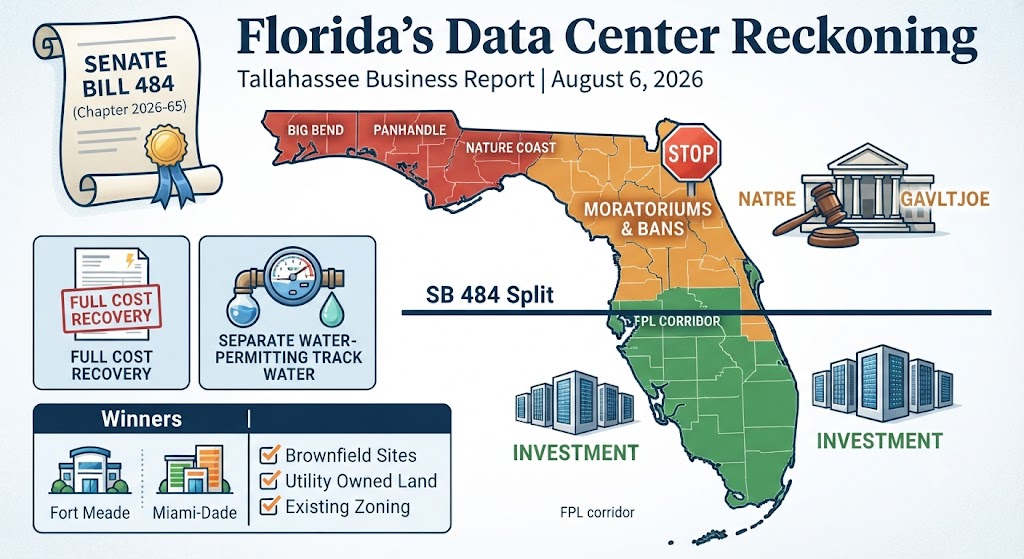
Florida enacted the nation’s first comprehensive hyperscale data center law on May 7, 2026. Senate Bill 484 (Chapter 2026-65) took effect July 1 and did three things at once: it forced large electricity users to pay their own full cost of service, it created a separate water-permitting track for facilities drawing 50 megawatts or more, and it explicitly preserved local government control over zoning and land use.
That third provision is the one reshaping Florida’s economic map. Within nine weeks of the law taking effect, more than a dozen counties and cities — including Leon County, which passed an 18-month moratorium on July 14 — moved to pause or prohibit large-scale data centers. Two Panhandle counties, Wakulla and Jackson, adopted outright bans against their own attorneys’ advice.
Meanwhile, the money is arriving anyway. NextEra Energy told investors on its second-quarter call that Florida Power & Light now projects 8 gigawatts of large-load demand by 2032, up from 6 GW in May, against roughly 21 GW of interest and 12 GW in advanced negotiations. Duke Energy flagged $5 billion to $10 billion of capital upside tied partly to Florida.
The result is a two-speed state. Southeast Florida’s FPL corridor, Polk County’s reclaimed phosphate lands, and the Treasure Coast are absorbing capital. The Big Bend, the Panhandle, and much of the Nature Coast have effectively taken themselves off the board. This report maps who prospers, who fights, and what the numbers actually support.
Key Takeaways
- SB 484 is not a ban and not a green light. It is a cost-allocation and local-control statute. The Florida Public Service Commission must propose implementing rules by March 1, 2027; utilities file conforming tariffs within 60 days after.
- 50 megawatts is the new legal line. A “large load customer” and a “large-scale data center” are both defined as a single location with anticipated monthly peak load of 50 MW or more, measured as the highest 15-minute average.
- 100 megawatts is the tax line. Since August 1, 2025, only facilities with 100 MW+ critical IT load qualify for Florida’s sales tax exemption — but that exemption now runs through June 30, 2037.
- At least 15 Florida local governments have adopted or advanced moratoriums or bans since April 2026.
- Florida ranked third nationally in total data center–supported employment in 2023 at roughly 335,800 jobs, per PwC — a figure independent analysts dispute.
- 68% of likely Florida voters oppose an AI data center in their own community, per a University of North Florida poll. The GOP gubernatorial primary is August 18.
What Does SB 484 Actually Require?
Governor Ron DeSantis signed SB 484 in Lakeland on May 7, 2026, framing it as protection for ratepayers against subsidizing what he described as some of the wealthiest companies in human history. He claimed it was the first law of its kind in the country. At the time of signing, no hyperscale data centers had yet been built in Florida, though the industry had been eyeing the state for expansion.
The statute works through four mechanisms.
Cost allocation. SB 484 creates Florida Statutes § 366.043, defining a large load customer as a customer with an anticipated monthly peak load of 50 megawatts or more, calculated as the highest average load over a 15-minute interval at a single location. The Public Service Commission must establish minimum tariff and service requirements, and those requirements must reasonably ensure that each large load customer bears its own full cost of service and that such cost is not shifted to the general body of ratepayers. The House staff analysis of the companion bill set the rulemaking clock: the PSC must propose a rule by March 1, 2027, and each public utility must file a conforming tariff within 60 days after the PSC adopts a final rule.
Local control. New § 163.326 states that local governments maintain the authority to exercise the powers and responsibilities for comprehensive planning and land development regulation with respect to large load customers. A companion provision bars treating a large load customer as an electric substation under § 163.3208 — closing a workaround that would have let projects bypass local review.
Water. § 373.203 now defines both “data center” and “large-scale data center.” New § 373.262 bars water management district governing boards and DEP from issuing an allocation permit to a large-scale data center applicant if the proposed use is harmful to the water resources of the area or is prohibited by the applicable local government zoning regulations and comprehensive plan. Districts may also require reclaimed water as a condition of approval.
Transparency and ownership. SB 484 eliminates the additional 12-month extension of the § 288.075 public records exemption for data center projects. Public utilities are barred from serving large load customers owned or controlled by foreign countries of concern.
Finally, the law directs the Office of Program Policy Analysis and Government Accountability to contract for an independent, interdisciplinary study of policy considerations related to the construction and operation of large-scale data centers, including recommendations on facility siting and mitigation measures. Findings are due to state leadership by July 1, 2027 — squarely inside the next governor’s first legislative session.
What SB 484 does not do is authorize local prohibition. Nassau County’s own published analysis is blunt on the point: the legislation does not explicitly provide for a blanket prohibition on data centers; rather, the local government must regulate according to Florida Statutes 163, Part II. Counties can condition, restrict, and delay. They cannot simply say no forever.
Three companion bills died. HB 1007 was laid on the table March 11 and folded into SB 484. SB 1118, a public-records exemption, died on the calendar March 13. HB 1517, the proposed Florida Data Center Transparency Act, never received a committee hearing.
🔹 Brian’s Take #1
Read SB 484 as a financing statute, not an environmental one.
Every headline focused on water and electric bills. The provision that will actually move billions is § 366.043’s full-cost-of-service mandate, because it converts a political risk into a contract term. Before this law, a hyperscaler evaluating Florida had to price in the possibility that a future PSC or a future legislature would claw back its rate deal after a backlash. Now the rule is written down, and — critically — it was written by a Republican legislature and signed by a Republican governor at a press conference in Polk County. That is about as durable as regulatory certainty gets in a state with a competitive governor’s race.
FPL’s own CEO said as much. Scott Bores told analysts in July that legislation enacted in Florida in May provides greater certainty for customers planning multibillion-dollar investments. That is not a utility complaining about regulation. That is a utility telling Wall Street the rules are now legible enough to underwrite against.
The irony writes itself. A law sold to voters as a restraint on data centers has, in the eyes of the state’s largest utility, made Florida more investable — because certainty is worth more to a $3 billion capital commitment than a marginal rate discount. The counties that read SB 484 as permission to slam the door are reading the wrong half of the bill.
Which Florida Regions Will Prosper?
The FPL Corridor: Southeast and Southwest Florida
The single most important number in Florida’s data center economy is not in any statute. It is in NextEra Energy’s second-quarter earnings deck.
NextEra raised its forecast for data center and other large-load demand at Florida Power & Light to 8 GW by 2032, up from a previous estimate of 6 GW. Behind that target sits roughly 21 GW of large-load interest, with 12 GW in advanced discussions and some service potentially beginning as early as 2028. The company expects to announce at least one transaction under the new tariff by year-end 2026.
FPL is not waiting on the PSC’s 2027 rulemaking. Two contract tariffs — Large-Load Contract Service 1 and 2 — have been in effect since January 1, 2026, approved as part of FPL’s rate settlement. Under that structure, the large customer bears connection costs and any new generation capacity required to serve it.
Why FPL territory wins: price and baseload. In the 2025 rate case, filings noted that under FPL’s GSLD-3 tariff, data centers had access to all-in electric rates of approximately 5.98 cents per kilowatt-hour before taxes and fees, competitive with data center power costs in Georgia, North Carolina, and Virginia, which run 5.5 to 7.5 cents. Florida’s average residential rate of about 15.38¢/kWh sits roughly 14% below the national average, and low-cost natural gas fuels about 70% of generation.
FPL’s Q2 balance sheet shows the machine running: net income of $1.41 billion, approximately $2.8 billion invested in the quarter, full-year capital expenditure guidance of $12 billion to $13 billion, and more than 90,000 new customers added.
Polk County: The Phosphate Land Play
Fort Meade — population roughly 5,300 — would host Florida’s first true hyperscale campus. On April 15, 2026, city commissioners voted unanimously to approve a developer agreement for what would be Florida’s first hyperscale data center, a $2.6 billion project spanning 4.4 million square feet on a 1,300-acre former phosphate mine. Developer Stonebridge’s commitments include roughly 450 permanent jobs averaging $107,000 per year, well above the Polk County median, plus $10 million toward local infrastructure — against a 10-year, $150 million tax incentive package.
At full capacity the facility would draw 1.2 gigawatts of electricity, potentially enough to power 1 million homes, served by Duke Energy’s Hines complex. Stonebridge says a closed-loop cooling system caps water use at about 50,000 gallons per day.
The economics for a small municipality are staggering. Reporting ahead of the vote noted Fort Meade, struggling to fund infrastructure upgrades, could get around $100 million a year if a hyperscale data center is built in the area.
The Treasure Coast: The Second Wave
St. Lucie County lost the $13.5 billion Sentinel Grove proposal — withdrawn February 26, 2026 — but retained Atlas Compute, a Miami-based developer that obtained zoning verification for a closed-loop, water-free cooling data center built in partnership with Penguin Solutions, specifically engineered for NVIDIA GPU workloads, starting at 240 MW with potential to reach 1 GW. Water-free cooling is the design answer to SB 484’s permitting chokepoint.
In Martin County, the Tesoro Groves PUD — a 5,722-acre FPL rezoning near Indiantown — was approved unanimously on April 30, 2026, with council declining to add language banning data centers. A resident challenge was dismissed with prejudice on July 2.
Miami-Dade: The Quiet Winner
Miami is the state’s largest data center market — roughly 37 facilities and about 93 MW — and it is the one place where new capacity is going up without a fight. Iron Mountain’s MIA-1, a 16 MW, 150,000-square-foot build in the Westview area of Miami-Dade, is slated for 2026 delivery, permitted by right as a telecommunications use.
Critically, Miami has room. Local vacancy has run around 16.4%, against a U.S. colocation vacancy of just 1.2% in Q1 2026, when national colocation inventory climbed 22% quarter over quarter to 29.0 gigawatts and net absorption hit 5.29 GW.
🔹 Brian’s Take #2
The winners share one trait, and it isn’t tax policy. It’s land with a prior sin.
Look at what actually got approved: a former phosphate mine in Fort Meade. A former citrus grove on the Treasure Coast. An industrial pocket of Miami-Dade already zoned for telecom. An FPL-owned agricultural tract in Indiantown. Every Florida project that has cleared local review sits on land that was already scarred, already industrial, or already owned by the utility.
Every project that died sat next to somebody’s house. Project Tango was denied 5–1 in Palm Beach County on July 15 — a 202-acre, 3.7-million-square-foot proposal about 1.8 miles from Lion Country Safari and adjacent to a 2,300-home community whose residents said they learned of it four days before the zoning hearing. Okeechobee’s Okee-One collapsed after roughly 3,000 residents signed a petition in a town of 5,500.
That is the actual siting rule in Florida, and no statute wrote it. If your parcel has a remediation history, a utility easement, or a heavy-industrial neighbor, you are in business. If it has a subdivision within earshot of a cooling array, you are in court.
Economic development offices in Bartow, Fort Pierce, and Indiantown should be marketing brownfields, reclaimed mine land, and closed landfills — not greenfield acreage. The differentiated asset in Florida right now is not cheap power. FPL sells cheap power to everybody. It is a parcel where nobody shows up to the hearing.
Where Is the Showdown — and Why Is Tallahassee at the Center of It?
Leon County did not wait for a proposal. It pre-empted one.
On July 14, 2026, county commissioners unanimously approved an 18-month moratorium on large-scale data centers, extended from an initially proposed 12 months at Commissioner Bill Proctor’s suggestion — pushing expiration to roughly January 2028. Commissioners raised concerns about possible environmental effects including water usage, saying more research and specific local regulations are needed. County staff now have 12 months to draft rules, leaving a six-month adoption buffer.
The city went the other way. On June 10, the Tallahassee City Commission rejected a similar motion in a 3-2 vote. City Manager Reese Goad’s argument was infrastructural, not ideological: local law does not allow for data centers; they cannot exist in Tallahassee today based on the comp plan and land use ordinances. He added that the city would have to triple the size of its utilities to support a center.
Commissioner Jeremy Matlow, who brought the motion, disputed the legal reading, noting the city land code does not define data centers at all and that facilities elsewhere are sited in anything zoned industrial. Leon County Chairman Christian Caban made the same point about the county’s comprehensive plan — which is precisely why the moratorium package included adding definitions for both “data center” and “large-scale data center.”
That definitional gap is the real vulnerability across North Florida. As Levy County’s attorney told commissioners, the county’s current code does not legally define data centers, meaning any proposed facility would have to go through an application process.
The Regional Map of Refusal
The Big Bend and Panhandle went furthest and fastest — and in two cases, past what the statute permits.
Wakulla County commissioners voted unanimously for a permanent ban on June 15. The vote came even as the board’s attorney cautioned that an indefinite ban put the county on riskier legal footing than a temporary moratorium. The county is home to Wakulla Springs, described in local coverage as the most extensive submerged cave network in North America. Jackson County adopted its own permanent ban ordinance on June 23. Walton County passed an emergency prohibition.
Hernando County took the opposite lesson. County Attorney Jon Jouben, citing federal case law, cautioned that enacting a moratorium longer than one year could infringe on property rights and expose the county to greater legal liability. Commissioner Steve Champion’s summary of the risk was direct: he argued the county needed to study the issue and write regulations, warning that a flat refusal would end in a courtroom loss.
Temporary moratoriums have passed or advanced in Nassau (12 months, the first county to act), Citrus, Clay, Lake, Sarasota, Hernando, Pasco (12 months, July 14), Levy, and St. Johns, plus the cities of Zephyrhills (six months) and Lakeland.
Lakeland’s is the most consequential municipal vote yet. On August 3, 2026 — three days ago — commissioners voted 4-3 to impose a one-year moratorium on new data centers and other businesses expected to use at least 50 megawatts of electricity, effective immediately, growing out of public opposition to Project Swan, a proposed 600,000-square-foot facility in west Lakeland. City Attorney Palmer Davis characterized it as a belt-and-suspenders measure, since data centers are already not a listed permitted use.
St. Johns County Commissioner Ann Taylor framed the cascade dynamic precisely: “By doing nothing, St. Johns County has a massive target on our back,” arguing that if neighboring counties close, hers becomes the path of least resistance.
The Statewide Backdrop
The politics are not close. A University of North Florida Public Opinion Research Lab poll found 68% of likely Florida voters oppose building an AI data center in their own community, while 28% support the idea. Nationally, 75 projects worth $130 billion were delayed or canceled in the first quarter of 2026 alone, matching all of 2025, with active opposition groups more than doubling from 396 to 833 across 49 states and 116 municipalities holding local moratoriums.
Even the state’s own economic development apparatus has broken ranks. Florida Commerce Secretary Alex Kelly sent an April 17, 2026 letter calling the Fort Meade proposal fundamentally flawed on water, energy, and transportation grounds, describing the developer’s water estimates as “woefully underestimated.” Two lawsuits filed May 14 seek to void the approval, and a recall effort targets three commissioners.
🔹 Brian’s Take #3
Wakulla and Jackson are going to lose, and everyone advising them knows it.
Both counties adopted permanent bans over explicit warnings from their own attorneys. SB 484 preserves local regulation — comprehensive planning and land development regulation under Chapter 163, Part II. It does not preserve local prohibition. Nassau County, working with counsel, published exactly that reading before adopting a time-limited moratorium instead. Hernando’s attorney reached the same conclusion from federal takings case law.
A permanent ban is an invitation to a facial challenge, and the first developer with a real site and real money will accept it. When that case is decided, the ruling will bind every county in Florida — and it will be litigated on the worst possible facts for local governments, because the ordinance under review will be the most extreme one on the books.
The counties that will still have leverage in 2028 are the ones doing the unglamorous work right now: writing definitions, setting noise limits at the property line, requiring closed-loop cooling, imposing decommissioning bonds, mandating buffer distances from residential zoning. Leon County’s 18-month package, whatever you think of the pause itself, at least directs staff to produce that framework.
Wakulla will spend its next 18 months in litigation instead. Same clock, nothing to show for it.
What Would Data Centers Contribute to Florida’s Economy and Tax Base?
This is where the evidence gets genuinely contested, and honest reporting has to present both sides.
The Industry Case
The Data Center Coalition’s PwC study is the most-cited source. Its 2026 edition found that in 2024 the U.S. data center industry directly employed 1,005,080 people, contributed $927 billion to U.S. GDP, and generated $204 billion in tax contributions to federal, state, and local governments, with each direct job supporting more than 4.5 jobs elsewhere. Over 2023–2024, the industry’s total tax contribution amounted to $369 billion.
For Florida specifically, the prior edition found that in 2023 the industry supported roughly 335,800 total jobs including direct, indirect, induced, and cross-state spillover effects — third nationally behind California at 724,700 and Texas at 485,100.
Georgia offers the closest regional comparison. A 2025 University of Georgia Carl Vinson Institute analysis found data centers created 28,350 construction jobs and added $3.4 billion to the state economy in a single year, plus 5,471 permanent operations roles generating another $823 million. On the property tax side, the same analysis found four new metro Atlanta data centers averaged $2.3 billion in assessed property value each, generating roughly $28 million in annual property tax revenue per project.
That property tax figure is the one Florida officials should study hardest, because Florida levies tangible personal property tax on business machinery and equipment.
The Florida-Specific Tax Structure
Florida’s fiscal position on data centers is unusual and, on paper, favorable.
| Tax lever | Florida treatment | Implication |
|---|---|---|
| Individual income tax | None | No wage-based revenue capture |
| Corporate income tax | 5.5%, sales-factor apportionment | Low exposure penalty for siting here |
| Sales tax on equipment | Exempt at 100 MW+ through June 30, 2037 | Hyperscale-only incentive |
| Sales tax on electricity | Exempt for qualifying facilities | Major operating cost relief |
| Commercial lease sales tax | Repealed by HB 7031 (2025) | Removes ~3–3.5% colocation drag |
| Tangible personal property tax | Levied at county millage | The county revenue engine |
The Tax Foundation’s December 2025 analysis models a $1 billion data center as $775 million in tangible personal property, a $225 million shell build, 40 acres, and 32 MW of utilization. Servers and chipsets account for 75 percent of TPP on a five-year replacement cycle — and for AI-oriented builds, that cycle often compresses to three years.
Because Florida taxes TPP but exempts qualifying data center equipment from sales tax, the state has effectively structured itself to collect recurring local property tax on a rapidly depreciating, rapidly replaced asset base while forgoing a one-time transaction tax. For comparison, the Tax Foundation calculated that sales tax exposure at the national average combined rate would cost a $1 billion facility an estimated $58.3 million in the first year and $9.7 million each year thereafter.
Scale that to Fort Meade. At $2.6 billion in planned real estate and equipment investment, applying the Tax Foundation’s TPP ratio implies an equipment base in the neighborhood of $2 billion — the kind of assessed value that, at typical Polk County millage, generates recurring eight-figure annual revenue for a city of 5,300 people. The $100 million-a-year figure discussed at the February town hall is aggressive, but the order of magnitude is not fantasy.
The Skeptical Case
Independent analysts have attacked the PwC methodology directly. A January 2026 Food & Water Watch brief noted that data centers in 2023 directly employed 603,000 people nationally while the report claimed support for 4.7 million jobs, and argued that employment at “data centers” is strongly correlated with state population, suggesting the report may be including numerous jobs in unrelated industries. Its exhibit: the study ranked Florida third for data center employment while ranking Virginia — the actual capital of the industry — ninth.
The ratepayer offset is the sharper critique. The Ohio River Valley Institute analyzed Pennsylvania and found that the data center industry directly contributed just $1.36 billion in state and local tax revenue in 2023 — roughly $340 million less than they are taking from Pennsylvania ratepayers in the form of higher electric bills. SB 484 is designed precisely to prevent that arithmetic in Florida, but the design is untested.
On jobs, the most useful Florida-specific number came from a University of Florida expert addressing Levy County commissioners: for every 10,000 square feet, a data center creates one to two permanent jobs. Apply that to Fort Meade’s 4.4 million square feet and you get 440 to 880 permanent positions — which brackets Stonebridge’s 450-job commitment almost exactly. The employment math checks out. It is simply small relative to the footprint.
🔹 Brian’s Take #4
Stop arguing about jobs. Argue about the assessment roll.
The jobs debate is a category error that both sides keep committing. A 4.4-million-square-foot campus producing 450 jobs is a terrible jobs project and a spectacular tax base project. Those are not contradictory findings; they are the same finding stated twice.
Compare it to what else could occupy 1,300 acres in Polk County. A distribution center of similar footprint would generate more employment, vastly more truck traffic, a fraction of the assessed value, and no tangible personal property worth taxing. Fort Meade is not choosing between a data center and a better employer. It is choosing between a data center and continued fiscal constraint — which is exactly why a commission facing 40 opposed speakers out of 41 still voted unanimously yes.
But here is the part economic developers underplay: the TPP base is a depreciating asset on a three-to-five-year replacement cycle. That is a feature and a risk. It is a feature because equipment gets replaced, resetting assessed value upward. It is a risk because if the operator ever stops reinvesting — if the AI capex cycle turns, if the tenant consolidates elsewhere — the assessed value collapses on a five-year schedule and the county’s budget goes with it.
Any Florida county writing data center rules over the next 18 months should be negotiating for what Fort Meade did not get: a minimum assessed-value floor, a capital reinvestment covenant, and a decommissioning bond. The tax base is the whole deal. Protect it contractually or don’t take it.
What Happens Next?
Four dates control the next 18 months.
Late August 2026 — the Duke tariff hearing. Duke Energy Florida’s proposed large-load tariff is the first real test of SB 484’s cost-allocation mandate. The Florida PSC voted 4-1 to keep the petition alive, rejecting a motion to dismiss outright, but with a pointed warning: Commissioner Gary Clark told the utility it was on “real shaky ground.” The state’s Office of Public Counsel has called the plan unlawful. A two-day evidentiary hearing will determine compliance. Duke currently has no large-load data center customers in Florida — it filed in September 2025 in anticipation of demand, and refiled in April 2026 to conform to the new law.
August 18, 2026 — the primary. Data centers have become a defining issue in the governor’s race. Democratic candidate David Jolly has called for a one-year statewide moratorium on new hyperscale facilities. Byron Donalds, the Trump-endorsed Republican frontrunner, has campaigned on conditional support, with advertising framing it as protecting ratepayers first. Lt. Gov. Jay Collins has argued the facilities cannot simply be banned. Polling suggests the issue is cutting: one recent survey found roughly a third of a rival’s voters citing Donalds’ data center posture as a top reason to oppose him.
March 1, 2027 — PSC rulemaking deadline. The commission must propose implementing rules for large load tariffs. Utilities file conforming tariffs within 60 days of final adoption.
July 1, 2027 — the OPPAGA report. The independent study lands with recommendations on siting and mitigation, in time for the 2028 session and a new administration.
Two wildcards sit outside that calendar. First, litigation: two suits against the Fort Meade approval, plus whatever facial challenge eventually tests Wakulla’s and Jackson’s permanent bans. Second, the water permits. Stonebridge had not applied to the Southwest Florida Water Management District as of late spring, and SWFWMD adopted a policy in December 2025 requiring data center water permits to clear its full governing board at a public meeting where residents can object — a venue where the Fort Meade project has never once won.
🔹 Brian’s Take #5
Florida’s real bottleneck was never regulatory. It’s interconnection queue position, and the counties saying no are handing it to the counties saying yes.
Here is the sequence nobody is tracking publicly. FPL reports 21 GW of large-load interest and 12 GW in advanced discussions against an 8 GW target for 2032. That means roughly 60% of advanced-stage interest will not get served in this decade — not because of moratoriums, but because generation, transmission, and substation capacity take five to seven years to build.
Every county that adopts a moratorium removes its sites from a queue that is already oversubscribed. The capacity does not evaporate. It reallocates — to Polk, to St. Lucie, to Miami-Dade, to whichever jurisdiction has a shovel-ready parcel when FPL’s first transaction closes, which the company says will happen before December 31.
That is the actual economic consequence of the last nine weeks. Leon County’s 18 months, Nassau’s 12, Pasco’s 12, Lakeland’s 12 — those are not pauses in a static market. They are forfeitures of position in a queue that clears once. When Leon County’s moratorium expires in January 2028 and staff present a beautifully drafted ordinance, FPL’s 8 GW will already be allocated and Duke’s tariff will already be settled.
For Tallahassee specifically, this may be the right trade. Reese Goad is correct that the city’s municipal utility cannot serve a hyperscale load without a generational capital program, and Leon County’s water sits atop a karst aquifer system that makes consumptive-use permitting genuinely hard. There is no version of 2026 where a 500 MW campus lands in Leon County. The moratorium costs the capital region very little because the capital region was never in the running.
But the Big Bend counties that banned facilities outright — Wakulla, Jackson, Walton — made a different bet. They had exactly one asset a data center wants: cheap land in the Northwest Florida Water Management District, which has abundant water and low current demand. That was a real, if modest, economic development position. They traded it for a legal fight they were told they would lose.
The state’s answer arrives July 1, 2027, in an OPPAGA report commissioned by the same legislature that wrote SB 484. Between now and then, roughly $20 billion in announced private capital is going to find somewhere in Florida to land. The map of where is being drawn in county commission chambers this summer — not in the Capitol.
Frequently Asked Questions
Is Florida’s SB 484 a data center ban? No. SB 484 requires large electricity users to pay their full cost of service, creates a separate water-permitting process for facilities at 50 MW or above, and preserves local zoning authority. It does not authorize local governments to prohibit data centers outright.
What is the threshold for a “large-scale data center” in Florida? A single location with a data center on site and an anticipated monthly peak load of 50 megawatts or more, calculated as the highest average load over a 15-minute interval.
Can Florida counties ban data centers? Counties can regulate siting, zoning, noise, water use, and buffers, and can adopt temporary moratoriums. Multiple county attorneys — in Nassau, Hernando, Wakulla, and Jackson — have advised that permanent bans exceed the authority SB 484 preserves and carry litigation risk.
Does Florida still offer a data center tax exemption? Yes, but only for facilities with 100 MW or more of critical IT load, following HB 7031 (2025), which raised the threshold from 15 MW effective August 1, 2025 with no grandfathering. The exemption certificate deadline was simultaneously extended to June 30, 2037.
Will data centers raise Florida electric bills? SB 484 is specifically designed to prevent that by requiring large load customers to bear their own full cost of service. FPL’s Large-Load Contract Service tariffs took effect January 1, 2026. Duke Energy Florida’s equivalent is still contested before the PSC.
How many permanent jobs does a data center create? A University of Florida expert briefing Levy County commissioners estimated one to two permanent jobs per 10,000 square feet. The Fort Meade project projects roughly 450 permanent positions averaging $107,000 annually across 4.4 million square feet.
Which Florida counties have restricted data centers? Permanent bans: Wakulla, Jackson, Walton. Moratoriums adopted or advancing: Leon (18 months), Nassau, Pasco, Citrus, Clay, Lake, Sarasota, Hernando, Levy, St. Johns, plus the cities of Lakeland and Zephyrhills. This list is changing weekly.
Can Tallahassee host a data center? Not currently. City Manager Reese Goad has stated the comprehensive plan and land development code do not permit them, and that municipal utility capacity would need to roughly triple. Leon County adopted an 18-month moratorium on July 14, 2026.
Sources
Statute and legislative record
- Florida Senate, CS/CS/SB 484 (2026), Chapter 2026-65 — flsenate.gov/Session/Bill/2026/484
- Florida Senate, 2026 Bill Summaries: SB 484 — flsenate.gov/Committees/BillSummaries/2026/html/484
- Florida House staff analysis, HB 1007 (h1007b.COM, March 2, 2026)
- Florida Senate, House Message Summary, CS/CS/SB 484
- Executive Office of the Governor, “Governor Ron DeSantis Signs Law to Protect Floridians from Subsidizing Data Centers,” May 7, 2026
- Florida Statutes §§ 163.326, 163.3208, 288.075, 366.043, 373.203, 373.262, 212.08(5)(s)
- Florida Senate, 2025 Bill Summaries: HB 7031
Legal analysis
- Carlton Fields, “Florida Senate Bill 484: Revisions to Regulations of Large-Scale Data Centers and Other Large Electricity Users,” July 22, 2026
- Holland & Knight, “Proposed Florida Legislation Creates New Regulatory Framework for Hyperscale Data Centers,” February 2026
- Greenberg Traurig, “Florida Legislature Passes Bill to End Sales Tax Exemption for Sub-100 MW Data Centers,” June 26, 2025
- KE Andrews, “Florida Ends Sales Tax Exemption for Data Centers Under 100 MW,” August 2025
Tax and economic analysis
- Tax Foundation, Jared Walczak, “State Taxation of Data Centers,” December 19, 2025 (updated February 3, 2026)
- PwC for the Data Center Coalition, “Economic Contributions of Data Centers in the United States,” 2025 and 2026 editions
- Center of Your Digital World, 2025 and 2026 Impact Studies
- University of Georgia Carl Vinson Institute of Government, 2025 state analysis (via REJournals)
- Food & Water Watch, “Artificial Jobs: The Illusion of Big Tech’s Data Center,” January 2026
- Ohio River Valley Institute, “Why Data Centers Will Be Economic Development Duds,” February 2026
- CSG South, “Take That For Data: Incentivizing Innovation or Inefficiency?”, March 2026
- Florida Department of Revenue, Property Tax Data Portal; Florida Association of Counties, Florida County Property Tax Report
Utility and grid
- NextEra Energy Q2 2026 earnings call and results (July 2026)
- Datacenter Dynamics, “NextEra raises data center forecast to 8GW by 2032 at Florida subsidiary FPL”
- FPL, Ten Year Power Plant Site Plan 2026–2035 (filed April 2026)
- Duke Energy Florida, FPSC Docket Nos. 20250113-EI and 20260064-EI
- RTO Insider, “Florida PSC Advances Duke Energy’s Large Load Tariff Proposal”
- Florida PSC filings, Document Nos. 15001-2025, 09146-2025, 02327-2026
- Avison Young, Q1/Q2 2026 U.S. Data Center Market Overview
Project and local government reporting
- FOX 13 Tampa Bay / WTSP, Fort Meade data center coverage (February–April 2026)
- Spectrum News 13 / MyNews13, Fort Meade and statewide data center law coverage
- LkldNow and WUSF, Lakeland moratorium coverage, August 3, 2026
- WCTV, WFSU, WTXL, Leon County and Tallahassee coverage (June–July 2026)
- Florida Politics, Wakulla and multi-county moratorium coverage (June 2026)
- Jacksonville Today and Jax Daily Record, Nassau and St. Johns County coverage
- Orlando Sentinel / GrowthSpotter, Lake County coverage
- WCJB, Levy County coverage
- Nassau County, Florida, official Data Centers page and Ordinance 2026-044
- ClickOrlando, “Florida’s new data center law takes effect next week”
- Government Technology / Tampa Bay Times, “Florida Bill Creates Data Center Guardrails for State”
Politics and polling
- University of North Florida Public Opinion Research Lab poll (via WINK News, July 2026)
- PolitiFact, “FL governor’s race: Did Jay Collins sponsor a bill giving permanent tax breaks to AI data centers?”, July 9, 2026
- Ballotpedia News, GOP gubernatorial primary candidate positions on data centers, July 18, 2026
Advocacy trackers (used for project inventory; independently verified where cited)
- floridadatacenters.org — independent opposition tracker
- Blackridge Research, “Top Upcoming Data Center Projects in Florida 2026”
About the Author