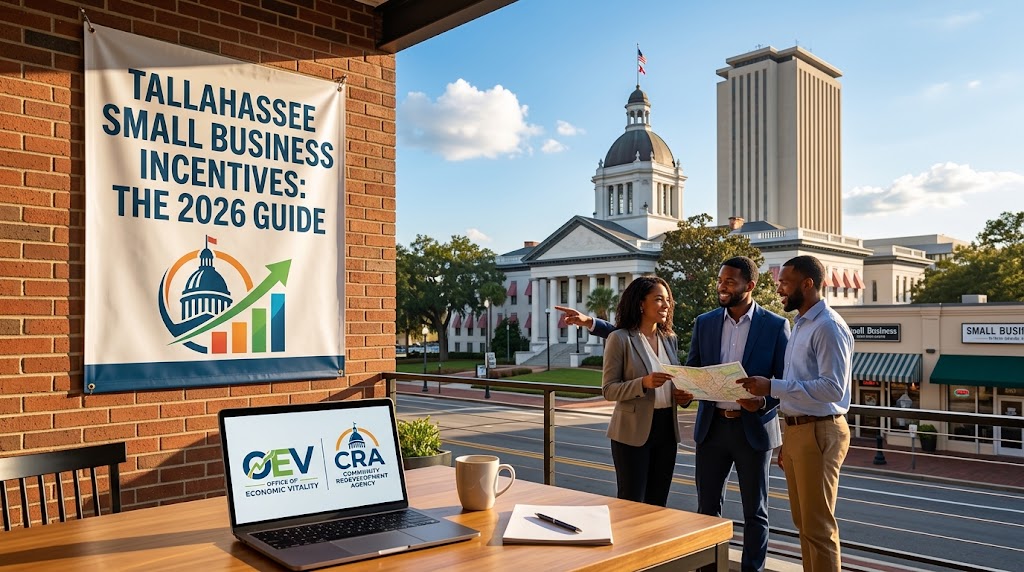
Quick Answer: Tallahassee’s strongest small business incentives come from four places: the Tallahassee-Leon County Office of Economic Vitality (OEV), which runs the Targeted Business Program and MWSBE certification; the Tallahassee Community Redevelopment Agency (CRA), which offers matching property-improvement grants; the Leon County Research and Development Authority’s TechGrant; and state programs run by FloridaCommerce and CareerSource Florida, chiefly SSBCI loan support and training grants.
Why Tallahassee Incentives Look Different in 2026
Small business owners researching incentives in Florida’s capital often find outdated advice. Many online guides still point to Enterprise Florida, the Qualified Target Industry (QTI) tax refund, or the Quick Action Closing Fund. None of those exist today.
In 2023 the Florida Legislature passed HB 5, which eliminated Enterprise Florida, Inc. and moved its duties to the Florida Department of Commerce, now called FloridaCommerce. The same bill repealed a long list of incentives, including the QTI tax refund, the qualified defense and space contractor refund, the Quick Action Closing Fund, the Innovation Incentive Program, and the state Microfinance Loan Program.
The practical result is that the incentive landscape for a Tallahassee small business now rests on three layers:
- Local programs run by the City of Tallahassee, Leon County, and their joint agencies
- State programs run by FloridaCommerce, CareerSource Florida, and the Florida SBDC Network
- Federal programs delivered locally, such as SBA loan guarantees and HUBZone certification
Another frequent point of confusion is the Capital Region Transportation Planning Agency (CRTPA). It is the metropolitan planning organization for Gadsden, Jefferson, Leon, and Wakulla counties and coordinates transportation projects. It does not issue grants to private businesses, though its road and transit priorities can shape where commercial growth happens.
This guide walks through every layer, explains who qualifies, and closes with a comparison table and contact directory.
Local Incentives: City of Tallahassee and Leon County
The Office of Economic Vitality (OEV): Your Front Door
The Tallahassee-Leon County Office of Economic Vitality is the joint economic development office of the City of Tallahassee and Leon County. It operates as a division of the Blueprint Intergovernmental Agency, the city-county partnership that also funds infrastructure through the local sales tax.
For a small business, OEV performs three jobs:
- Incentive navigation. Staff help companies determine which local, state, and federal programs they qualify for.
- Direct incentives. OEV administers the Targeted Business Program and other locally funded programs.
- Certification. OEV runs the consolidated Minority, Women, and Small Business Enterprise (MWSBE) program for the city, county, and Blueprint.
OEV is located at 315 South Calhoun Street, Suite 450, in downtown Tallahassee. A first call costs nothing and is the single most efficient step any business owner can take.
Targeted Business Program (TBP)
The Targeted Business Program is OEV’s main job-creation incentive. It reimburses a portion of a company’s property taxes, development fees, and permit fees once the company meets performance commitments.
How the program works:
- The business must fall within OEV’s targeted industry list. OEV’s current focus sectors are manufacturing and transportation/logistics, health care, applied sciences and innovation, and professional services and information technology.
- The project must be located within the Leon County-City of Tallahassee Urban Services Area.
- Applicants are scored on points. Points come from the number of jobs created, wage levels, capital investment, location in a targeted area, and use of local businesses.
- Location points are available for sites in a Historically Underutilized Business Zone, an Urban Job Tax Credit area, or a priority business area such as Innovation Park or an identified industrial park.
- Reimbursement is paid after jobs are created and verified, either annually or in a single payment after the job targets are met.
Reporting burden: Moderate to high. Companies sign a reimbursement agreement, document headcount and annualized wages, and lose the incentive if commitments are not met.
Best fit: Growing companies adding 10 or more jobs, building or expanding a facility, and paying above the local average wage.
Urban Vitality Job Creation Pilot Program
OEV created this pay-for-performance program to spur hiring in Tallahassee’s Promise Zone, the federally designated area covering parts of the city’s south and central neighborhoods. Eligible businesses receive a refund based on the number of jobs created and their average wages.
Eligibility has included businesses in agriculture, manufacturing, retail (excluding eating and drinking establishments), lodging, warehousing, film production, and research and development. Created jobs must pay at least 75 percent of the Leon County average annual wage. Applications have been accepted first come, first served.
Because this began as a pilot, owners should confirm current funding status with OEV before planning around it.
MWSBE Certification: An Incentive Hidden in Procurement
Many small business owners overlook certification because it does not hand out cash. That is a mistake. Since April 1, 2020, the City of Tallahassee, Leon County, and Blueprint have followed one consolidated MWSBE policy, and government contracts carry aspirational participation goals for certified firms.
Who can qualify:
- Minority-owned and women-owned firms
- Small businesses with fewer than 200 employees and under $5 million in sales
- Businesses located in Leon, Wakulla, Jefferson, or Gadsden counties
- For-profit firms in business for at least one calendar year before applying
What certification delivers:
- Scoring credit on city, county, and Blueprint competitive solicitations
- Listing in OEV’s online directory of certified vendors, which agencies and prime contractors use to find subcontractors
- Notice of upcoming procurement opportunities
- Free training on doing business with local government
Blueprint alone funds hundreds of millions of dollars in road, park, and infrastructure projects. For contractors, engineers, suppliers, and professional services firms, certification is often worth more than any grant.
Tallahassee CRA Grants: The Best Matching Funds in Town
The Tallahassee Community Redevelopment Agency (CRA) offers the most concrete matching grants available to small property owners and tenants, but only inside its two districts: Greater Frenchtown/Southside and Downtown.
Effective October 1, 2024, the CRA Board replaced its older programs with three new ones.
Façade Assistance and Community Enhancement (FACE)
- Reimbursement grant for exterior improvements to commercial buildings
- Matches 50 percent of eligible costs
- Maximum award of $10,000 per fiscal year
- Requires three bids per improvement; the grant is based on the lowest qualified bid
Best fit: A storefront retailer, restaurant, or service business that wants new signage, paint, awnings, lighting, or landscaping.
Commercial Property Improvement Program (CPIP)
- Covers construction, renovation, expansion, and permanent improvements to commercial buildings
- Combines a no-match portion with a matched portion. The CRA’s published example shows a $35,000 grant built from $20,000 with no match plus $15,000 matched by the applicant
- Awards up to $25,000 can be approved by the CRA executive director; larger awards require CRA Board approval
- Funding must deliver a significant benefit to the district, such as higher taxable value
Best fit: An owner rehabbing an older commercial building for a new tenant or expanding usable space.
New Construction Assistance Program (NCAP)
NCAP supports new commercial, mixed-use, and multifamily projects. Projects must show a tangible community benefit, such as infrastructure improvements or affordable housing units, and receive final approval from the CRA Board after a public hearing.
CRA Rules That Trip Up Applicants
- No retroactive funding. Work already completed cannot be reimbursed. Apply first, build second.
- Location is absolute. Properties outside a CRA district are ineligible regardless of merit.
- Zoning must allow the use. The commercial use must be permitted under current zoning.
- Commitments last. Grant agreements typically require the property to stay commercial and the improvements to be maintained.
The CRA encourages a free consultation before applying.
Innovation and Startup Incentives
Leon County R&D Authority TechGrant
The Leon County Research and Development Authority governs Innovation Park, the 208-acre research campus near Florida State University’s engineering and magnet lab facilities. Its TechGrant competition, launched in 2005, awards up to $15,000 to early-stage companies commercializing a technology in Leon County.
- Open to entrepreneurs, local businesses, and university-linked founders
- Competitive, with finalists pitching before judges
- Funds go to product development, commercialization services, and leveraging matching dollars
- Grant funds generally cannot be used for salaries or travel
By 2020 the program had awarded 27 companies a combined $462,000. Past winners include weather analytics, medical device, and propulsion sensor startups.
IGNITE Tallahassee and Domi Station
Two facilities anchor the local startup pipeline:
- IGNITE Tallahassee at Innovation Park is a roughly 40,000-square-foot incubator with wet and dry labs aimed at turning university research into companies.
- Domi Station, at 914 Railroad Avenue, has served as Tallahassee’s nonprofit incubator and coworking hub since 2013 and reports supporting nearly 400 small businesses. Its programs include early-stage cohorts and PowerUP, a second-stage program run with First Commerce Credit Union. In April 2026 the Capital City Chamber of Commerce moved its office into Domi.
Neither is a grant, but both reduce costs through subsidized space, mentoring, and investor access.
Local Lending Programs
FAMU FCU SmartSteps Microloan
OEV partnered with FAMU Federal Credit Union to create the $1 million SmartSteps Microloan Program, designed for small businesses that need modest capital and may not qualify for conventional bank loans.
Florida Black Business Loan Program
This state program, authorized under Florida Statute 288.7102, funds loans, loan guarantees, and investments through certified loan administrators for Black-owned businesses that cannot obtain conventional financing. FAMU Federal Credit Union serves as a local administrator. Eligibility requires 51 percent Black ownership, Florida domicile, and active Sunbiz registration. Loans have been listed at up to $250,000, subject to annual legislative funding.
Apalachee Regional Planning Council Revolving Loan Fund
The regional planning council operates revolving loan funds for job creation and retention across the Apalachee region, which includes Leon County.
City of Tallahassee Utilities Efficiency Loans
City utility customers, including commercial accounts, can finance energy-saving improvements at 5 percent interest. Loans reach $10,000 for most measures and $20,000 for solar or ENERGY STAR roofing when not bundled. The utility also offers commercial energy audits.
State Incentives Through FloridaCommerce and CareerSource
State Small Business Credit Initiative (SSBCI)
SSBCI is the largest pool of state-administered small business capital in Florida. Florida received more than $488 million in federal SSBCI funds, managed by FloridaCommerce with the Florida Opportunity Fund.
SSBCI does not lend directly. It strengthens loans made by participating banks and credit unions through:
- Loan Guarantee Program – a short-term partial guarantee for the lender
- Loan Participation Program – state funds lent alongside private funds
- Collateral Support Program – a cash deposit covering a collateral shortfall
- Capital Access Program – pooled loan-loss insurance for lenders
- Venture Capital Program – equity investment through fund managers
Most programs require a Florida-based business with fewer than 500 employees. Uses include startup costs, working capital, equipment, inventory, business acquisition, and tenant improvements.
How to apply: Ask your lender whether it participates in SSBCI. The program works through partner lenders, not direct applications.
CareerSource Florida Training Grants
Incumbent Worker Training (IWT) reimburses Florida businesses for training current full-time employees. For the July 2026 to June 2027 fiscal year, $3 million is available, with a maximum of $100,000 per company. Most companies receive up to 50 percent reimbursement; priority small businesses can receive up to 75 percent. Training must be finished within 12 months.
Quick Response Training (QRT) funds customized training for new hires at new or expanding businesses in targeted industries.
CareerSource Capital Region, the local workforce board, also offers recruiting help, on-the-job training reimbursements, and applicant screening at no charge.
Florida Small Business Emergency Bridge Loan
This short-term, interest-free bridge loan program is activated after declared disasters. After Hurricanes Debby, Helene, and Milton, FloridaCommerce approved nearly $93 million for more than 2,340 businesses. Tallahassee owners should register with their insurance agent and SBDC before hurricane season so they can apply quickly if the program activates.
Florida Job Growth Grant Fund
This fund pays for public infrastructure and workforce training projects, not grants to individual companies. Funds cannot benefit a single business exclusively. Local governments, colleges, and economic development organizations apply, often partnering with private employers whose expansion depends on the project.
Federal Programs Delivered Locally
- HUBZone certification: Parts of Tallahassee are designated Historically Underutilized Business Zones, giving qualifying firms an edge on federal contracts.
- SBA 7(a) loans: Government-guaranteed loans up to $5 million through local lenders.
- Florida SBDC at FAMU: Free consulting, business plan reviews, financial projections, and help packaging loan applications.
Step-by-Step: How to Apply for Tallahassee Incentives
Step 1: Register your business properly. Confirm active Sunbiz registration, a City of Tallahassee or Leon County business tax receipt, and an EIN. Nearly every program checks these first.
Step 2: Confirm your location. Look up whether your property sits in a CRA district, the Promise Zone, a HUBZone, or the Urban Services Area. Location alone decides eligibility for several programs.
Step 3: Call OEV before you commit. Many incentives require approval before you sign a lease, announce a project, or start hiring. Acting first can disqualify you.
Step 4: Gather documents. Expect to provide tax returns, payroll records, ownership documentation, project budgets, contractor bids, and site plans.
Step 5: Match programs to goals. Hiring points to TBP and CareerSource. Building improvements point to the CRA. Capital needs point to SSBCI, SmartSteps, or the Black Business Loan Program. Government contracting points to MWSBE certification.
Step 6: Build a compliance calendar. Track job counts, wage reports, and maintenance obligations. Missed reporting is the most common reason businesses lose incentives they already earned.
Brian’s TakeThe most valuable incentive in Tallahassee is not a check. It is sequencing.
Most small business owners discover incentives after they have signed a lease, hired staff, or started renovations, and by then they have already disqualified themselves. The CRA will not pay for completed work. The Targeted Business Program expects contact before the investment decision. State training grants require pre-approval of costs.
The second lesson is that Tallahassee rewards businesses that sell to government. With the State Capitol, Leon County, the City, Blueprint, three colleges and universities, and two hospital systems all buying goods and services, MWSBE certification combined with HUBZone status can generate more revenue than any grant program. It is the least glamorous incentive and probably the most underused.
Finally, the end of Enterprise Florida shifted the state’s emphasis from deal-closing cash toward capital access and workforce training. For a small firm, that is arguably better news. SSBCI and CareerSource money is available to ordinary companies, not just large relocations.
The practical playbook is simple: call OEV first, confirm your location, get certified, and talk to an SSBCI lender before you need the money.
Frequently Asked Questions
Does Tallahassee offer grants to start a small business?
Few programs provide cash grants for startup costs. The closest options are the Leon County R&D Authority TechGrant, up to $15,000 for technology companies, and CRA façade grants for businesses inside redevelopment districts. Most startup support comes through low-cost loans, incubators, and free SBDC consulting.
Is Enterprise Florida still offering incentives?
No. Enterprise Florida was eliminated by the 2023 Legislature, and its duties moved to FloridaCommerce. The QTI tax refund and Quick Action Closing Fund were repealed at the same time.
Who qualifies for MWSBE certification in Tallahassee?
Minority-owned, women-owned, and small businesses located in Leon, Wakulla, Jefferson, or Gadsden counties that have operated for at least one year. Small businesses must have fewer than 200 employees and under $5 million in sales.
Can I get a CRA grant for work I already finished?
No. CRA grants are reimbursements for approved, future work. Applying before starting construction is mandatory.
What is the easiest incentive to get?
For property owners in a CRA district, the FACE grant has the simplest requirements. For employers, CareerSource’s Incumbent Worker Training grant accepts applications on a rolling basis.
Does the Capital Region Transportation Planning Agency give business grants?
No. The CRTPA plans and prioritizes transportation projects for Gadsden, Jefferson, Leon, and Wakulla counties. It does not fund private businesses.
Sources and Further Reading
- Tallahassee-Leon County Office of Economic Vitality, “Financing & Grants” and Targeted Business Program guidelines
- Tallahassee-Leon County Office of Economic Vitality, Urban Vitality Job Creation Pilot Program overview
- City of Tallahassee, “Minority Business Enterprise” (consolidated MWSBE policy)
- Tallahassee Community Redevelopment Agency, “CRA Project Funding,” FACE and CPIP program packages
- Leon County Research and Development Authority / Innovation Park, TechGrant program announcements
- Leon County Board of County Commissioners, Domi Station annual report agenda item (2026)
- Florida Senate, CS/CS/HB 5 Economic Programs bill summary (2023)
- Florida OPPAGA, Report 25-08 on state economic development incentives
- FloridaCommerce, State Small Business Credit Initiative 2.0 announcements
- CareerSource Florida, Incumbent Worker Training and Quick Response Training program guidelines
- Florida Statutes, Section 288.7102, Black Business Loan Program
- City of Tallahassee Utilities, energy efficiency loan and rebate programs
- Capital Region Transportation Planning Agency, agency overview and Transportation Improvement Program
About the Author