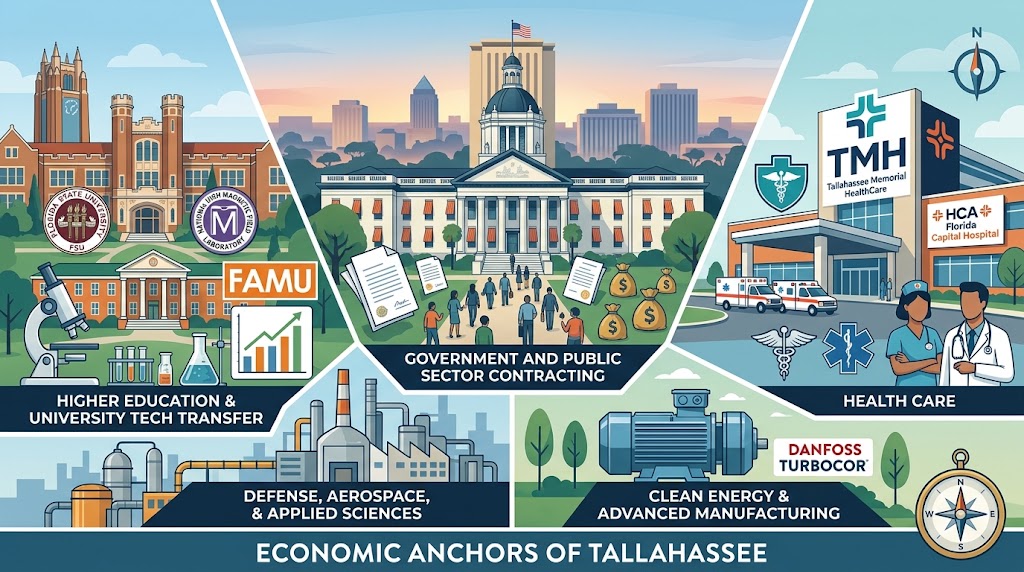
Quick Answer: Tallahassee’s economy is anchored by state government, which accounts for roughly one in three local jobs, followed by higher education at Florida State University, Florida A&M University, and Tallahassee State College. Health care, led by Tallahassee Memorial HealthCare and HCA Florida Capital Hospital, is the largest private employer base. Applied sciences tied to the National High Magnetic Field Laboratory, defense power research, and advanced manufacturing round out the region’s growth sectors.
Tallahassee’s Economy at a Glance
Tallahassee is often described as a government town. That is true, but incomplete. The metro area, which includes Leon, Gadsden, Jefferson, and Wakulla counties, has built a second economy around research universities, health care, and technology spun out of university labs.
| Metric | Value |
|---|---|
| Metro labor force | About 206,000 |
| Employed residents | About 196,000 (Aug. 2026) |
| Unemployment rate | About 5% (mid-2026) |
| Government jobs | About 60,000–64,000 |
| State government jobs | About 46,000 |
| Mean hourly wage | $28.64 (May 2025) |
| U.S. mean hourly wage | $33.54 (May 2025) |
Three numbers tell the story. First, government employs about 60,000 to 64,000 people in the metro, rising during the academic year and dipping in summer, with state government alone at roughly 46,000. Second, local wages trail the nation: the May 2025 mean hourly wage was $28.64, compared with $33.54 nationally, or roughly $59,600 a year for full-time work. Third, unemployment has drifted up, from about 4 percent in 2025 to around 5 percent in mid-2026.
The outlook is improving among investors. In the 2026 Emerging Trends in Real Estate report from PwC and the Urban Land Institute, Tallahassee-Leon County jumped from 69th to 33rd for overall real estate prospects.
The Tallahassee-Leon County Office of Economic Vitality (OEV) targets four sectors for growth: applied sciences and innovation; manufacturing and transportation/logistics; health care; and professional services and information technology.
1. Government and Public Sector Contracting
Why It Dominates
As Florida’s capital, Tallahassee hosts the Legislature, the Governor’s office, the Florida Supreme Court, and the headquarters of nearly every state agency. That base makes the local economy unusually stable during recessions, but it also caps wage growth, because state pay scales set the local benchmark for many white-collar jobs.
The concentration shows up in occupational data. Business and financial operations jobs, the analysts, budget officers, auditors, and compliance staff who run government, account for about 11 percent of local employment, compared with under 7 percent nationally. Tax examiners and revenue agents work in Tallahassee at nearly nine times the national rate, and management analysts at almost six times the national rate.
The Contracting Economy
The larger private opportunity is selling to government. State agencies, the City of Tallahassee, Leon County, Blueprint, three universities, and the school district all buy goods and services. That supports a dense cluster of:
- IT consultants and software vendors
- Lobbying and government relations firms
- Law firms specializing in administrative and regulatory law
- Engineering, architecture, and construction firms
- Accounting, audit, and management consulting firms
- Staffing and professional services companies
| Contracting Need | Who Benefits |
|---|---|
| IT and data systems | Software and consulting firms |
| Infrastructure | Engineers, contractors |
| Policy and advocacy | Lobbyists, law firms |
| Audits and compliance | CPA and consulting firms |
Networking and Resources
- MyFloridaMarketPlace: the state’s vendor registration and procurement system
- OEV MWSBE certification: for City, County, and Blueprint contracts
- Florida APEX Accelerator: free government contracting assistance
- Greater Tallahassee Chamber of Commerce and Capital City Chamber of Commerce
- Big Bend Minority Chamber of Commerce
2. Higher Education and University Tech Transfer
Three Institutions, More Than 60,000 Students
Florida State University enrolls more than 44,000 students and reported about $485 million in research expenditures for fiscal 2025. It receives more National Science Foundation funding than any other Florida university and consistently ranks among the top 10 nationally in NSF physical sciences grants.
Florida A&M University has posted record research totals for several consecutive years, reaching $112.4 million in research awards and $72.6 million in R&D spending in fiscal 2023-24, as it pursues Carnegie R1 status. FAMU aims to become the first historically Black university with that designation.
Tallahassee State College, renamed from Tallahassee Community College in July 2024, is the leading transfer institution to both FSU and FAMU and now offers bachelor’s degrees alongside workforce training.
The MagLab: Tallahassee’s Signature Asset
The National High Magnetic Field Laboratory, headquartered at FSU since 1994, is Florida’s only national laboratory and home to the world’s most powerful magnets. Key figures:
| MagLab Metric | Value |
|---|---|
| NSF funding (2022–2027) | $195.5 million |
| Floridians employed | 562 |
| Annual economic impact | $325 million |
| Visiting researchers per year | 1,800+ |
The MagLab draws scientists from around the world and supports a cluster of magnet, materials, and superconductivity research that local companies tap for talent and testing.
Tech Transfer Pipeline
University research reaches the market through:
- Innovation Park: the 208-acre research park governed by the Leon County Research and Development Authority
- IGNITE Tallahassee: a roughly 40,000-square-foot incubator with wet and dry labs for deep-tech startups
- Domi Station: Tallahassee’s nonprofit incubator and coworking hub since 2013
- FAMU-FSU College of Engineering: the region’s main engineering talent pipeline
- FSU Jim Moran College of Entrepreneurship
Networking and Resources
- FSU Office of Commercialization and FAMU Office of Technology Transfer
- Leon County R&D Authority TechGrant competition
- Domi Station pitch events and cohorts
3. Health Care
The Largest Private Employer Base
Health care is the biggest private-sector employer in Tallahassee and serves a referral region that extends across the Big Bend and into South Georgia.
| Health System | Profile |
|---|---|
| Tallahassee Memorial HealthCare | 772-bed nonprofit; 6,000+ staff |
| HCA Florida Capital Hospital | 288-bed for-profit; 1,400+ staff |
| FSU College of Medicine | Community-based medical school |
Tallahassee Memorial HealthCare (TMH) is the city’s largest private employer. Founded in 1948, the nonprofit system operates a 772-bed acute care hospital and a psychiatric hospital, and serves a 22-county region in North Florida and South Georgia. TMH runs the region’s only Level II trauma center and Level III neonatal intensive care unit, along with residency programs and about 50 affiliated physician practices.
HCA Florida Capital Hospital, formerly Capital Regional Medical Center, is owned by HCA Healthcare. It reports more than 1,400 employees and about 500 providers, and operates freestanding emergency departments in Leon and Gadsden counties.
Opportunities in the Sector
- Outpatient, specialty, and ambulatory care growth
- Senior care and assisted living, driven by an aging regional population
- Health IT, billing, and revenue cycle services
- Behavioral health
- Medical office real estate
Health care practitioners are among the region’s higher-paid occupational groups, making the sector central to raising Tallahassee’s below-average wage level.
Networking and Resources
- Capital Medical Society
- FSU College of Medicine and FAMU College of Pharmacy partnerships
- Tallahassee State College nursing and allied health programs
- CareerSource Capital Region for health care workforce recruitment
4. Defense, Aerospace, and Applied Sciences
A Research-Driven Defense Cluster
Tallahassee does not host a large military base, but it has a growing defense research economy built on FSU labs.
The Center for Advanced Power Systems (CAPS) at FSU researches electric power systems, power electronics, and high-temperature superconductors. It recently secured an $88 million U.S. Navy contract to develop modeling, simulation, and testing capabilities for next-generation shipboard power systems through 2031, with options that could raise the total to about $99.5 million.
Other assets include:
- Florida Center for Advanced Aero-Propulsion (FCAAP) at FSU
- High-Performance Materials Institute for composites and additive manufacturing
- The MagLab’s magnet and materials research, with defense and energy applications
Startups and Spinouts
Innovation Park and Domi Station have produced propulsion, sensor, and materials startups. Past TechGrant winners include Sensatek Propulsion Technology, which develops sensors for turbine engines.
Networking and Resources
- FSU Office of Research industry partnership programs
- Innovation Park tenant network
- Florida APEX Accelerator for defense contracting
5. Clean Energy and Advanced Manufacturing
Danfoss Turbocor: The Flagship Manufacturer
Danfoss Turbocor Compressors, at Innovation Park, designs and manufactures oil-free, magnetic-bearing compressors for heating and cooling systems in large commercial buildings, hospitals, and data centers. The company chose Tallahassee to work alongside FSU expertise in aerodynamics, power electronics, and magnetics.
Danfoss has expanded locally more than once, including a 2017 expansion announced with 120 jobs and a 2020 expansion projected to create 239 manufacturing and research jobs. Danfoss also funds a research fellowship program with the FAMU-FSU College of Engineering focused on HVAC efficiency.
Utility-Scale and Municipal Energy
The City of Tallahassee Utilities is a municipally owned electric, gas, and water provider, which gives the city direct control over local energy investment. The utility operates community solar through its Tallahassee Solar program and offers efficiency loans and rebates to businesses.
Manufacturing and Logistics
Manufacturing is small, about 4,000 jobs, but high-value. Tallahassee’s industrial submarkets have very low vacancy, which constrains growth but signals demand. Logistics benefits from Interstate 10 and Tallahassee International Airport.
Networking and Resources
- OEV business development team for manufacturing and logistics
- FAMU-FSU College of Engineering industry partnerships
- City of Tallahassee Utilities commercial programs
Sector Comparison
| Sector | Anchor Employers | Growth Outlook |
|---|---|---|
| Government | State agencies, City, County | Stable |
| Higher education | FSU, FAMU, TSC | Growing research |
| Health care | TMH, HCA Florida Capital | Growing |
| Defense/applied science | CAPS, MagLab | Growing |
| Clean energy/manufacturing | Danfoss, City Utilities | Selective growth |
| Professional services | Law, lobbying, consulting | Stable |
Workforce Strengths and Weaknesses
Strengths
- Highly educated talent pool. Tens of thousands of students and graduates each year from three institutions
- Concentrated policy expertise. Unmatched density of analysts, auditors, attorneys, and regulatory specialists
- Research infrastructure. A national lab and a major research university
- Stability. Government employment cushions downturns
Weaknesses
- Wages trail the nation, with a mean hourly wage about 15 percent below the U.S. average
- Graduate retention. Many graduates leave for larger metros
- Limited private headquarters compared with Tampa, Orlando, or Jacksonville
- Office development has stalled, with no new downtown office buildings completed recently
Brian’s Take
Tallahassee’s economy is a lesson in concentration risk and concentration advantage at the same time.
The government base is the region’s ballast. When other Florida metros lose jobs in a recession, Tallahassee bends but rarely breaks. The tradeoff is that state pay scales set the ceiling for local wages, which is why the metro’s average wage still trails the nation by a wide margin.
The upside lies in what the universities produce. FSU spends close to half a billion dollars a year on research. The MagLab is one of a kind. CAPS just landed a major Navy contract. FAMU is closing in on R1 status. Danfoss is proof that a global manufacturer will build in Tallahassee to be near that research. The question for the next decade is whether more of that research turns into local companies that stay.
For investors and B2B marketers, I would watch three things: university commercialization, health care expansion, and government contracting. The firms that sell expertise to the State of Florida, and the companies that spin out of FSU and FAMU labs, are where the region’s higher-paying private jobs are most likely to come from.
Frequently Asked Questions
What is the largest industry in Tallahassee?
Government is the largest, with roughly 60,000 to 64,000 jobs in the metro area, including about 46,000 in state government. Higher education and health care are the next largest sectors.
Who is the largest private employer in Tallahassee?
Tallahassee Memorial HealthCare is the largest private employer, with more than 6,000 staff and a 772-bed acute care hospital.
What is the average wage in Tallahassee?
The Tallahassee metro’s mean hourly wage was $28.64 in May 2025, compared with $33.54 nationally, according to the U.S. Bureau of Labor Statistics. That equals roughly $59,600 a year for full-time work.
What is the MagLab?
The National High Magnetic Field Laboratory, headquartered at Florida State University, is Florida’s only national laboratory and operates the world’s most powerful magnets. It employs 562 Floridians and generates an estimated $325 million a year for Florida’s economy.
Is Tallahassee a good place for tech companies?
Tallahassee offers university research, the MagLab, incubators such as Domi Station and IGNITE Tallahassee, and Innovation Park. Its tech sector is smaller than Florida’s major metros, but it is strong in applied sciences, power systems, and government technology.
What industries is Tallahassee trying to attract?
The Office of Economic Vitality targets applied sciences and innovation, manufacturing and transportation/logistics, health care, and professional services and information technology.
What happened to Tallahassee Community College?
It was renamed Tallahassee State College, effective July 1, 2024, after the Florida Legislature passed and the Governor signed Senate Bill 522.
Sources and Further Reading
- U.S. Bureau of Labor Statistics, Tallahassee, FL Economy at a Glance
- U.S. Bureau of Labor Statistics, Occupational Employment and Wages in Tallahassee, FL, May 2025
- Federal Reserve Bank of St. Louis (FRED), Tallahassee MSA employment series
- Florida State University, FSU Highlights and Rankings
- Office of U.S. Rep. Neal Dunn, MagLab funding statement (June 2025)
- The Capitolist, “FSU’s National MagLab Secures $195 Million National Science Foundation Funding”
- Florida A&M University, “FAMU Announces a Record $112M in Research Awards”
- Tallahassee State College, renaming announcement (March 2024)
- Tallahassee Memorial HealthCare, organizational profile
- HCA Florida Capital Hospital, hospital overview
- FSU News, Center for Advanced Power Systems Navy contract coverage
- WCTV, “Danfoss to Expand Tallahassee Manufacturing Facility, Expected to Create 239 Jobs”
- Tallahassee-Leon County Office of Economic Vitality, Targeted Industries
- City of Tallahassee, “Tallahassee-Leon County’s Economy Is Building Momentum” (February 2026)
About the Author