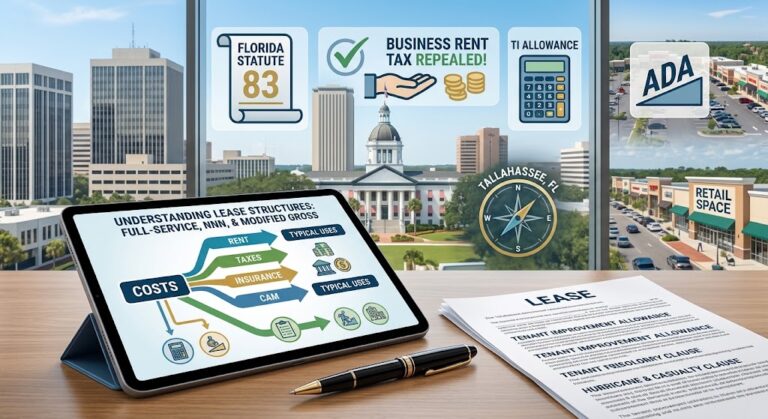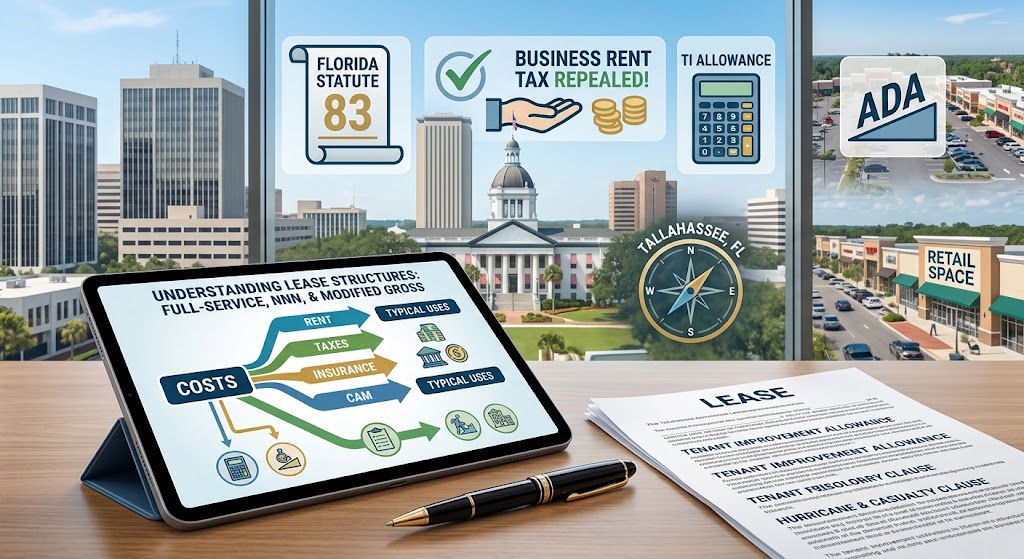
Quick Answer: Tallahassee commercial leases are governed by the lease contract itself and Part I of Chapter 83 of the Florida Statutes. Most office space leases on a full-service or modified gross basis, while retail and industrial space usually leases triple net (NNN). Key terms to negotiate are the tenant improvement allowance, rent escalations, operating expense pass-throughs, hurricane and casualty clauses, assignment and subletting rights, ADA responsibility, and any personal guaranty.
The Tallahassee Market at a Glance
Before negotiating, a tenant needs to know who has leverage. In Tallahassee, the answer depends heavily on property type.
| Property Type | Market Conditions | Tenant Leverage |
|---|---|---|
| Downtown office | Moderate vacancy, no new supply | Moderate |
| Suburban office | Wide range by submarket | Varies |
| Retail | Very tight vacancy | Low |
| Industrial/flex | Very tight vacancy | Low |
Office. Tallahassee’s office market totals roughly 7.4 million square feet. CommercialCafe data put the 2024 average asking rent at about $21 per square foot with an 18 percent vacancy rate in larger buildings, ranging from about 3 percent in the East submarket to over 30 percent in the Northwest. Downtown asked about $26 per square foot. Class B space makes up roughly three-quarters of current office listings.
At NAI TALCOR’s annual market update in March 2026, brokers reported roughly 100,000 square feet of vacant space across about 850,000 square feet of downtown office inventory in nine buildings, and noted that no new office building had been completed in the previous year. They described the local economy as stable but largely flat.
Retail. Retail is the tightest segment. A Matthews market report put Tallahassee retail vacancy at 2.7 percent, down 1.4 points year over year. Well-located space near FSU, FAMU, and major corridors leases quickly.
Industrial and flex. Third-party data shows most Leon County industrial submarkets with vacancy under 5 percent and asking rents generally between about $7 and $12 per square foot, with almost nothing under construction.
Outlook. In the 2026 Emerging Trends in Real Estate report from PwC and the Urban Land Institute, Tallahassee-Leon County jumped from 69th to 33rd for overall real estate prospects, one of the largest gains in the Southeast.
What this means for tenants: office tenants, especially those considering older Class B buildings, often have room to negotiate on rent, free rent, and improvement allowances. Retail and industrial tenants usually do not, and should focus on protective terms rather than price.
The Law That Governs Florida Commercial Leases
Florida commercial leases are governed mainly by the lease contract. State law fills gaps and controls certain procedures through Part I of Chapter 83, Florida Statutes, which covers nonresidential tenancies.
Key statutory rules every Tallahassee tenant and landlord should know:
- Written leases. Under Florida’s statute of frauds, a lease longer than one year must be in writing and signed to be enforceable.
- Tenancy at will. Without a written lease, a month-to-month tenancy can be ended by either side with at least 15 days’ notice before the end of a monthly period.
- Nonpayment. A landlord must serve a three-day written notice demanding rent or possession before filing for eviction. Commercial guidance interprets the three days as excluding weekends and legal holidays.
- Other breaches. For non-monetary defaults, Florida law provides a 15-day notice to cure, unless the lease provides otherwise.
- Court registry. A commercial tenant who wants to contest an eviction generally must deposit the rent alleged due into the court registry. Failure to do so can result in an immediate default.
- Landlord’s lien. Florida gives commercial landlords a statutory lien on a tenant’s property on the premises for unpaid rent.
- Holdover. A tenant who refuses to leave after the lease ends can be charged double rent.
- Construction liens. Under Section 713.10, a landlord can protect its property from liens arising from a tenant’s improvements if the lease prohibits such liens and other statutory conditions are met. Contractors working on tenant buildouts need to understand this.
- Radon notice. Florida requires a radon gas disclosure in rental agreements for buildings, including commercial leases.
The End of the Business Rent Tax
Florida was long the only state that charged sales tax on commercial rent. That tax, first enacted in 1968 and once as high as 6 percent, was repealed effective October 1, 2025. Rent for occupancy periods on or after that date is no longer taxable, though rent for earlier periods, including late-billed CAM reconciliations for those periods, still is.
Many existing Tallahassee leases still contain sales tax clauses. Landlords often keep them in case the tax returns, but tenants should confirm that invoices no longer include it.
The Four Main Lease Structures
Full-Service Gross Lease
The tenant pays one rent amount, and the landlord pays property taxes, insurance, maintenance, and usually utilities and janitorial.
Common in: downtown and Class A office buildings.
Watch for: a base year or expense stop. Most “gross” leases still pass through increases in operating costs above the first year’s level.
Modified Gross Lease
Base rent covers some expenses, while the tenant pays others, often its own electricity, janitorial, or a share of expense increases.
Common in: suburban office and smaller Class B buildings.
Triple Net (NNN) Lease
The tenant pays base rent plus its share of the three “nets”: property taxes, building insurance, and common area maintenance (CAM).
Common in: retail centers, freestanding buildings, industrial and flex space.
Watch for: what is included in CAM. Capital replacements such as roofs and parking lots, management fees, and administrative markups can add up.
Percentage Lease
A retail tenant pays base rent plus a percentage of gross sales above a breakpoint.
Common in: mall and high-traffic retail, including centers near FSU and the Governor’s Square area.
Watch for: the definition of gross sales, audit rights, and whether online sales or delivery orders count.
Lease Structure Comparison
| Structure | Tenant Pays | Cost Predictability | Typical Use |
|---|---|---|---|
| Full-service gross | Rent + increases | High | Downtown office |
| Modified gross | Rent + some costs | Medium | Suburban office |
| Triple net | Rent + taxes, insurance, CAM | Low | Retail, industrial |
| Percentage | Base + % of sales | Low | Mall/center retail |
Understanding Rent and Escalations
How Rent Is Quoted
Tallahassee rents are usually quoted per square foot per year. A 2,000-square-foot space at $22 per square foot costs $44,000 a year, or about $3,667 a month.
Rentable vs. Usable Square Feet
In multi-tenant office buildings, tenants pay on rentable square feet, which includes a share of lobbies, corridors, and restrooms. The difference, called the load factor, is often 10 to 20 percent. Always ask for both numbers.
Escalations
- Fixed increases, commonly around 3 percent a year
- CPI-based increases, tied to inflation
- Stepped rent, set dollar increases at specific dates
Operating Expense Pass-Throughs
Tenants in NNN and many gross leases pay a share of operating costs. Negotiate:
- Caps on controllable expenses, such as 5 percent annual growth
- Exclusions for capital improvements, landlord financing, leasing commissions, and costs of correcting code violations that existed before the lease
- Audit rights to review the landlord’s annual reconciliation
Tenant Improvement (TI) Allowances
A TI allowance is money the landlord contributes to build out the space.
How allowances work in Tallahassee:
- Larger allowances are tied to longer terms. A five- to ten-year office lease typically supports a meaningful allowance; a one- to three-year lease may get little more than paint and carpet.
- Second-generation space, previously built out for a similar user, needs less work and comes with smaller allowances.
- Retail and industrial tenants often receive less TI and more free rent, or take space “as is.”
Key negotiation points:
- Who manages construction, the landlord or the tenant
- What the allowance covers. Some landlords limit it to hard construction costs, excluding architecture, permits, cabling, furniture, and signage.
- What happens to unused funds, which tenants can sometimes apply to rent
- Construction delays. Rent should not begin until the space is substantially complete and a certificate of occupancy is issued.
- Code upgrades. Changing a space’s use can trigger fire sprinkler, restroom, and ADA work. The lease should say who pays.
Local tip: Before signing, confirm the intended use with a zoning verification letter from the City of Tallahassee Growth Management Department or Leon County, and confirm whether the buildout triggers a change of occupancy requiring a new fire inspection.
Hurricane, Force Majeure, and Casualty Clauses
North Florida is not South Florida, but Tallahassee has seen serious storm damage, including Hurricane Michael’s winds in 2018 and Hurricanes Idalia and Helene in 2023 and 2024. A lease needs to address weather clearly.
Force Majeure
A force majeure clause excuses a party’s performance when events beyond its control occur: hurricanes, floods, utility failures, pandemics, government orders.
Tenant red flags:
- Clauses that excuse the landlord’s obligations but not the tenant’s
- Clauses that expressly exclude rent from relief, which is common and landlords strongly resist changing
- No definition of qualifying events
Casualty and Restoration
Casualty clauses determine what happens when a storm or fire damages the property. They usually matter more than force majeure.
Negotiate:
- Rent abatement while the space is unusable
- Restoration deadlines, with a tenant right to terminate if repairs take too long (often 180 to 270 days)
- Landlord termination rights after major damage, so the tenant is not left waiting indefinitely
- Insurance responsibilities, including windstorm coverage, deductibles, and business interruption insurance
Florida Statute 83.201
If a lease requires the landlord to maintain or repair, and the landlord’s failure renders the premises wholly untenantable, Florida law allows the tenant to give written notice and, after 20 days, withhold rent. The procedure is technical, so tenants should consult counsel before using it.
Assignment and Subleasing Rights
Business needs change during a five- or ten-year lease. Assignment and subletting rights determine whether a tenant can get out.
Assignment transfers the entire lease to a new tenant. Subleasing rents all or part of the space to a subtenant while the original tenant stays responsible.
Negotiate:
- Landlord consent “not to be unreasonably withheld, conditioned, or delayed”
- Permitted transfers without consent to affiliates or a buyer of the business, which matters if you plan to sell
- Release of the original tenant from liability after an assignment to a creditworthy party
- Limits on recapture, the landlord’s right to take back the space rather than approve a sublease
- Profit sharing on sublease income
Tallahassee context: Lobbying firms, consultants, and contractors whose work tracks the legislative session or state contracts should prioritize flexible subleasing. Florida’s regular legislative session begins in January in even-numbered years and in March in odd-numbered years, and space needs near the Capitol often rise and fall with it.
ADA Compliance Responsibilities
Under Title III of the Americans with Disabilities Act, both the landlord and the tenant of a place of public accommodation can be held responsible for accessibility. Lawsuits do not care what the lease says; the lease only decides who pays.
Allocate clearly:
- Landlord: common areas, parking, entrances, building restrooms, elevators
- Tenant: the interior of its premises and any alterations it makes
Before signing, ask for:
- Any prior ADA surveys or lawsuits involving the property
- Confirmation that common areas comply
- Landlord responsibility for pre-existing violations
Older buildings near downtown, Midtown, and the university corridors are the most likely to carry accessibility issues.
Personal Guaranties
Landlords commonly ask small business owners to personally guarantee the lease. A guaranty puts the owner’s personal assets on the line and can defeat much of the protection an LLC provides.
Ways to limit a guaranty:
- Cap the guaranty at a fixed dollar amount or a set number of months of rent
- Burn off the guaranty after a period of on-time payments
- Good-guy guaranty: liability ends if the tenant gives notice, pays rent through move-out, and surrenders the space in good condition
- Offer a larger security deposit or letter of credit instead
Negotiation Red Flags
| Red Flag | Why It Matters |
|---|---|
| Unlimited CAM pass-throughs | Costs can rise without limit |
| Capital repairs in CAM | Tenant pays for roofs and parking lots |
| Rent starts before buildout ends | Paying for unusable space |
| One-sided force majeure | Rent due even after a storm |
| No casualty termination right | Stuck waiting for repairs |
| Unconditional personal guaranty | Owner’s assets fully exposed |
| Landlord relocation clause | Can move you mid-lease |
| No exclusive use clause (retail) | Competitor can open next door |
| Broad landlord recapture | Blocks your exit strategy |
| Automatic renewal | Lease extends if you miss a deadline |
Step-by-Step: Leasing Commercial Space in Tallahassee
Step 1: Define needs. Square footage, parking, location, signage, access, and buildout.
Step 2: Hire a tenant representative broker. In most Tallahassee deals, the landlord pays the commission, so representation usually costs the tenant nothing.
Step 3: Verify zoning. Confirm your use is allowed before touring seriously.
Step 4: Compare total occupancy cost. Base rent plus pass-throughs, utilities, and load factor, not the quoted rate alone.
Step 5: Negotiate a letter of intent. Settle rent, term, TI, free rent, and guaranty before the lease draft.
Step 6: Have an attorney review the lease. Focus on casualty, assignment, guaranty, default, and expense clauses.
Step 7: Inspect the space. Check HVAC, roof, electrical capacity, restrooms, and accessibility.
Step 8: Plan permits and inspections. Buildouts need building permits, a final fire inspection, and a certificate of occupancy.
Step 9: Calendar critical dates. Renewal options, expense audit windows, and expiration notices.
Brian’s Take
Tallahassee is really three lease markets wearing one name.
Office tenants have negotiating room right now. With a meaningful amount of downtown space sitting vacant and no new buildings being completed, landlords of older Class B space are competing for tenants. That is the time to ask for free rent, a real improvement allowance, a capped guaranty, and expense caps. The quoted rate matters less than the total package.
Retail and industrial tenants face the opposite market. With vacancy in the low single digits, the best spaces lease fast and landlords rarely bend on price. In that environment, the smart move is to concentrate on the clauses that protect the business over time: exclusive use, casualty termination, assignment rights tied to a sale of the business, and limits on capital costs in CAM.
Two Florida-specific points deserve attention. First, the business rent tax is gone, which is a real savings, but many leases still contain the old language, so check every invoice. Second, hurricanes. The difference between a well-drafted and a poorly drafted casualty clause can decide whether a business survives a bad storm season. Read that clause before you read the rent.
Frequently Asked Questions
What is the average commercial rent in Tallahassee?
Office space has averaged roughly $21 per square foot per year, with downtown space asking more, around $26 per square foot in recent data. Industrial space generally asks about $7 to $12 per square foot. Retail varies widely by location.
What is a triple net lease?
A triple net (NNN) lease requires the tenant to pay base rent plus its share of property taxes, building insurance, and common area maintenance. It is the most common structure for Tallahassee retail and industrial space.
Do Tallahassee businesses still pay sales tax on rent?
No. Florida repealed the sales tax on commercial rent effective October 1, 2025. Rent for occupancy periods before that date remains taxable.
How much notice does a Florida landlord give for unpaid rent?
A landlord must serve a three-day written notice demanding payment or possession before filing a commercial eviction. Other lease violations generally require a 15-day notice to cure unless the lease says otherwise.
Who is responsible for ADA compliance in a commercial lease?
Both landlord and tenant can be liable under federal law. The lease should assign common areas to the landlord and the tenant’s interior premises to the tenant, and address pre-existing violations.
Is a tenant improvement allowance negotiable?
Yes. TI allowances depend on lease length, the condition of the space, and market leverage. Office tenants signing longer leases in Tallahassee’s current market often have the most room to negotiate.
Can I get out of a commercial lease early in Florida?
Only if the lease allows it, through an early termination option, assignment, subleasing, or a negotiated buyout. Florida law does not give commercial tenants a general right to terminate early.
Sources and Further Reading
- Florida Statutes, Chapter 83, Part I, Nonresidential Tenancies
- Florida Statutes, Section 713.10, construction liens and leased property
- Florida Statutes, Section 404.056, radon gas disclosure
- CommercialCafe, Tallahassee Office Market Trends and Office Space Listings
- Tallahassee Reports, “Tallahassee Real Estate Leaders Describe ‘Bouncy’ Economy at Annual Market Update” (April 2026)
- Matthews Real Estate Investment Services, Gainesville, Tallahassee, and Panhandle Retail Market Report
- City of Tallahassee / Office of Economic Vitality, “Tallahassee-Leon County’s Economy Is Building Momentum” (February 2026)
- PwC and Urban Land Institute, Emerging Trends in Real Estate 2026
- GrayRobinson, “Florida Repeals Sales Tax on Commercial Real Property Leases”
- Bloomberg Tax, “Florida’s Commercial Rent Sales Tax Repeal a Boon for Businesses”
- Shumaker, Loop and Kendrick, Commercial Eviction (Florida) practice guide
- U.S. Department of Justice, ADA Title III guidance for businesses
About the Author