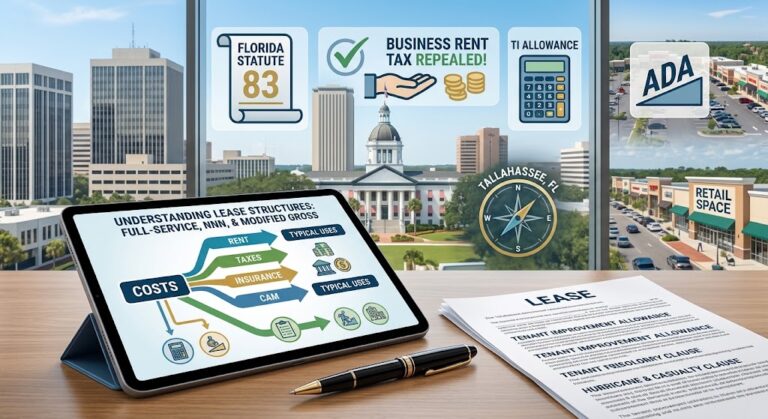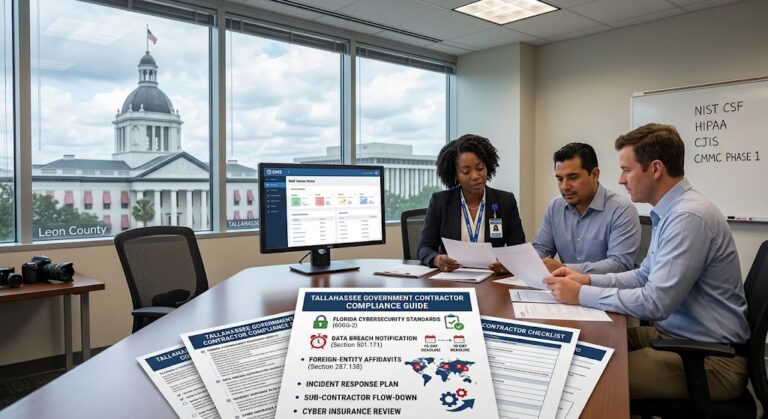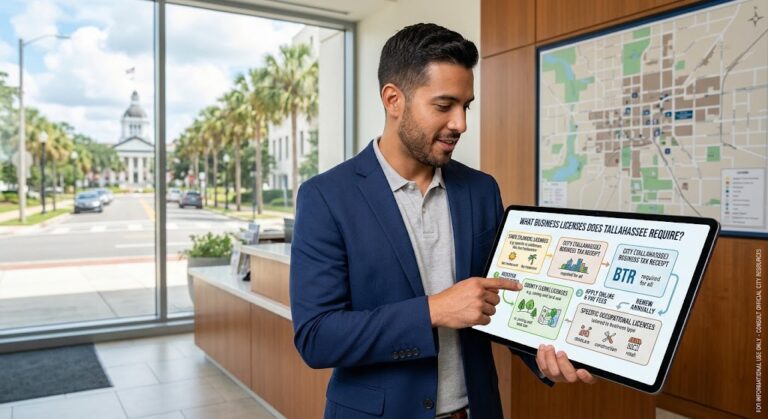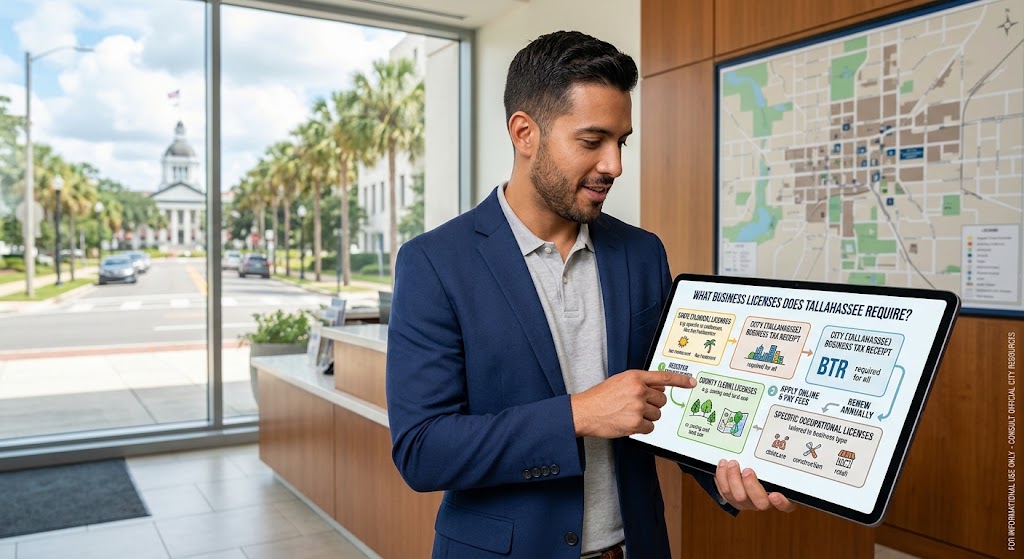
Quick Answer: Tallahassee and Leon County do not require a general business license or business tax receipt; both local business taxes were repealed. What most businesses need instead is zoning approval, a certificate of occupancy and fire inspection for commercial space, state registration with Sunbiz and the Florida Department of Revenue, and an industry license from a state agency such as DBPR, the Department of Health, or the Department of Agriculture.
The Short Answer Most Guides Get Wrong
Search for “Tallahassee business license” and you will find dozens of pages telling owners to buy a City of Tallahassee Business Tax Receipt (BTR) and a Leon County BTR. That advice is out of date.
The Tallahassee City Commission voted unanimously to repeal the city’s business license tax, effective with the 2017-18 fiscal year. Leon County had already repealed its county business tax, making Tallahassee-Leon County the first community in Florida to eliminate all local business license taxes. Before the repeal, the city tax averaged $119 a year for local businesses and $303 for non-local businesses, and affected about 12,000 companies.
That does not mean Tallahassee businesses operate without rules. It means compliance runs through four other channels:
- Local land use: zoning, building permits, certificates of occupancy, signs, and environmental permits
- Local fire safety: Tallahassee Fire Department plan review and inspections
- State registration: Sunbiz entity filing and Florida Department of Revenue tax accounts
- State and federal industry licensing: professional boards and regulatory agencies
This guide breaks down each layer and ends with an industry-by-industry matrix.
Layer 1: State Registration Every Business Needs
Before industry licenses, almost every Tallahassee business completes the same baseline steps.
Sunbiz Entity or Fictitious Name Filing
- LLCs and corporations register with the Florida Department of State, Division of Corporations (Sunbiz). An LLC costs $125 to form.
- Sole proprietors using a name other than their legal name must register a fictitious name on Sunbiz for $50.
Florida Department of Revenue
Register online, free of charge, if you will:
- Sell taxable goods or services (Tallahassee’s combined sales tax rate is 7.5 percent)
- Have employees (reemployment tax)
- Collect other state taxes, such as tourist development tax on short-term rentals
Federal EIN
Businesses with employees, multiple owners, or a corporate tax election need a free EIN from the IRS.
Tangible Personal Property Return
Businesses owning furniture, fixtures, computers, or equipment file an annual return (Form DR-405) with the Leon County Property Appraiser by April 1. Florida exempts the first $25,000 of value, but you must file the initial return to claim it.
Layer 2: Local Land Use and Zoning
Zoning is the closest thing Tallahassee has to a local business license. Every business location must be a permitted use under the zoning code.
Who Handles Zoning?
- Inside city limits: the City of Tallahassee Growth Management Department, Land Use and Environmental Services Division
- Unincorporated Leon County: Leon County Development Support and Environmental Management (DSEM)
Check whether your address is inside city limits before calling. Many Tallahassee mailing addresses are actually in unincorporated Leon County.
Zoning Tools for New Businesses
Zoning Verification Letter. Written confirmation that a particular use is consistent with a property’s zoning district. City planners complete the review within seven working days, and applications go through the city’s online permit portal. Landlords, lenders, and state licensing agencies often ask for this letter.
Land Use Compliance Certificate (LUCC). Determines whether a proposed use or development is permitted under the Tallahassee Land Development Code and which permits the project will need.
Certificate of Concurrency. For new development, the city confirms adequate traffic and stormwater capacity before issuing building permits.
Building Permits and Certificates of Occupancy
If you renovate, build out, or change the use of commercial space, you will likely need:
- Building permits for construction, electrical, plumbing, and mechanical work
- A certificate of occupancy or certificate of completion, issued after all required inspections pass, including subtrade permits
A change of occupancy is a common trap. Converting a retail space into a restaurant, gym, daycare, or assembly space can trigger new code requirements for exits, sprinklers, restrooms, and ventilation, even when no walls move.
Sign Permits
Most new exterior signs, and many sign replacements, require a sign permit through the building division.
Layer 3: Home-Based Businesses
Tallahassee has thousands of home-based consultants, contractors, designers, tutors, and online sellers. Since 2021, Florida law has sharply limited how local governments can regulate them.
Section 559.955, Florida Statutes, created by HB 403 in 2021, provides that a home-based business that meets the statute’s conditions may operate in a residential zone and cannot be prohibited, restricted, regulated, or licensed differently from other businesses in the jurisdiction.
What Qualifies as a Home-Based Business
Under the statute, the business generally must meet conditions such as:
- Employees who work at the residence must also live there, plus a limited number of employees or contractors who do not
- Parking related to the business must comply with local zoning
- The exterior of the home must look residential and blend with the neighborhood
- Business activities must be secondary to the home’s residential use
- Heavy equipment and vehicles are restricted
- The business must comply with local noise, nuisance, and similar general rules
What the Law Does Not Override
- HOA and condominium rules. Deed restrictions and association covenants still apply, and many Tallahassee subdivisions have them.
- State licensing. A home-based contractor or food producer still needs the same state license as anyone else.
- Building and fire codes for any physical changes.
Practical tip: If you are leasing a home, check the lease. Landlords can prohibit business use regardless of state law.
Layer 4: Fire Safety and Inspections
The Tallahassee Fire Department’s Prevention Division oversees fire inspections for businesses in both the City of Tallahassee and Leon County.
What the fire department reviews:
- Construction plans for new commercial buildings and renovations
- Fire protection, fire detection, and fire alarm systems
- Final fire inspections, which every commercial building must pass before a certificate of occupancy is issued
- Annual inspections of hospitals, nursing homes, assisted living facilities, schools, daycares, apartment complexes, and industrial facilities
Businesses that change occupancy, occupy space without a certificate of occupancy, or add suppression systems all trigger fire permits and fees.
Capitol-area note: State-owned and state-leased buildings are inspected by the Florida Division of State Fire Marshal rather than the local fire department. Firms leasing space inside state facilities should confirm which authority applies.
Layer 5: Food Service Permits
Food is the industry where owners most often apply to the wrong agency. Florida splits food regulation among three state agencies, not the county health department.
| Business Type | Licensing Agency |
|---|---|
| Restaurants, fast food, caterers | DBPR Hotels & Restaurants |
| Food trucks, mobile units | DBPR Hotels & Restaurants |
| Bars that serve food | DBPR Hotels & Restaurants |
| Grocery, convenience, bakeries | FDACS |
| Prepackaged food sellers | FDACS |
| Bars with no food | Department of Health |
| Schools, institutions | Department of Health |
| Cottage food (home) | No state permit |
Restaurant Licensing Steps
- Plan review. DBPR’s Division of Hotels and Restaurants must approve facility plans for new establishments before construction is finalized.
- License application before opening. New owners of existing restaurants also need a new license.
- Inspection by the division.
- Certified food protection manager on staff, and food safety training for employees within 60 days of hire.
Alcohol
Beverage licenses come from DBPR’s Division of Alcoholic Beverages and Tobacco. The division will not issue a beverage license to a food service establishment until it has passed inspection and received a Hotels and Restaurants license number. Local zoning may also restrict alcohol sales near schools or churches.
Cottage Food
Florida’s cottage food law lets home producers sell certain non-hazardous foods, such as many baked goods and jams, without a state food permit, subject to labeling rules and an annual sales cap. Cottage producers still need sales tax registration when applicable.
Temporary Events and Farmers Markets
Vendors serving prepared food at festivals need a DBPR temporary event license. Prepackaged food vendors go through FDACS.
Layer 6: Environmental Clearances
Environmental permits apply mostly to development and to businesses that handle regulated materials.
Local environmental permits:
- City of Tallahassee Environmental Management Permit for development activity inside city limits, covering stormwater, tree protection, and environmentally sensitive lands
- Leon County DSEM environmental permits for unincorporated areas
- Stormwater operating permits for many commercial sites
State environmental permits, through the Florida Department of Environmental Protection:
- Air emissions permits for certain manufacturing, painting, and fuel operations
- Stormwater and wetland permits for larger development
- Hazardous waste generator notification for businesses such as auto repair, dry cleaning, printing, and labs
- Storage tank registration for petroleum tanks
Businesses most likely to need environmental review: auto repair and body shops, gas stations, dry cleaners, manufacturers, landscapers using regulated chemicals, medical and dental offices generating biomedical waste (regulated by the Department of Health), and any business building or expanding a site.
Layer 7: State Professional and Industry Licenses
Most of Tallahassee’s licensing burden comes from the state, and many licensing agencies are headquartered in town.
Department of Business and Professional Regulation (DBPR)
DBPR licenses more than a million professionals and businesses through its professional boards and divisions, including:
- Construction: certified and registered general, building, residential, roofing, plumbing, mechanical, and pool contractors (Construction Industry Licensing Board); electrical contractors (Electrical Contractors’ Licensing Board)
- Real estate: brokers, sales associates, and appraisers
- Accounting: CPAs and CPA firms
- Engineering and architecture
- Cosmetology and barbering: professionals and salons or barbershops
- Community association managers
- Auctioneers, talent agencies, and home inspectors
- Vacation rentals and lodging
Registered versus certified contractors: A state-certified contractor can work anywhere in Florida. A state-registered contractor is limited to jurisdictions where the contractor holds a local certificate of competency, so confirm local requirements with the building division before bidding work.
Department of Health (DOH)
Through its Medical Quality Assurance boards, DOH licenses physicians, nurses, dentists, pharmacists, massage therapists and establishments, chiropractors, physical therapists, psychologists, mental health counselors, and many other health professions. It also regulates tattoo establishments and body art practitioners.
Agency for Health Care Administration (AHCA)
AHCA licenses health care facilities: hospitals, nursing homes, assisted living facilities, home health agencies, clinical laboratories, and many health care clinics.
Department of Children and Families (DCF)
DCF licenses child care facilities and family day care homes, along with certain substance abuse and mental health providers.
Florida Department of Agriculture and Consumer Services (FDACS)
Beyond food, FDACS regulates pest control operators, motor vehicle repair shops, moving companies, telemarketers, charitable organizations, sellers of travel, health studios, dance studios, pawnbrokers, and private security and investigative services (concealed weapons and security licenses).
Department of Financial Services and Office of Financial Regulation
- DFS: insurance agents, adjusters, and agencies
- OFR: mortgage brokers and lenders, money transmitters, consumer finance lenders, and securities dealers
Other State Regulators
- Florida Bar: attorneys
- FLHSMV: motor vehicle dealers and repair related registrations
- Department of Education: private postsecondary schools, through the Commission for Independent Education
Industry-by-Industry License Matrix
| Business | Local | State |
|---|---|---|
| Consultant (home) | None if 559.955 | Sunbiz; DOR if taxable |
| Retail store | Zoning, CO, fire, sign | DOR sales tax |
| Restaurant | Zoning, CO, fire, sign | DBPR H&R; ABT if alcohol |
| Food truck | Location rules | DBPR H&R |
| Bakery/grocery | Zoning, CO, fire | FDACS |
| Contractor | Permits per job | DBPR CILB/ECLB |
| Salon/barber | Zoning, CO, fire | DBPR Cosmetology/Barbers |
| Medical office | Zoning, CO, fire | DOH; AHCA if clinic |
| Child care | Zoning, fire | DCF |
| Real estate | Zoning, CO | DBPR FREC |
| Insurance agency | Zoning, CO | DFS |
| Auto repair | Zoning, CO, fire | FDACS; DEP waste |
| Pest control | Zoning | FDACS |
| Short-term rental | Zoning, HOA | DBPR; DOR; tourist tax |
| Manufacturer | Zoning, CO, fire, env. | DEP permits |
Federal Licenses That Apply to Some Tallahassee Businesses
- Firearms dealers: Federal Firearms License (ATF)
- Alcohol producers and importers: TTB permits
- Trucking companies: USDOT number and FMCSA operating authority
- Broadcast and radio businesses: FCC licenses
- Investment advisers: SEC or state registration, depending on assets under management
- Commercial drone operators: FAA Part 107 certification
Step-by-Step Licensing Checklist
Step 1: Form the business. Register your entity or fictitious name on Sunbiz.
Step 2: Confirm jurisdiction. Determine whether your location is inside Tallahassee city limits or unincorporated Leon County.
Step 3: Verify zoning before signing a lease. Request a zoning verification letter or land use compliance certificate.
Step 4: Identify your state licensing agency. Use the matrix above and confirm on the agency’s website.
Step 5: Start plan reviews early. Food service, health care facilities, and child care centers require state approval of facility plans, and some reviews run in parallel with city building permits.
Step 6: Pull building permits and pass inspections. Including the final fire inspection.
Step 7: Obtain your certificate of occupancy.
Step 8: Register for state taxes. Sales tax and reemployment tax as applicable.
Step 9: File your tangible personal property return by April 1 of the following year.
Step 10: Calendar renewals. State licenses, food service licenses, and the Sunbiz annual report (due January 1 to May 1) all renew on separate schedules.
Key Tallahassee Contacts
| Office | Contact |
|---|---|
| City Growth Mgmt (zoning) | 850-891-7100, opt. 4 |
| City Building Inspection | 850-891-7001, opt. 2 |
| Tallahassee Fire Dept. Prevention | Via talgov.com |
| Office of Economic Vitality | 850-219-1060 |
| Leon County DSEM | Via leoncountyfl.gov |
| State Fire Marshal | 850-413-3171 |
Brian’s Take
Tallahassee did something unusual: it got rid of the business license tax entirely. Most Florida cities still charge owners every year for the privilege of operating. Here, the local license question has effectively become a zoning question.
That shifts the real risk to the lease. The most expensive licensing mistake in Tallahassee is signing a lease on a space that cannot legally host your business, or that needs a change of occupancy with sprinklers, grease traps, or ADA restrooms the landlord never mentioned. A zoning verification letter takes about a week and costs far less than a five-year lease on the wrong building.
The second insight is about geography. Tallahassee sits on top of the state licensing system itself. DBPR, the Department of Health, AHCA, FDACS, and the State Fire Marshal are all headquartered here. That proximity is an underused advantage: local owners can attend board meetings, meet regulators, and resolve licensing questions in person in ways a Miami or Orlando owner cannot.
Finally, home-based founders should know their rights. Since 2021, state law has sharply limited local regulation of qualifying home businesses. The real constraints for a Tallahassee home business today are usually HOA covenants and leases, not city hall.
Frequently Asked Questions
Do I need a business license to operate in Tallahassee?
There is no general city or county business license or business tax receipt. The City of Tallahassee repealed its business license tax effective fiscal year 2017-18, and Leon County repealed its county business tax earlier. You may still need zoning approval, permits, and a state industry license.
Do I need a Leon County business tax receipt?
No. Leon County repealed its business tax, so businesses in unincorporated Leon County also do not need a county business tax receipt.
Can I run a business from my home in Tallahassee?
Generally yes. Section 559.955, Florida Statutes, allows qualifying home-based businesses to operate in residential zones and limits local regulation. HOA rules, leases, and state licensing requirements still apply.
Who issues restaurant licenses in Tallahassee?
The Florida Department of Business and Professional Regulation’s Division of Hotels and Restaurants licenses restaurants, caterers, and food trucks. Grocery stores and bakeries are licensed by the Florida Department of Agriculture and Consumer Services.
Do I need a fire inspection to open a business?
Every commercial building must pass a final fire inspection before receiving a certificate of occupancy. The Tallahassee Fire Department also performs annual inspections of many occupancy types, including daycares, schools, health care facilities, and apartment complexes.
How do I confirm my business is allowed at a location?
Request a Zoning Verification Letter from the City of Tallahassee Growth Management Department, which planners complete within seven working days, or contact Leon County DSEM for unincorporated properties.
Do contractors need a local license in Tallahassee?
State-certified contractors can work statewide. State-registered contractors need a local certificate of competency for the jurisdiction where they work. All contractors pull building permits for each job.
Sources and Further Reading
- Greater Tallahassee Chamber of Commerce, “City Votes to Repeal Business License Tax Based on Chamber Proposal”
- WCTV, “City of Tallahassee to Repeal Business License Tax”
- City of Tallahassee Growth Management Department, Land Use application information and Zoning Verification Letter guidance
- City of Tallahassee Growth Management, Building Inspection FAQs on certificates of occupancy
- Tallahassee Fire Department, Commercial Businesses and Plans Review information
- Florida Statutes, Section 559.955, Home-Based Businesses (CS/HB 403, 2021)
- Florida Department of Business and Professional Regulation, Division of Hotels and Restaurants, “Who Needs a License?”
- University of Florida IFAS Extension, “Food Business in Florida” (FS435)
- Florida Division of State Fire Marshal, Bureau of Fire Prevention
- Florida Department of State, Division of Corporations (Sunbiz)
- Florida Department of Revenue, business tax registration
- Florida Department of Environmental Protection, business permitting guidance
- Leon County Property Appraiser, tangible personal property guidance
About the Author