Quick Answer
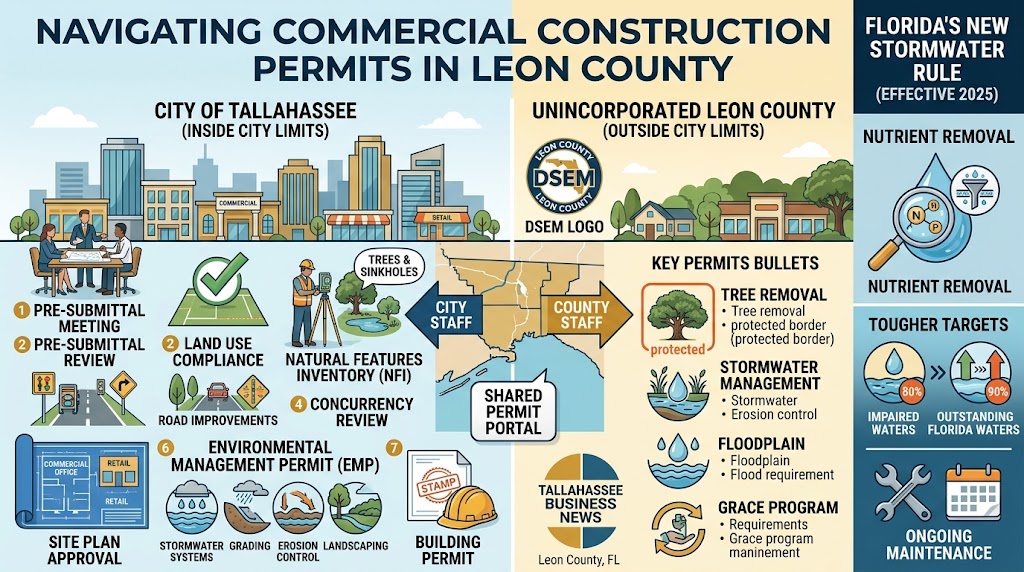
New commercial construction in Leon County generally needs:
- a land use or zoning approval
- a Natural Features Inventory
- a site plan approval
- a local Environmental Management Permit (EMP) covering trees, stormwater, grading and landscaping
- a state Environmental Resource Permit (ERP) for the stormwater system
- transportation concurrency clearance
- a building permit
Projects inside Tallahassee city limits go through City Growth Management. Projects in unincorporated areas go through Leon County DSEM. Most commercial site plans take several months from first submittal to building permit.
Who Reviews Commercial Projects in Leon County?
| Agency | Jurisdiction | What It Reviews |
|---|---|---|
| City of Tallahassee Growth Management | Inside city limits | Land use, site plans, EMP, building permits |
| Leon County DSEM | Unincorporated county | Site plans, EMP, building permits |
| NW Florida Water Mgmt. District / FDEP | Statewide program | Environmental Resource Permits (stormwater, wetlands) |
| Florida Dept. of Transportation | State roads | Driveway and drainage connections to state roads |
| Florida Fish & Wildlife Conservation Commission | Statewide | Protected species issues |
| U.S. Army Corps of Engineers | Federal waters | Federal wetland dredge-and-fill permits |
Why the City vs. County Split Matters
The first question for any Leon County project is whether the parcel is inside Tallahassee city limits. The city and county have separate land development codes, review staff and fee schedules. Both use the shared Tallahassee/Leon County permit portal for filing. Confirm the jurisdiction on the Leon County Property Appraiser’s website before hiring engineers.
Step-by-Step: The Commercial Permitting Sequence
The steps below follow the City of Tallahassee process. Unincorporated Leon County follows a similar order under its own code.
Step 1: Pre-Submittal Meeting (Optional, Recommended)
The city’s pre-submittal review has no application fee. Within about a week, applicants get comments from every relevant department. The point is to catch problems before engineering costs pile up.
Step 2: Land Use Compliance Certificate
This certificate confirms whether your proposed use is allowed under the Land Development Code and which permit track your project will follow.
Step 3: Natural Features Inventory (NFI)
The Natural Features Inventory maps the environmental features on the site, such as wetlands, watercourses, significant forests, endangered species habitat and sinkholes. You prepare it, and Growth Management confirms it. Sites with no regulated features can apply for an inspection and waiver instead.
Leon County’s version also screens for karst features such as sinkholes and springs, native forests, floodplains and Special Development Zones. These features shape how much of a site can actually be built on.
Step 4: Environmental Impact Analysis (EIA)
The EIA covers the specific impacts of your proposed development. These include stormwater runoff, tree removal, land clearing, grade changes and paving.
Step 5: Concurrency Review
Tallahassee and Leon County use a transportation concurrency system to make sure roads and other infrastructure can handle new development. The city and county have studied replacing it with a tiered mobility fee. Ask Growth Management which system applies when you file.
Step 6: Site Plan Approval
The city requires a site plan for all non-residential development over 2,500 square feet and for multifamily projects larger than a triplex.
Step 7: Environmental Management Permit (EMP)
The EMP is the core local environmental permit. It covers:
- protected trees
- stormwater management
- site grading
- erosion and sediment controls
- landscaping
Before the EMP is issued, the city requires the Land Use Compliance Certificate, the NFI, the EIA and the site plan, as applicable. You need either an EMP or an Environmental Permit Waiver before you can get a building permit.
In unincorporated Leon County, DSEM requires an EMP for stormwater management, floodplain, landscaping, tree protection and tree removal work.
Step 8: State Environmental Resource Permit (ERP)
Florida law requires an ERP for stormwater systems that discharge to surface waters, for work in wetlands, and for other land disturbance. Plan this permit alongside your local EMP; don’t wait until the end.
Under Florida law, a city may not make you obtain a state or federal permit before it acts on your local permit, unless that agency has already denied its permit. Even so, stormwater designs for the two permits have to match.
Step 9: Building Permit and Inspections
Once the EMP is issued, your construction drawings become the basis for site work and building permits.
Step 10: Stormwater Operating Permit and Certificate of Occupancy
The EMP covers how a stormwater facility is built. A separate stormwater operating permit covers how it is run and maintained. You get the operating permit near the end of the project, after the facility is built.
Tree Removal Rules for Commercial Sites
Tree protection in Tallahassee is handled through the EMP, not a separate permit. The city’s tree preservation standards are in Chapter 5 of the Land Development Code. Removing protected trees typically means mitigation, either replacement planting or fees.
Practical tips:
- Survey early. A licensed surveyor or arborist should map protected trees before you lay out the site.
- Design around large trees. Keeping big canopy trees is often cheaper than paying to mitigate them, and it can reduce required landscaping.
- Ask about GRACE. In unincorporated Leon County’s Urban Services Area, the GRACE program lets developers reduce the area set aside for landscaping or natural area, if that area has no preservation features.
- Call engineering staff. For tree-code questions inside the city, call Growth Management at 850-891-7001, option 4.
How Florida’s New Stormwater Rule Affects Tallahassee Projects
The biggest regulatory change for commercial developers is Florida’s Statewide Stormwater Rule. Governor DeSantis signed it into law on June 28, 2024.
What Changed
- Proven nutrient removal: Engineers must now show that a stormwater system removes the required nitrogen and phosphorus for the specific site. The old rules assumed removal once volume standards were met.
- Tougher targets for sensitive waters: Outstanding Florida Waters require 90% phosphorus and 80% nitrogen reduction. Impaired waters require 80% of each, and post-development loading must be lower than pre-development.
- Wet ponds alone often fall short: Traditional wet detention systems alone usually can’t meet the new standards.
- Ongoing maintenance duties: Owners must have operation and maintenance plans, long-term cost estimates and regular system inspections.
Key Dates
- The new net improvement requirements took full effect December 28, 2025.
- Projects with valid, unexpired ERPs issued before June 28, 2024, are generally exempt.
Local Impact
Tallahassee’s sinkholes and closed drainage basins, plus nutrient-impaired waters like Lake Munson and Lake Lafayette, make stormwater design especially site-specific here. Expect bigger stormwater footprints or added treatment systems. Both can shrink buildable area and raise costs, so budget for them early.
Timeline Expectations
Local Review Times
| Review Step | Typical Timeframe |
|---|---|
| Pre-submittal comments | ~1 week |
| Land Use Compliance Certificate | ~1 week |
| Environmental inventory (with floodplain) | 14 working days; 7 for resubmittal |
| Minor EMP (fast track) | 7 working days |
| Standard EMP with stormwater (fast track) | 15 working days |
| EMP resubmittal (fast track) | 7 working days |
| Building permit, first review | ~20 working days |
State Deadlines on Local Governments
Florida law sets outside deadlines for local reviews:
- Receipt: Local governments must confirm receipt of an application within 5 business days.
- Decision: They must approve, approve with conditions, or deny within 120 days after deeming the application complete. Applications that need a public or quasi-judicial hearing get 180 days.
- Written reasons: Every decision must include written findings.
Realistic Total Timeline
These review clocks run separately, and resubmittals restart parts of them. On a straightforward commercial site with clean submittals, going from pre-submittal to building permit commonly takes about three to six months. Sites with wetlands, floodplains, karst features or significant trees often take longer. Projects that need rezoning or a public hearing add more time.
Review Volume
Leon County DSEM’s Environmental Services approved 41 Natural Features Inventories, 97 site plans and 35 environmental management permits in fiscal 2025.
How to Speed Up Approval
- Confirm jurisdiction first. City or county determines the code, staff and fees.
- Use the free pre-submittal meeting. It’s the cheapest way to find deal-breakers.
- Order the NFI and tree survey early. Environmental features drive site layout.
- Design stormwater to the new state rule from day one. Redesigning after comments costs more time than anything else.
- Coordinate the local EMP and state ERP designs so each agency sees the same stormwater plan.
- Use the city’s fast-track timelines and respond to comments quickly; each resubmittal resets part of the clock.
- Track the 120-day deadline. Once your application is deemed complete, state law limits how long the local government can take.
Frequently Asked Questions
What environmental permits do I need to build a commercial property in Leon County?
Most commercial projects need:
- a Natural Features Inventory (or waiver)
- an Environmental Impact Analysis
- a local Environmental Management Permit
- a state Environmental Resource Permit for stormwater
Projects that affect federal wetlands, state road drainage or protected species may need additional federal or state approvals.
How do stormwater rules affect commercial development in Tallahassee?
Under Florida’s 2024 Statewide Stormwater Rule, engineers must show measurable nutrient removal, and stricter targets apply near impaired and Outstanding Florida Waters. Combined with local karst and lake protections, this often means larger or more complex stormwater systems. That can reduce buildable area.
Do I need a permit to remove trees on a commercial site in Tallahassee?
Yes. Removing protected trees on a development site is reviewed through the Environmental Management Permit and usually requires mitigation.
Who issues building permits in Leon County?
The City of Tallahassee Growth Management Department issues permits inside city limits. Leon County issues them in unincorporated areas.
How long does commercial site plan approval take in Tallahassee?
Individual reviews range from about one week to 20 working days per step. Florida law requires a final decision within 120 days of a complete application, or 180 days if a public hearing is required. Total timelines commonly run several months.
Does Tallahassee still use transportation concurrency?
Tallahassee and Leon County have used a concurrency system, and both have studied a tiered mobility fee to replace it. Check the current system with Growth Management at application.
Sources and Further Reading
- City of Tallahassee Growth Management, Current Projects and development process overview
- City of Tallahassee Growth Management, Environmental Management Permit page
- City of Tallahassee Growth Management, Stormwater Operating Permit page
- City of Tallahassee, Land Development Process flowchart
- City of Tallahassee Growth Management, Land Use and Environmental Services overview
- City of Tallahassee, Growth Management FAQ: tree removal
- Leon County Water Resources, Environmental Permits
- Leon County DSEM, Environmental Management Permit Application (revised March 26, 2024)
About the Author